
Read the full article on Nebraska Examiner
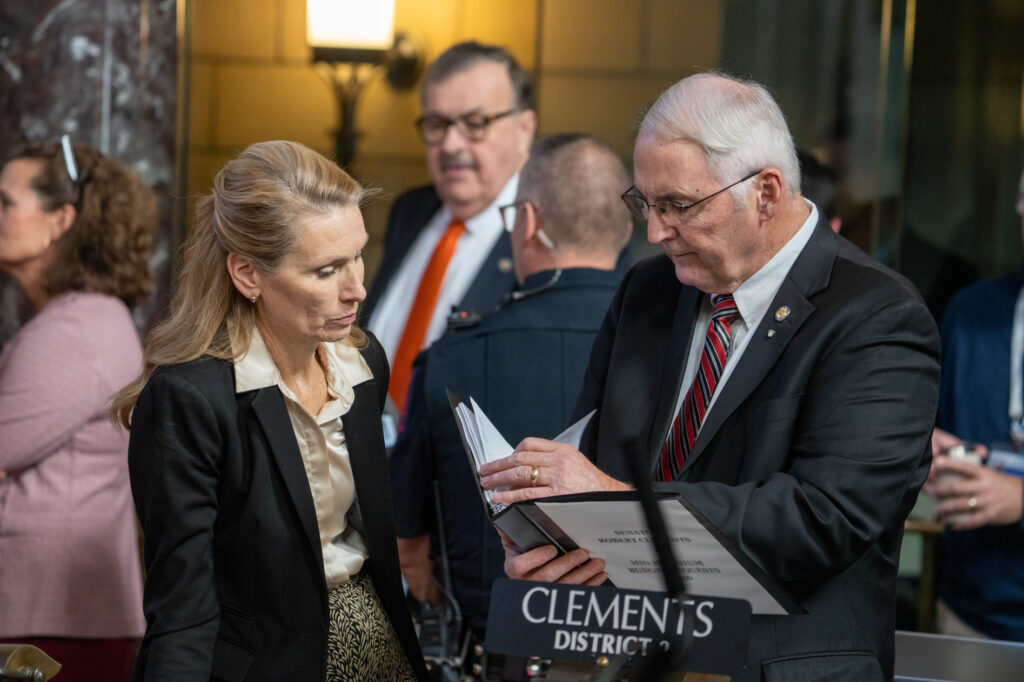
State Sens. Christy Armendariz of Omaha and Rob Clements of Elmwood, vice chair and chair of the Nebraska Legislature’s Appropriations Committee, respectively. Jan. 12, 2026. (Zach Wendling/Nebraska Examiner)
LINCOLN — The University of Nebraska Board of Regents, in a clash with Nebraska Medicine’s former board over the future of the nonprofit, asked Nebraska’s attorney general to investigate the nonprofit over alleged lobbying the regents said intended to hit NU where it would hurt: state appropriations.
In a Jan. 8 letter, NU Regent Paul Kenney, board chair, said NU had become aware of multiple conversations between Nebraska Medicine officers or directors and multiple state lawmakers, including some members of the Legislature’s nine-person, budget-writing Appropriations Committee.
The request to the state’s top prosecutor came just six days after NU regents first disclosed an $800 million proposal with Clarkson Regional Health Services to buy out its leadership stake and related properties of the longtime partner in Nebraska Medicine. The proposal passed the following week.

Kenney alleged in the three-page letter that, based on talks between Appropriations members and NU, some of Nebraska Medicine’s leaders had “shockingly” asked legislators to reconsider appropriations to Project Health, a $2.19 billion endeavor involving NU and Nebraska Medicine for the next generation of health care, and to reduce future NU appropriations.
Kenney’s letter said Nebraska Attorney General Mike Hilgers has oversight under multiple sections of law that might apply, though none were explicitly referenced.
In the eyes of the former leadership of Nebraska Medicine, Kenney wrote, “the university did not need the state’s financial support if it can move forward to compensate [Clarkson] in connection with its resignation.”
Kenney described using the “ransom” of Project Health funding as “immense concern” to NU regents. He said Clarkson officials were informed of the alleged conversations and “share our concerns.” A Clarkson spokesperson said last week they had nothing to add to the letter when asked.
A spokesperson for the Attorney General’s Office confirmed on Jan. 13 that the state’s top law enforcement officer had initiated a “thorough review” of the allegations and any investigation would remain “strictly confidential.”

NU and Clarkson cited the AG’s investigation as a reason both owners chose to replace most Nebraska Medicine board members on Jan. 22. They inserted leaders from their own organizations who support the transaction. The former leaders of Nebraska Medicine had sued to stop the deal. The new leaders moved to drop the lawsuit, which is now over.
After learning of the Kenney letter to the AG’s Office, the Nebraska Examiner asked the nine state senators on Appropriations to confirm whether they were asked to change the university’s state appropriations.
All of the appropriators denied having been lobbied that way in conversations with the Examiner over the past several weeks.
‘Misuse of state resources’
State Sen. Rob Clements of Elmwood, Appropriations Committee chair, said the now-former Nebraska Medicine board members had contacted him. He initially declined to say how those conversations went.
Asked about Project Health, Clements said the future University of Nebraska Medical Center and Nebraska Medicine facility “wasn’t an important part of the conversation.” He denied being asked to change the roughly $700 million in tax dollars the state gives to NU each year, mostly from sales and income taxes.
State Sen. Christy Armendariz of Omaha, vice chair of Appropriations, said Project Health had been a “minor piece” of her conversations and also confirmed no changes were sought to base funding.

State Sen. Machaela Cavanaugh of Omaha said no one from Nebraska Medicine, NU or Clarkson had reached out to her. She said she reached out on her own and she noted she is one lawmaker who remained skeptical of the state investing in Project Health because of the state’s financial situation.
“If someone was going to be spoken with about withdrawing the money, I would probably be on that list, and nobody has spoken to me about it,” Cavanaugh said.
Cavanaugh said she would have appreciated NU leaders asking her to see if the university’s concerns had merit before escalating them by letter to the AG’s Office. She said she felt used as a “political pawn.”
Said Cavanaugh: “I think that, without having confirmation from members of the Appropriations Committee that we were in fact lobbied in this way, it is a misuse of state resources to ask for this type of investigation.”
Former Neb Med leaders denied claims
Former Nebraska Medicine leaders, in a statement provided to the Examiner on Jan. 13, said they were aware of the NU regents’ claims and had told them they had no merit. The then-leaders of the nonprofit argued it was an effort to distract from questions about the “takeover” of Nebraska Medicine.
“If there is any risk or distraction with Project Health, it is the University’s $800 million proposed takeover of Nebraska Medicine, the lack of transparency on a proposal of such magnitude and impact and, most of all, the serious questions which remain unanswered,” the statement said.

The conflict between the former Nebraska Medicine board and the NU Board of Regents has moved quickly over the past month, from a deal publicly announced Jan. 2, in which regents announced the $800 million proposal to pay Clarkson, to unanimous approval on Jan. 15.
The then-Nebraska Medicine board sued to stop the deal less than 24 hours after its approval. A week later, NU and Clarkson replaced most of Nebraska Medicine’s board, and the new board pushed to dismiss the lawsuit, which a judge allowed Monday.
Lance Fritz, the former Nebraska Medicine board chair and former Union Pacific CEO and president, declined to comment since the board shakeup. In a previous interview, he emphasized Nebraska Medicine’s support for Project Health.
“We are absolutely committed to its successful achievement,” he said on Jan. 13. “This is really complicating that.”
Regents sidestep questions
Given the board shakeup, and the unanimous vote to move forward with spending $800 million in less than two weeks, the Examiner asked the AG’s Office whether the investigation continued.
A spokesperson for the attorney general declined to comment.

Reached Friday, Regent Barbara Weitz of Omaha said a lot had been going on internally with nondisclosure agreements about the possible NU-Clarkson deal dating back to July 2024. The work involved a few regents to comply with the state’s Open Meetings Act and notice requirements.
Weitz said the small group included Kenney, University of Nebraska President Dr. Jeffrey Gold and Regents Rob Schafer of Beatrice and Jim Scheer of Norfolk. Scheer is a former speaker of the Nebraska Legislature.
“They have the history, and they have the current status of what’s going on,” Weitz said Friday. “Those would be the people that could give you what we can give you.”
Regent Kathy Wilmot of Beaver City said she was involved in and aware the letter was sent to the AG’s Office but also referred the Examiner to Kenney, “because I know he could go a lot deeper with you on it than I possibly could.”
Regent Jack Stark of Omaha and Schafer gave similar responses, directing questions to Kenney.

The Examiner first asked Kenney about the letter to the AG’s Office on Jan. 13, two days before the NU regents gathered for a rescheduled vote on the possible purchase. He said regents believed Nebraska Medicine leaders had not followed nondisclosure terms and that regents were “just trying to get the truth out.”
Kenney did not respond to multiple calls or a text for comment over multiple days based on follow-up reporting with Appropriations members. Scheer and Regent Tim Clare of Lincoln did not return calls either.
In a statement on Tuesday, the regents declined to answer further questions, stating: “This is an ongoing matter with the attorney general, and it would be inappropriate to comment.”
Accused of ‘fear mongering’
The letter requesting a state investigation also referenced an “orchestrated campaign” to communicate with Nebraskans that the former Nebraska Medicine leaders knew or should have known was “intentionally misleading and fear mongering.”
The letter cited an email regents said was sent to Nebraska Medicine patients. The AG’s Office declined to provide the email, which the Examiner obtained through a public records request to NU.

The email linked to a Nebraska Medicine fact page on the transaction and referred to what its then-leaders had termed a “state takeover,” a term to which the regents objected. The fact page cited concerns about unclear finances, loss of local control, more state control, limits on care and difficulty recruiting doctors, specialists or medical staff.
The fact page linked to a website nonprofit leaders had put together trying to rally opposition to the deal and “explain in detail what is at risk.”
The advocacy website and all related Nebraska Medicine news releases about the transaction have been taken down since the Nebraska Medicine board was largely replaced. The Examiner had archived a version of the site and the Jan. 6 news release announcing it.
The letter from the regents said it was “reprehensible” to cause stress or confusion to patients and families. Gold has voiced similar concerns.

Kenney’s letter also said Nebraska Medicine leaders had engaged the philanthropic community to similarly encourage them to pause or cancel support for Project Health. One unnamed donor had requested their donation be returned, the letter alleged.
Some state lawmakers had described the board shakeup as a “nuclear” option and questioned how the feud might impact an already divided donor community. Some key Omaha leaders served with Fritz on the board and were also removed.
Cavanaugh said it wasn’t “fear mongering” to question the implications of more control from a state-funded university. She said it was “completely reasonable and rational to wonder.”
NU focused on ‘moving forward’
Over the past few weeks, NU, Clarkson and Nebraska Medicine have worked to rebuild trust with one another as well as students, employees, staff and faculty and generally tried to move on.
A second Tuesday statement, from the NU system, reaffirmed that NU “remains focused on moving forward in the best interest of the students, patients and Nebraskans we serve in partnership with Nebraska Medicine and others.”
The statement continued: “Our priority is ensuring we continue to provide world-class medical care to our patients, and that we are set up to grow, evolve and best serve Nebraska in the years ahead.”

One of the last hurdles for the NU-Clarkson deal now could be Legislative Bill 1125 from State Sen. Tony Sorrentino of the Elkhorn area. It would require legislative approval before NU could acquire a controlling or sole interest in any hospital or health care facility valued at more than $100 million.
LB 1125 is set for a Feb. 19 hearing before the Legislature’s Executive Board. NU has said moving forward on the purchase is in the “best interest” of the community and is “best achieved without legislation.”
Gold, reached Friday, said he had “no idea” as president what the now-former Nebraska Medicine leaders were saying to legislators, the public or anyone else. But he stressed that the letter did not question patient care, including quality, safety, access and billing.
“Other than the fact that I know a letter was sent, that’s my sum of knowledge,” said Gold, a heart surgeon and former UNMC chancellor. “But I am quite confident that it did not address any of the, what I would call, clinical activities of Nebraska Medicine, and that’s a very important distinction to make.”
Nebraska Medicine ownership transfer timeline
- July 2024 — Clarkson approaches NU about wanting out of its 50% share of the nonprofit to instead create a health-focused institute to still support Nebraska. Multiple nondisclosure agreements are signed in the following months.
- August 2025 — Nebraska Medicine enters a nondisclosure agreement related to the transaction after months of trying to iron out the details of such an agreement.
- Dec. 17, 2025 — NU, Clarkson and Nebraska Medicine meet about the transaction.
- Jan. 2, 2026 — NU publicly announces it will seek to spend $800 million in a deal with Clarkson to buy its 50% share of Nebraska Medicine and related properties. In return, Clarkson would donate $200 million back to NU for Project Health.
- Jan. 8 — Regents request an investigation into Nebraska Medicine leadership. More than 30 state lawmakers call to delay the planned Jan. 9 vote. Regents agree.
- Jan. 14 — NU and Clarkson host competing forums with state lawmakers.
- Jan. 15 — Regents vote unanimously to proceed with the deal, expected to “close” by June 30, authorizing the chair of the regents to proceed in the meantime.
- Jan. 16 — The former Nebraska Medicine board sues to stop the transaction.
- Jan. 22 — NU and Clarkson, as the parent organizations of Nebraska Medicine, remove eight members of the then-13-member Nebraska Medicine board. Three new voting members are added alongside one remaining member. All support the transaction.
- Jan. 30 — The new Nebraska Medicine leadership files to dismiss its lawsuit.
- Feb. 2 — A Douglas County District Court judge accepts the motion to dismiss the lawsuit from the new Nebraska Medicine board.