

Read the full article on Nebraska Examiner
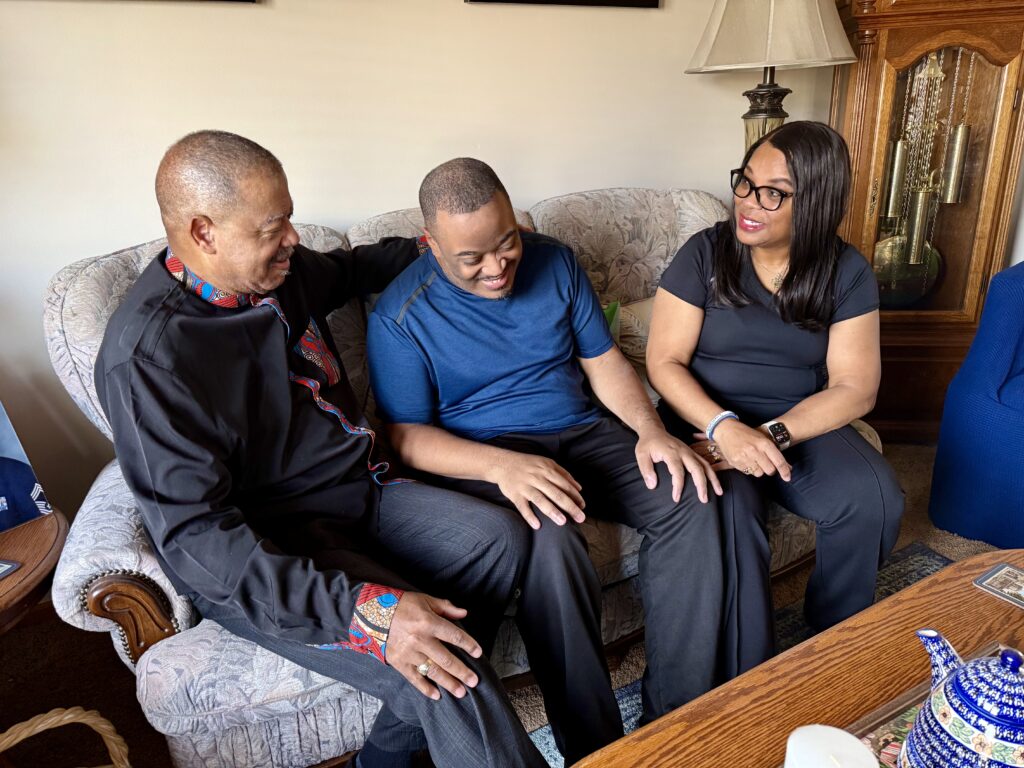
BELLEVUE, Nebraska — Isaac Rountree’s parents were more than puzzled when their adult child, a member of the state’s developmentally disabled community, was suddenly cut from his Medicaid coverage.
The rationale from the Nebraska Department of Health and Human Services made no sense to the Rountrees, who felt deprived of the detailed explanation about their son’s benefits they said is required under Nebraska law.

Stressing the family most was losing Medicaid-covered day services that they say Isaac, 37, thrived in. The parents described the activities, interactions and support he enjoys at the community-based program as a lifeline for the wellbeing of their eldest child living with Fragile X syndrome.
Isaac qualifies for Medicaid as a low-income adult with the autism-like condition that affects learning and development, though he relies on his parents for care.
Ultimately, after days of fretting and figuring how to adjust their budget to pay for his services themselves, a DHHS representative called to say Nebraska’s largest state agency had made a “data entry error.”
The mistake was corrected, the Rountrees were told, and Isaac had his Medicaid reinstated and his disability waiver reopened.
“It’s still confusing to us,” said State Sen. Victor Rountree, a Nebraska lawmaker whose training as an accountant has him looking for an analysis that explains how his son was booted. “I wanted to see the work papers — show me the work.”
Compelled to speak out
Rountree said he didn’t bring up his elected position during the ordeal, because it was not relevant. But now he feels compelled to speak out, to possibly spare others grief and to demand more efficiency and transparency in the DHHS-administered Medicaid program that taxpayers fund with state and federal dollars.
He and wife Cheryl fear some vulnerable Nebraskans are being “peeled off” of public health insurance benefits without adequate understanding or an alternative safety net — particularly as coverage changes are set to arrive from the federal tax and spending law President Donald Trump called “big and beautiful.”
Nebraska DHHS also has signaled that it is searching for cost-cutting measures. The state faces a projected $471 million budget shortfall by mid-2027 and Gov. Jim Pillen wants to cut state spending by $500 million.
The Rountrees’ concern is shared by nonprofit Nebraska Appleseed, which foresees “tens of thousands” of low-income Nebraskans possibly losing coverage in coming months due to new and stricter work requirements for the Medicaid expansion population.

Those rules were called for in the federal budget package Congress adopted in mid-2025. Changes in Medicaid and other social safety net programs were intended to help offset costs of Trump-favored tax cuts, increased spending on immigration enforcement and other policies.
Nonprofit policy research KFF estimates that Nebraska will lose up to $4 billion in federal Medicaid funding over the next decade as a result of the federal budget law. Advocates for low-income Nebraskans anticipate negative ripple effects on community health, emergency and health care systems.
I’m taking my gloves off.
– State Sen. Victor Rountree of Bellevue, on ensuring transparency in Medicaid program
Sarah Maresh, Appleseed’s health care access director, said angst already was elevated among advocates and Medicaid recipients since Pillen’s December announcement that Nebraska was accelerating the timeline for the work requirement changes. She said DHHS has indicated it will not add any staff to handle the workload, and she foresees increased risk of mistakes and circumstances that can nudge people off Medicaid benefits.

“Rushing to implement something that’s new and complex without any additional staff we think is a recipe for disaster,” said Maresh. “There is a way to do this responsibility so we’re not causing families to suffer.”
Nationally, the work requirement changes are to become effective in 2027. Pillen pushed up Nebraska’s implementation to May 2026. State health officials have said those changes will apply to work-eligible adults who now must work at least 80 hours a month or be enrolled in school at least half-time to receive or keep the benefits. Pillen describes the change as a “hand up and not a hand out.” State health officials say the adjustments are designed to support eligible recipients, not remove them.
DHHS said it has always encouraged eligible Nebraskans in need of assistance to apply for Medicaid benefits.
Roughly 72,000 people receive benefits from the expanded Medicaid program, which Nebraska voters approved in 2018. Overall, more than 330,000 people receive Medicaid benefits statewide, including children, the elderly and people with disabilities.
Old insurance policy a culprit?
Rountree said his son’s situation offered him a deeper look at the DHHS’ handling of Medicaid cases. He said Nebraskans should not be left to wonder why a benefit was reduced or stopped.
The second-year lawmaker recalled finishing up a medical procedure Jan. 29 and finding his wife Cheryl in distress. An email from a DHHS caseworker provided written notification that their son’s Medicaid coverage would end Jan. 31.
Cheryl Rountree, Isaac’s legal guardian, said that according to the caseworker, an insurance policy taken out on Issac was creating an excessive income problem. His parents own the $50,000 death policy in question. They said they took it out some 20 years ago, as they did for each of their three children. So long ago, said Cheryl Rountree, “the papers had turned yellow.”
The Rountrees didn’t view the policy as an income producer and said it had not been an issue for Medicaid in years past.
“It only pays out if Isaac dies,” Cheryl Rountree said.
If an error occurs that incorrectly attributes resources to a Medicaid recipient, DHHS corrects the issue promptly once it is brought to our attention.
– Jeff Powell, spokesperson for Nebraska Department of Health and Human Services
DHHS spokesperson Jeff Powell said the agency could not comment on a specific case, due to privacy laws. “If an error occurs that incorrectly attributes resources to a Medicaid recipient, DHHS corrects the issue promptly once it is brought to our attention,” he said.
Cheryl Rountree said the state caseworker presented options: Cash in the policy, valued at less than $4,000, and put the proceeds into a special account that would not apply toward income, or sign over the policy to a funeral home.
Neither felt right or fair, she said.

The Rountrees said the loss of Medicaid meant Isaac would need a different means to pay the roughly $80-a-day cost for his daytime services, or they’d end. His parents said they did not want a setback for their son, so they were determined to find a way to pay the cost themselves.
Rountree said the Duet program — which provides physical wellness, craft and social activities and supervised opportunities to volunteer and engage in community events — is “like family” to Isaac.
After receiving the Jan. 29 email notification of the Jan. 31 Medicaid cut, the Rountrees spoke to an advocate at Duet who reached out to DHHS. A reporter also called the state agency in the first few days of February seeking an explanation about the lawmaker’s family.
On Feb. 6, a DHHS representative told Cheryl Rountree by phone about the “data entry error” but Victor Rountree said there was no elaboration other than that it was fixed.
‘Digging into anything’
Though Isaac’s predicament apparently is resolved, the senator said his concern remains. He suspects state health officials are “digging to find anything they can latch onto” to question a person’s eligibility.
He said not everyone may be in a position to challenge a decision. He wants the DHHS to adhere to state law, and routinely provide the computation and methodology behind a decision that alters lives, adding that complete information is vital to launching an appeal.
“I’m taking my gloves off,” Rountree said. “I’m just like every other parent and family … we need bonafide, good information where we can make decisions.”
SUBSCRIBE: GET THE MORNING HEADLINES DELIVERED TO YOUR INBOX