

Read the full article on Nebraska Examiner
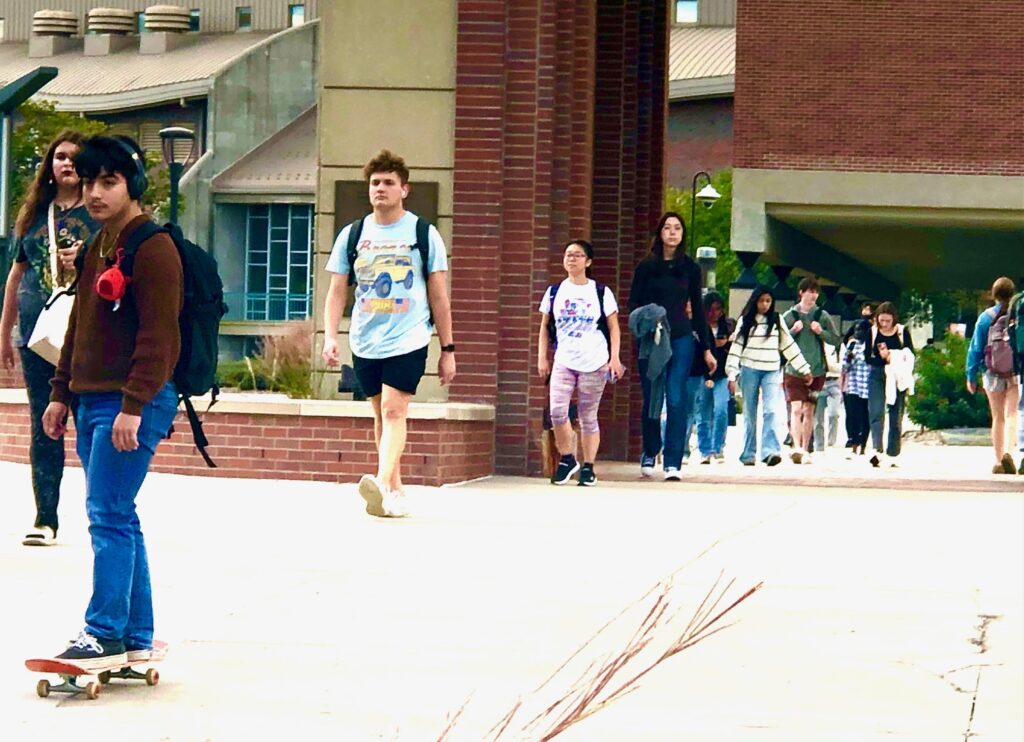
Class change time on the University of Nebraska at Omaha campus in September 2024. (Cindy Gonzalez/Nebraska Examiner)
LINCOLN — Opponents far outnumbered supporters Monday of two legislative proposals seeking to throw out parts of a 20-year-old Nebraska law allowing certain undocumented immigrants who grew up and graduated in the state to pay in-state tuition at public colleges and universities.
In all, 13 Nebraskans testified against Legislative Bills 1061 and 870, introduced by State Sens. Dave Murman of Glenvil and Bob Andersen of western Sarpy County, respectively. The bills were aired Monday during a two-hour public hearing before the Legislature’s Education Committee.
In contrast, one person showed up to speak in favor.
A combined 215 people wrote to the committee to object to the two bills, and 32 submitted written support.
The committee took no immediate action on whether to advance either measure to the full Legislature.
As state law currently stands, students who graduate from Nebraska high schools after living here three years and who meet certain other criteria — regardless of immigration status — can continue their education in the state by paying the same tuition rates as local counterparts who are U.S. citizens.
‘Attack’ on immigrants
In response to questions from committee members, neither Andersen nor Murman could say how many students might be affected. They said their concern was fairness to taxpayers, though they identified no specific cost savings.
State Sen. Danielle Conrad of Lincoln, a member of the committee, said the bills appear to be a tactic that perpetuates fear among immigrants. The proposed changes come as national and local protests have swelled over the Trump administration’s efforts to rid the country of undocumented immigrants.

Saturday in Minneapolis, the second U.S. citizen in three weeks was shot to death by federal agents while rallying against immigration enforcement in that city, which has escalated under the second Trump administration.
“I think that we have to put a name on the fact that this is really just another attack, I think, on immigrant neighbors in Nebraska and has very little, if anything, to do with budgetary savings,” said Conrad.
Andersen described his effort as “a simple bill to reimplement common sense and fiscal responsibility.”
“It’s a cost-saving effort and making sure people entitled to get the entitlement actually get it,” he said. Murman told the committee that he plans to withdraw his bill and support Andersen’s LB 870.
The University of Nebraska doesn’t ask for documentation of a student’s immigration status and uses high school transcripts to verify whether the applicant is a Nebraska resident for tuition purposes, according to a legislative fiscal analysis for the Andersen bill. If the proposed changes pass, the analysis says, new verification procedures would need to be implemented at an estimated cost next fiscal year of about $372,400, and $383,572 the following year.
‘Magnet’ for illegal immigration
Doug Kagan, who leads Nebraska Taxpayers for Freedom, was the lone testifier in support of the bills. He said current in-state tuition provisions are a “magnet for further illegal immigration into Nebraska” and are “unfair” to American citizens.
Those testifying in support of the current law included university professors, immigration lawyers, a Douglas County commissioner speaking on his own and a veteran who described LBs 1061 and 870 as contrary to state efforts to strengthen the talent and workforce pipeline.

Crystal Garcia, a professor at the University of Nebraska-Lincoln, said she wanted to appeal to lawmakers’ humanity.
“The proposed bills do not in any way improve the lives of Nebraskans,” she said. “(They) will also hurt Nebraska colleges and universities, as they will certainly lose students who will pursue education outside of Nebraska and critical revenue along with those students.”
When questioned by committee members — some of whom challenged the loose use of immigration terminology by the two bill sponsors — Murman and Andersen clarified that their goal is to repeal in-state tuition for students who do not have a lawful status in the country.
Murman said he wanted to comply with federal law and save Nebraska the cost of defending a lawsuit.
Both proposals follow a push by the Trump administration to eliminate similar in-state tuition laws in other states. Under his leadership, the feds launched legal challenges in at least seven states with similar laws, including Texas, California, Illinois and Minnesota.
The U.S. Justice Department has argued that in-state tuition laws give an unfair benefit to foreign-born students unavailable to U.S. citizens and legal residents living in different states.
State Sen. Jana Hughes of Seward asked if Nebraska Attorney General Mike Hilgers had weighed in on the legality of the proposals, to which Murman said no.
‘Brain drain’ pain
Among those opposing the bills was Lina Traslaviña Stover, a sociologist whose research has focused on access to higher education and who is executive director of a statewide immigrant advocacy organization called Heartland Workers Center.
She called the legislation “shortsighted” and opposite the goal of reversing Nebraska’s brain drain, the exodus of young talent from the state.
“These bills send a harmful message to middle school students from immigrant families that they are not welcomed or valued in our education system,” Stover said. “When students believe college is unattainable because of cost, they are more likely to disengage from school and leave the college-pre track. This limits their options for years to come.”

She estimated that a “small number” of Nebraska immigrants tap into the current in-state tuition provisions.
Douglas County commissioner Roger Garcia told the committee his wife, Yanira, was assisted by in-state tuition rates that have been in effect since the Legislature in 2006 overrode a veto by then-Gov. Dave Heineman.
Yanira is now a U.S. citizen, a professional in the banking industry and an elected member of the Regional Metropolitan Transit Board.
Undocumented students typically are not eligible for federal student aid. But in-state tuition can be the key pathway for higher education to some undocumented students already being educated in Nebraska’s public school system, Garcia said.
“This is not a scholarship. This is not a financial grant. There is no money going into a student account. They are paying tuition,” he said. Garcia said he doubted the number of recipients in Nebraska is remarkable but said they likely work multiple jobs to pay for tuition.
“So these are actually pretty outstanding students and young individuals in our state,” he said.
SUBSCRIBE: GET THE MORNING HEADLINES DELIVERED TO YOUR INBOX