
Read the full article on Nebraska Examiner
LINCOLN — A petition campaign aimed at eliminating Nebraska property, income and inheritance taxes and forcing the Legislature to find alternative revenue sources is over for 2026 but hopes to regroup for 2028.
The “EPIC Option” campaign announced this week that its “EPIC Option 2.0” effort to pass a constitutional amendment was not projected to meet its July 1 goal of 160,000 signatures, based on weekly checks of notarized petitions.
Instead, advocates are marking a “reset” in the hopes of organizing stronger for the 2028 general election ballot.

Advocates set a goal to raise $1.86 million for paid petition circulators, which would mark a shift in the campaign’s tactics. Steve Jessen, president of the group, said if just 8,000 Nebraskans donated $250, the campaign would have $2 million.
“This is a small investment compared to the annual tax burden that will be eliminated,” Jessen said in a Facebook post. “Together, Nebraskans can make EPIC Option 3.0 a reality.”
Moving forward
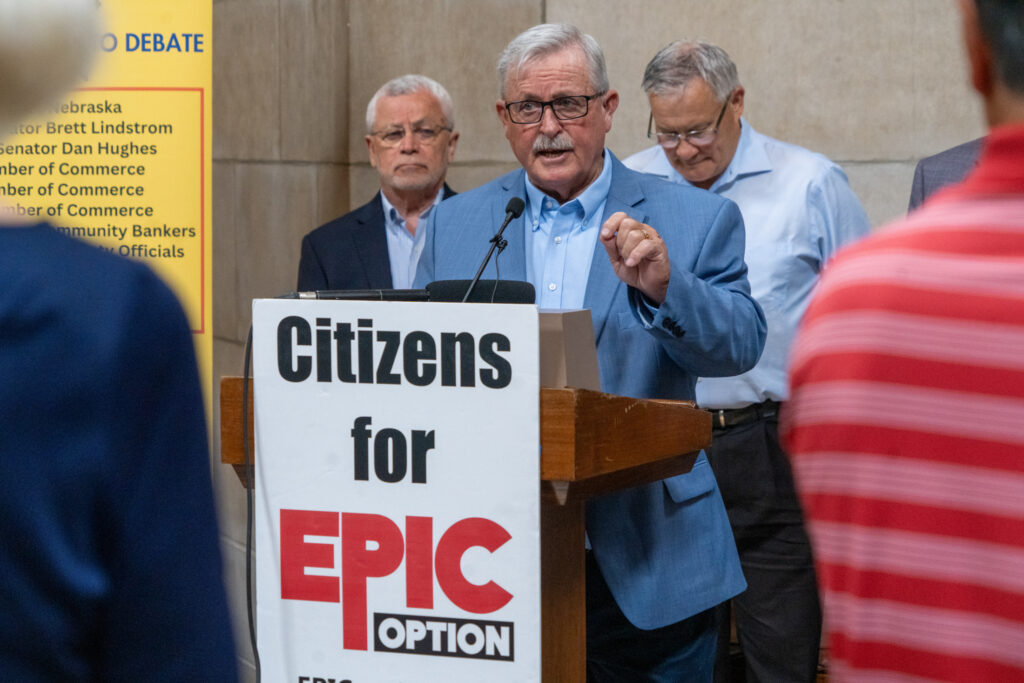
Former State Sen. Steve Erdman of Bayard, a campaign leader, told the Nebraska Examiner that EPIC is by no means over. He pointed to a cartoon that shows a stork swallowing a frog and the frog has its hands around the stork’s neck. At the bottom, it says, “Never give up.”
“I have never been associated with a group of volunteers who’ve never held an elected position, who have no skin in the game, for the people in Nebraska like this group in EPIC,” Erdman said.

Erdman said people have financially contributed thousands and volunteered thousands of hours to get EPIC where it is now. The campaign has learned that since 1966, few, if any, volunteer-only petition drives have been successful. It was in 1966 when voters eliminated state property taxes as state lawmakers sought to authorize sales and income taxes, a situation in which the state could have been left with no major revenue streams, Erdman said.
“That’s how dangerous it was then, but the taxes were so high that people didn’t care,” Erdman said. “We haven’t arrived at that stage, yet, but I think the urban people are catching up.”
While signature gathering is easier in rural Nebraska, Erdman said, there have been difficulties in the state’s largest counties in the east — Douglas, Lancaster and Sarpy.
Multiple legislative, petition attempts
Multiple legislative attempts to implement EPIC have also stalled.
To qualify a constitutional amendment, EPIC organizers would need valid signatures from 10% of registered Nebraska voters (nearly 130,000). Of the bulk total, signatures must come from at least 5% of registered voters in at least 38 of the state’s 93 counties.

The EPIC team has argued all taxes, excluding sales, excise or consumption taxes, are mandatory and bring consequences if not paid, up to property repossession, wage confiscation or jail. Yet taxes at the point of purchase, Erdman said, give taxpayers more freedom in what to buy when.
“It’s vital that we get back to a system that’s fair. Fair for everybody, everybody has skin in the game,” Erdman said. “That’s not what we have now.”
The campaign started with two broad petitions in 2024 that would have prohibited property, income and inheritance taxes and also explicitly protected certain grocery items from ever being taxed, both in the Nebraska Constitution. This time around, for 2026, the campaign ran a one-sentence constitutional amendment to eliminate the same taxes beginning Jan. 1, 2028.
If EPIC is successful, the Legislature would be left to figure out how to fund state and local government. The current sales tax rate statewide is 5.5 cents per $1 purchase.
EPIC will launch its third campaign, and supporters will consider whether they need to change their approach. Erdman said advocates are considering how to ensure urban Nebraskans understand the significance of EPIC and sign on.
Campaign finance
EPIC raised $184,865.87 and spent $131,300.39 on its 2024 campaign, according to campaign filings with the Nebraska Accountability and Disclosure Commission.
As of latest campaign filings through Feb. 28, the 2026 campaign had raised $25,910.65 and spent $65,071.90. The campaign listed $14,404.23 cash on hand.
Some of the state’s largest business and government organizations opposed EPIC’s 2024 campaign and organized as “No New Taxes.” That competing group raised and spent $101,327.92 with supporters including the League of Nebraska Municipalities, Nebraska Chamber of Commerce, Nebraska Hospital Association, Nebraska Realtors and Nebraska Health Care Association.

Former “No New Taxes” spokesperson Korby Gilbertson, a registered lobbyist at the State Capitol, said it wasn’t surprising that EPIC didn’t gain traction.
“It proves that Nebraskans know that EPIC isn’t, wasn’t a good idea,” Gilbertson said in a text. “Tax policy is a complicated issue and should be addressed appropriately, not with a scorched-earth proposal that upends Nebraska’s ecomomy.”
‘The system’s broken’
But Erdman, who served in the Legislature for eight years, said no Legislature will “ever” deal with the tax issue “straight up and head on” and deliver property tax relief.
He points to the state’s 2024 special session at Gov. Jim Pillen’s request, solely focused on property taxes, which Erdman has repeatedly argued ended in the “largest property tax increase in the history of the state, and nobody knew it,” because of how lawmakers changed the timing at which property tax credits are awarded — a so-called “missing year” of tax relief.
Despite a large state increase in property tax credits meant to provide relief for local spending, Erdman said taxing entities also aren’t lowering taxes.
“The system’s broken, and until the people comprehend that we’re trying to fix a system that’s been broken for 57, 58 years, we will never get property tax relief,” Erdman said. “We always get a decrease in the increase.”
Erdman said the end goal is still to make Nebraska’s tax system the fairest in the country.
“We will continue,” Erdman said. “We will keep the fight going until we actually become successful and we fix this tax system.”
SUBSCRIBE: GET THE MORNING HEADLINES DELIVERED TO YOUR INBOX