
Read the full article on KETV 7

The Food Bank for the Heartland has officially moved into its new building near 84th and L streets, and they say it’s needed now more than ever.It’s a move that’s been nearly seven years in the making. “Been waiting for this day for a long, long time,” Brian Barks, president and CEO of the Food Bank for the Heartland, said. “This building will allow us to do so much more mission work, better mission work, more efficient, serve our community better.”Barks said the new facility is all about efficiency. “We were the epitome of inefficiency at our previous building. We had so many different bottlenecks from the lack of storage in our freezer and cooler, having a trailer to store food in our parking lot, utilizing offsite storage. We had no meeting space for our office staff to do collaborative work. This is the exact opposite of that,” Barks said. Starting in the new warehouse space, Barks said the square footage for dry storage is actually smaller than their old building, but he said it’s not necessarily about square footage, rather pallet positions. “So the number of pallet positions that we have, increased by about 1,800 pallet positions at our old facility have grown to about 2,900 in this one,” Barks said. “We’re racking four pallets high in, in the dry storage area, which gives us much greater capacity, which is why we’re able to shrink the square footage of the dry storage specifically, but yet have more pallet positions to hold more food.”With those additional pallet positions, the warehouse also has a new layout. “We had a company come in and track how we move food by product type at our old facility, and it was just no rhyme or reason. and that drawing looked like spaghetti,” Barks said. “The people that helped lay out the facility here. It’s just a nice up and down flow. And we call that one lasagna. So we’re going from spaghetti to lasagna. We’re touching things on average 11 times at our old facility. And we’ll touch them on average about five times here.”Those efficiency changes are also being made in their transporting efforts. “We have nine dock doors that we can utilize here,” Barks said. “At our previous facility, we had six; however, we really only did business out of two of them because only two of our docks at our old facility where the appropriate height of a semi.”Each room in the new facility serves a unique purpose, like the protein repack center. “We can take that big tote of frozen protein, break it down into family friendly sizes for distribution,” Barks said. “We are one of 12 food banks in the Feeding America family of 200 food banks that has a room like this.”Barks said they’re especially excited about the varying capabilities and increased efficiency of the larger space, but those are not the only reasons.”We have other food banks in the region that are interested in sending us protein in their area for us to repack for them, and we could potentially turn this into a revenue source,” Barks said. None of the work the Food Bank does could be completed without the help of volunteers. “One out of every six pounds that we distribute out of this facility is somehow handled by a volunteer,” Barks said. And, the Food Bank is working to increase from 50 volunteers per shift to 100. Barks said that will be a gradual process, but it is the ultimate goal, which makes the brand new custom volunteer center, equipped with custom racking, that much more essential. “When we’re going to be distributing 23, 24 million pounds worth of food, when you do the math, we got to have volunteers,” Barks said. “Our volunteer space grew by, I think, it was about 9,000 square feet to about 14,000 square feet.”The new center is equipped with plenty of natural light, a separate area for personal items, a handwashing station, and more unique features. All of the additions, Barks said, are an effort to raise the volunteer experience. Barks said there were several reasons they chose to move their facility, and by having a location at what he says is the seventh busiest intersection in the metro, it’s unmistakable. “It’s easy for volunteers to get to anyone in the community to get to,” Barks said. “The awareness that we are raising by being at the seventh busiest intersection in the city of Omaha sends a loud and clear message that we have a we have an issue that we need to address. Also, it’s very close to the interstate. It’s located in the center of the city. Easy for people to get to.”The move comes as Barks said they’re seeing the largest need in their history, and it will only strengthen their fight against food insecurity for their entire service area. “Our service area covers 93 total counties, 77 in Nebraska and 16 in western Iowa. This is not just for the Omaha metropolitan area. This is for the folks that we serve in Scottsbluff in Gering, Missouri. Valley in Glenwood. This is about them, too,” Barks said. “We built this building for the future, not just for today, but for 10, 15, 20 years down the road.”It’s an effort to feed the community, that’s been fed by the community. “We had a $27 million fundraising goal, and we did it. And to have $27 million given to us, to make this a reality. It’s humbling. It’s inspiring,” Barks said. “This is going to make us a really, really good food bank. It’s going to make a really, really good food bank. And even better, one.”Monday, Feb. 9, will be the first time volunteers will be welcomed into the new facility, Barks said he can’t wait for that moment. If you would like to volunteer, donate or learn more about the Food Bank for the Heartland, click here. Make sure you can always see the latest news, weather, sports and more from KETV NewsWatch 7 on Google Search.NAVIGATE: Home | Weather | Local News | National | Sports | Newscasts on demand |
The Food Bank for the Heartland has officially moved into its new building near 84th and L streets, and they say it’s needed now more than ever.
It’s a move that’s been nearly seven years in the making.
Advertisement
“Been waiting for this day for a long, long time,” Brian Barks, president and CEO of the Food Bank for the Heartland, said. “This building will allow us to do so much more mission work, better mission work, more efficient, serve our community better.”
Barks said the new facility is all about efficiency.
“We were the epitome of inefficiency at our previous building. We had so many different bottlenecks from the lack of storage in our freezer and cooler, having a trailer to store food in our parking lot, utilizing offsite storage. We had no meeting space for our office staff to do collaborative work. This is the exact opposite of that,” Barks said.
Starting in the new warehouse space, Barks said the square footage for dry storage is actually smaller than their old building, but he said it’s not necessarily about square footage, rather pallet positions.
“So the number of pallet positions that we have, increased by about 1,800 pallet positions at our old facility have grown to about 2,900 in this one,” Barks said. “We’re racking four pallets high in, in the dry storage area, which gives us much greater capacity, which is why we’re able to shrink the square footage of the dry storage specifically, but yet have more pallet positions to hold more food.”
With those additional pallet positions, the warehouse also has a new layout.
“We had a company come in and track how we move food by product type at our old facility, and it was just no rhyme or reason. and that drawing looked like spaghetti,” Barks said. “The people that helped lay out the facility here. It’s just a nice up and down flow. And we call that one lasagna. So we’re going from spaghetti to lasagna. We’re touching things on average 11 times at our old facility. And we’ll touch them on average about five times here.”
Those efficiency changes are also being made in their transporting efforts.
“We have nine dock doors that we can utilize here,” Barks said. “At our previous facility, we had six; however, we really only did business out of two of them because only two of our docks at our old facility where the appropriate height of a semi.”
Each room in the new facility serves a unique purpose, like the protein repack center.
“We can take that big tote of frozen protein, break it down into family friendly sizes for distribution,” Barks said. “We are one of 12 food banks in the Feeding America family of 200 food banks that has a room like this.”
Barks said they’re especially excited about the varying capabilities and increased efficiency of the larger space, but those are not the only reasons.
“We have other food banks in the region that are interested in sending us protein in their area for us to repack for them, and we could potentially turn this into a revenue source,” Barks said.
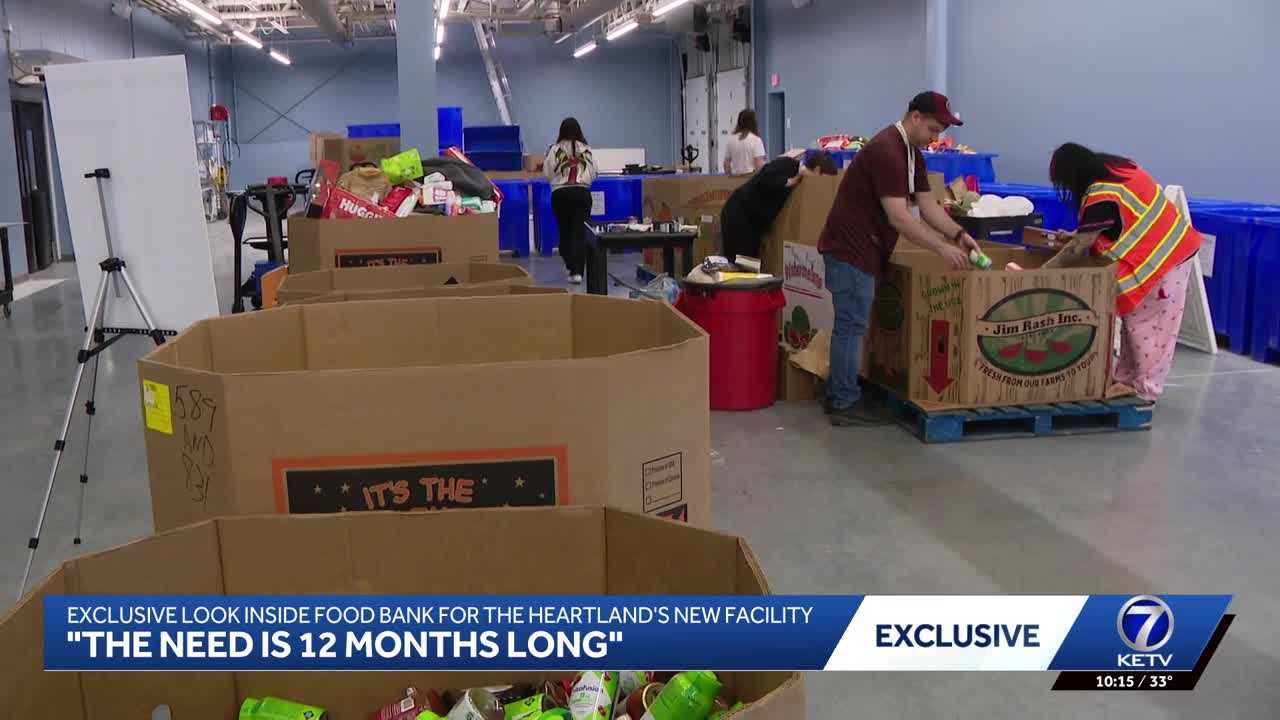
None of the work the Food Bank does could be completed without the help of volunteers.
“One out of every six pounds that we distribute out of this facility is somehow handled by a volunteer,” Barks said.
And, the Food Bank is working to increase from 50 volunteers per shift to 100. Barks said that will be a gradual process, but it is the ultimate goal, which makes the brand new custom volunteer center, equipped with custom racking, that much more essential.
“When we’re going to be distributing 23, 24 million pounds worth of food, when you do the math, we got to have volunteers,” Barks said. “Our volunteer space grew by, I think, it was about 9,000 square feet to about 14,000 square feet.”
The new center is equipped with plenty of natural light, a separate area for personal items, a handwashing station, and more unique features. All of the additions, Barks said, are an effort to raise the volunteer experience.
Barks said there were several reasons they chose to move their facility, and by having a location at what he says is the seventh busiest intersection in the metro, it’s unmistakable.
“It’s easy for volunteers to get to anyone in the community to get to,” Barks said. “The awareness that we are raising by being at the seventh busiest intersection in the city of Omaha sends a loud and clear message that we have a we have an issue that we need to address. Also, it’s very close to the interstate. It’s located in the center of the city. Easy for people to get to.”
The move comes as Barks said they’re seeing the largest need in their history, and it will only strengthen their fight against food insecurity for their entire service area.
“Our service area covers 93 total counties, 77 in Nebraska and 16 in western Iowa. This is not just for the Omaha metropolitan area. This is for the folks that we serve in Scottsbluff in Gering, Missouri. Valley in Glenwood. This is about them, too,” Barks said. “We built this building for the future, not just for today, but for 10, 15, 20 years down the road.”
It’s an effort to feed the community, that’s been fed by the community.
“We had a $27 million fundraising goal, and we did it. And to have $27 million given to us, to make this a reality. It’s humbling. It’s inspiring,” Barks said. “This is going to make us a really, really good food bank. It’s going to make a really, really good food bank. And even better, one.”
Monday, Feb. 9, will be the first time volunteers will be welcomed into the new facility, Barks said he can’t wait for that moment.
If you would like to volunteer, donate or learn more about the Food Bank for the Heartland, click here.
Make sure you can always see the latest news, weather, sports and more from KETV NewsWatch 7 on Google Search.
NAVIGATE: Home | Weather | Local News | National | Sports | Newscasts on demand |