
Read the full article on KETV 7

President Donald Trump marked the 100th anniversary of Black History Month at the White House on Wednesday, as a new lawsuit accuses his administration of censoring history, including exhibits on slavery, at National Parks. The president didn’t directly address the lawsuit at Wednesday’s event. Instead, he touted a range of policies that he said would help all Americans prosper. Trump touched on tax cuts, funding for Historically Black Colleges and Universities, and criminal justice reforms passed during his first term. Trump also paid tribute to the civil rights icon, Rev. Jesse Jackson, who died earlier this week, and detailed the historic contributions of other Black Americans. “We thank God for the strength and courage and grit and devotion of Black Americans who have helped make America the most powerful country in the history of the world,” Trump said. The message stands in contrast to a lawsuit filed by several conservation and historical organizations this week.”We are engaging in a lawsuit because we want to stop and then reverse the erasure of our history in National Parks,” said Alan Spears, senior director of cultural resources for the National Park Conservation Association, one of the groups involved in the legal challenge. The lawsuit says the Trump administration is forcing National Park Service staff to remove or edit factually accurate exhibits on a range of topics, including the civil rights movement and slavery. It says scientific information on climate change is also being impacted. Spears said the pressure campaign is rolling back decades of progress towards more fully telling our nation’s history at these sites. “We’re seeing the National Park Service in a kind of duck and cover mode, and really stepping away from trying to interpret the history of enslavement, race, or racism in this country,” Spears said. In one example last month, explanatory panels detailing George Washington’s ownership of slaves were taken down at Independence National Historic Park in Philadelphia, which is currently the subject of a separate legal battle. A federal judge ordered the exhibit to be restored while the lawsuit continues to make its way through the courts, but the Trump administration is appealing. It’s the latest fallout from an executive order signed by Trump last year. It directed a wide-ranging review of exhibits at Smithsonian Museums and National Parks. “The Department of the Interior is engaged in an ongoing review of our nation’s American history exhibits in accordance with the President’s executive order to eliminate corrosive ideology, restore sanity, and reinstate the truth,” White House spokeswoman Taylor Rogers said in a statement on Wednesday. “The Department’s actions are not yet finalized, and therefore, these lawsuits are premature.”Rogers added that the latest lawsuit “is based on inaccurate and mischaracterized information.”
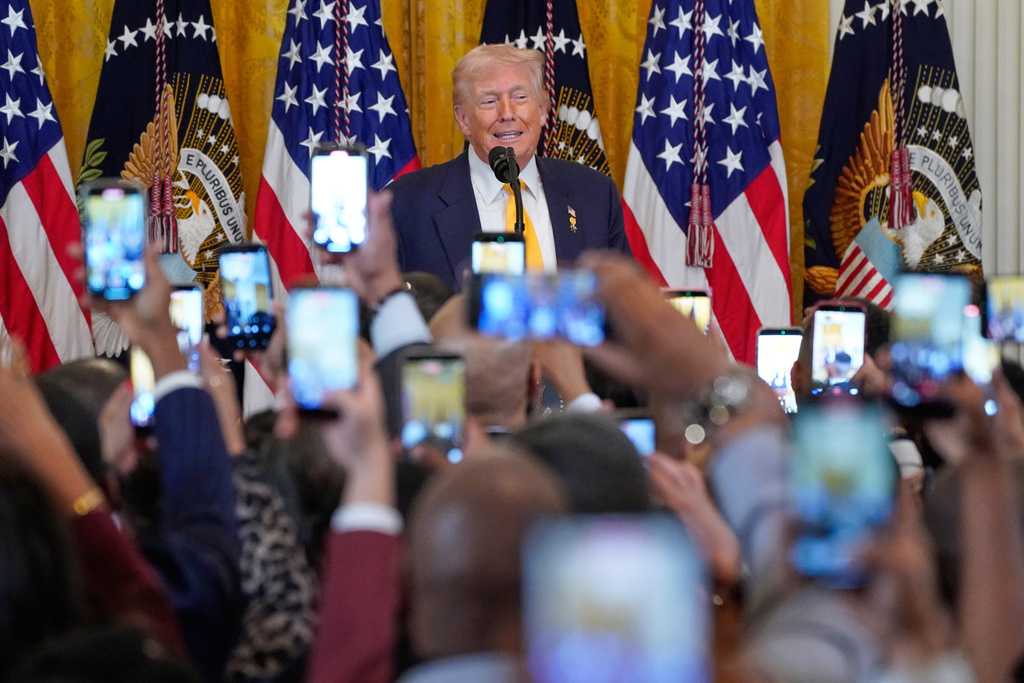
President Donald Trump marked the 100th anniversary of Black History Month at the White House on Wednesday, as a new lawsuit accuses his administration of censoring history, including exhibits on slavery, at National Parks.
The president didn’t directly address the lawsuit at Wednesday’s event. Instead, he touted a range of policies that he said would help all Americans prosper. Trump touched on tax cuts, funding for Historically Black Colleges and Universities, and criminal justice reforms passed during his first term.
Advertisement
Trump also paid tribute to the civil rights icon, Rev. Jesse Jackson, who died earlier this week, and detailed the historic contributions of other Black Americans.
“We thank God for the strength and courage and grit and devotion of Black Americans who have helped make America the most powerful country in the history of the world,” Trump said.
The message stands in contrast to a lawsuit filed by several conservation and historical organizations this week.
“We are engaging in a lawsuit because we want to stop and then reverse the erasure of our history in National Parks,” said Alan Spears, senior director of cultural resources for the National Park Conservation Association, one of the groups involved in the legal challenge.
The lawsuit says the Trump administration is forcing National Park Service staff to remove or edit factually accurate exhibits on a range of topics, including the civil rights movement and slavery. It says scientific information on climate change is also being impacted.
Spears said the pressure campaign is rolling back decades of progress towards more fully telling our nation’s history at these sites.
“We’re seeing the National Park Service in a kind of duck and cover mode, and really stepping away from trying to interpret the history of enslavement, race, or racism in this country,” Spears said.
In one example last month, explanatory panels detailing George Washington’s ownership of slaves were taken down at Independence National Historic Park in Philadelphia, which is currently the subject of a separate legal battle. A federal judge ordered the exhibit to be restored while the lawsuit continues to make its way through the courts, but the Trump administration is appealing.
It’s the latest fallout from an executive order signed by Trump last year. It directed a wide-ranging review of exhibits at Smithsonian Museums and National Parks.
“The Department of the Interior is engaged in an ongoing review of our nation’s American history exhibits in accordance with the President’s executive order to eliminate corrosive ideology, restore sanity, and reinstate the truth,” White House spokeswoman Taylor Rogers said in a statement on Wednesday. “The Department’s actions are not yet finalized, and therefore, these lawsuits are premature.”
Rogers added that the latest lawsuit “is based on inaccurate and mischaracterized information.”