

Read the full article on KETV 7

A coffee house in Boston, Massachusetts, is now a temporary home to a pay phone you don’t have to pay to use, and which only calls one location.On the front are the words, “Call a Boomer.”It’s the brainchild of a neuroscience startup company aiming to reduce loneliness in boomers and members of Generation Z. “I honestly never call random people,” said Isabel Lemionet, who works on the marketing team for Pavement Coffeehouse, outside of which the Call a Boomer phone has been installed.Lemionet picked up the phone, it rang a few times, and she was immediately connected with a person named Josh, who picked up from a senior center in Reno, Nevada. “He was just waking up, going out for a walk,” said Lemionet. “He complained about the weather!”Pavement Coffeehouse became the temporary stewards of the revamped pay phone over the weekend. Marketing Coordinator Thomas Tague-Bleau said when they got the call to participate, they were all in. “Honestly, the biggest logistical thing was just getting wires to get all the way to a nice an outlet inside,” Tague-Bleau said. The masterminds behind the phones have done this before. In January, they installed a pair of phones in San Francisco, California and Abilene, Texas, inviting people to “Call a Republican” and “Call a Democrat.” “We’re focused on helping people become more emotionally fit,” said Calla Kessler with Matter Neuroscience, which designed the phones.She works for the fully remote neuroscience startup that aims to identify measurable biomarkers of happiness. This, Kessler said, is part of their overall mission to help people build happier brains, which could ultimately lead to happier communities. “Our goal is to help people live happier lives by helping them understand their brain’s feel-good neurotransmitters and how they’re connected to positive emotions,” said Kessler.So, where does a refurbished payphone from Facebook Marketplace come in? Matter Neuroscience points to a study published in 2020 suggesting rates of loneliness are highest among young adults and people of old age. With the phones, Kessler said they hope to bridge the gap.”A lot of people feel disconnected from their communities and feel alone and upset. And all of these negative feelings cause a spike in our cortisol, which is our brain’s primary stress hormone,” said Kessler. “And so we’re trying to figure out a way that we can get people in conversation to find their common ground and connect with people they might not otherwise meet.”They chose the Boston location for its proximity to a college campus. But you don’t have to be a Boomer on the Boston end of the line to pick up the phone.”What young people may not know is we’re still them on the inside, but we look really crappy!” said passerby Mark Krone, a self-described Boomer. He picked up the phone after lunch with a friend. No one in Reno answered, but Krone was able to leave a voicemail for a fellow boomer anyway.”That’s what I love about this, it’s just simple connection. It’s not deep. It’s not intellectual. It’s not political, thank God,” he said. “It’s just two people.”As people stopped to read the message on the phone or snap a photo, Tague-Bleau said the mission of the phone aligns with Pavement Coffeehouse’s mission for person-to-person connection. “We’re so connected to just your algorithmic ‘this is what it is’ versus complete randomness, a complete stranger,” said Tague-Bleau. “And so I think that it’s a good change, I hope people will be excited about trying out.”
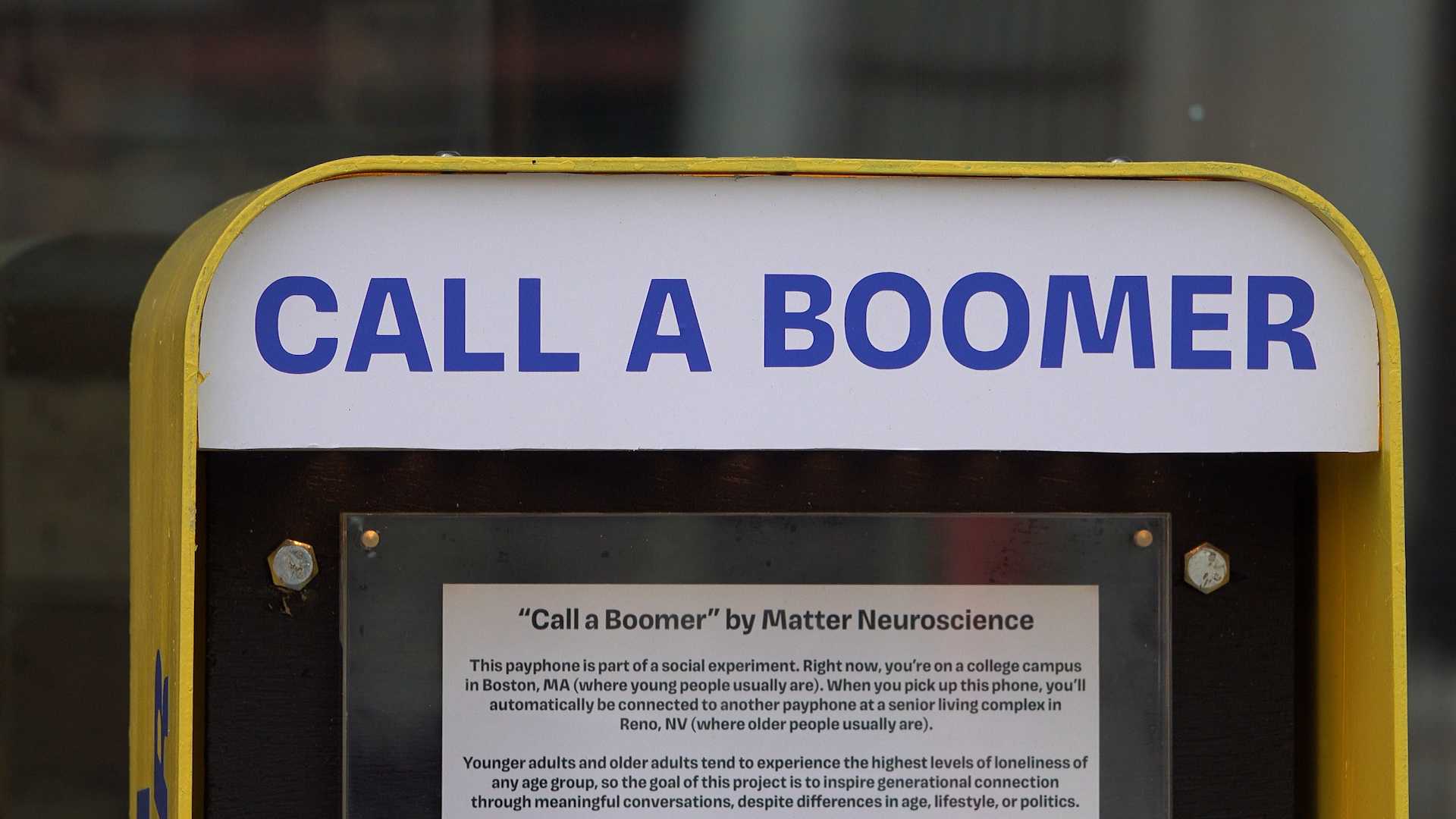
A coffee house in Boston, Massachusetts, is now a temporary home to a pay phone you don’t have to pay to use, and which only calls one location.
On the front are the words, “Call a Boomer.”
Advertisement
It’s the brainchild of a neuroscience startup company aiming to reduce loneliness in boomers and members of Generation Z.
“I honestly never call random people,” said Isabel Lemionet, who works on the marketing team for Pavement Coffeehouse, outside of which the Call a Boomer phone has been installed.
Lemionet picked up the phone, it rang a few times, and she was immediately connected with a person named Josh, who picked up from a senior center in Reno, Nevada.
“He was just waking up, going out for a walk,” said Lemionet. “He complained about the weather!”
Pavement Coffeehouse became the temporary stewards of the revamped pay phone over the weekend. Marketing Coordinator Thomas Tague-Bleau said when they got the call to participate, they were all in.
“Honestly, the biggest logistical thing was just getting wires to get all the way to a nice an outlet inside,” Tague-Bleau said.
The masterminds behind the phones have done this before. In January, they installed a pair of phones in San Francisco, California and Abilene, Texas, inviting people to “Call a Republican” and “Call a Democrat.”
“We’re focused on helping people become more emotionally fit,” said Calla Kessler with Matter Neuroscience, which designed the phones.
She works for the fully remote neuroscience startup that aims to identify measurable biomarkers of happiness. This, Kessler said, is part of their overall mission to help people build happier brains, which could ultimately lead to happier communities.
“Our goal is to help people live happier lives by helping them understand their brain’s feel-good neurotransmitters and how they’re connected to positive emotions,” said Kessler.
So, where does a refurbished payphone from Facebook Marketplace come in?
Matter Neuroscience points to a study published in 2020 suggesting rates of loneliness are highest among young adults and people of old age. With the phones, Kessler said they hope to bridge the gap.
“A lot of people feel disconnected from their communities and feel alone and upset. And all of these negative feelings cause a spike in our cortisol, which is our brain’s primary stress hormone,” said Kessler. “And so we’re trying to figure out a way that we can get people in conversation to find their common ground and connect with people they might not otherwise meet.”
They chose the Boston location for its proximity to a college campus. But you don’t have to be a Boomer on the Boston end of the line to pick up the phone.
“What young people may not know is we’re still them on the inside, but we look really crappy!” said passerby Mark Krone, a self-described Boomer.
He picked up the phone after lunch with a friend. No one in Reno answered, but Krone was able to leave a voicemail for a fellow boomer anyway.
“That’s what I love about this, it’s just simple connection. It’s not deep. It’s not intellectual. It’s not political, thank God,” he said. “It’s just two people.”
As people stopped to read the message on the phone or snap a photo, Tague-Bleau said the mission of the phone aligns with Pavement Coffeehouse’s mission for person-to-person connection.
“We’re so connected to just your algorithmic ‘this is what it is’ versus complete randomness, a complete stranger,” said Tague-Bleau. “And so I think that it’s a good change, I hope people will be excited about trying out.”