
Read the full article on Nebraska Examiner
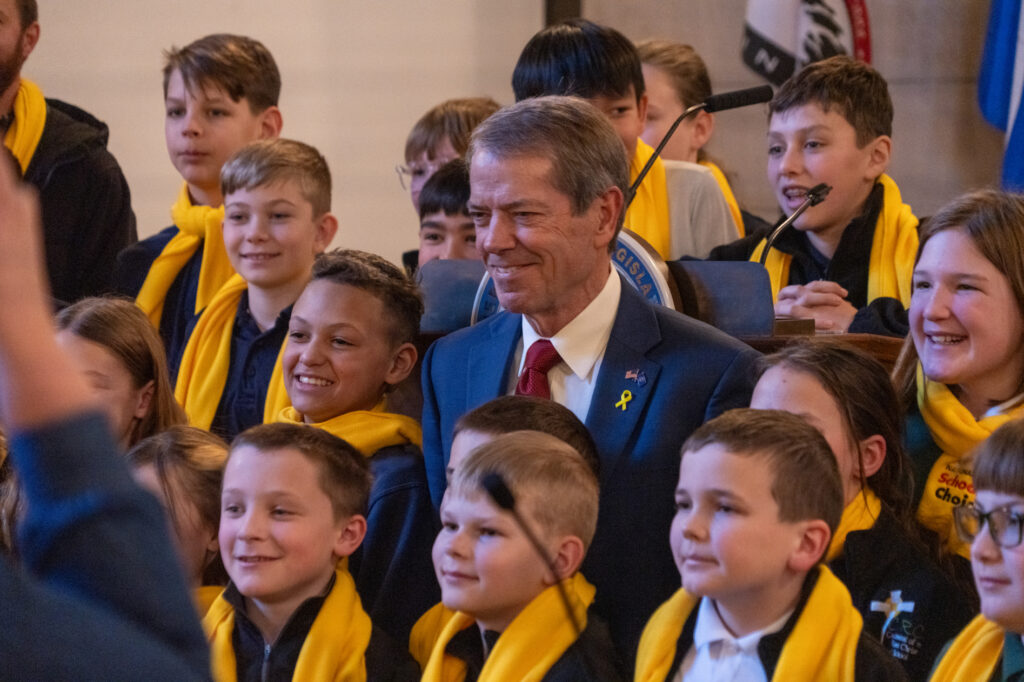
Nebraska Gov. Jim Pillen, center, smiles with local private school students after ceremoniously signing a proclamation for “National School Choice Week” in the state. Jan. 28, 2026. (Zach Wendling/Nebraska Examiner)
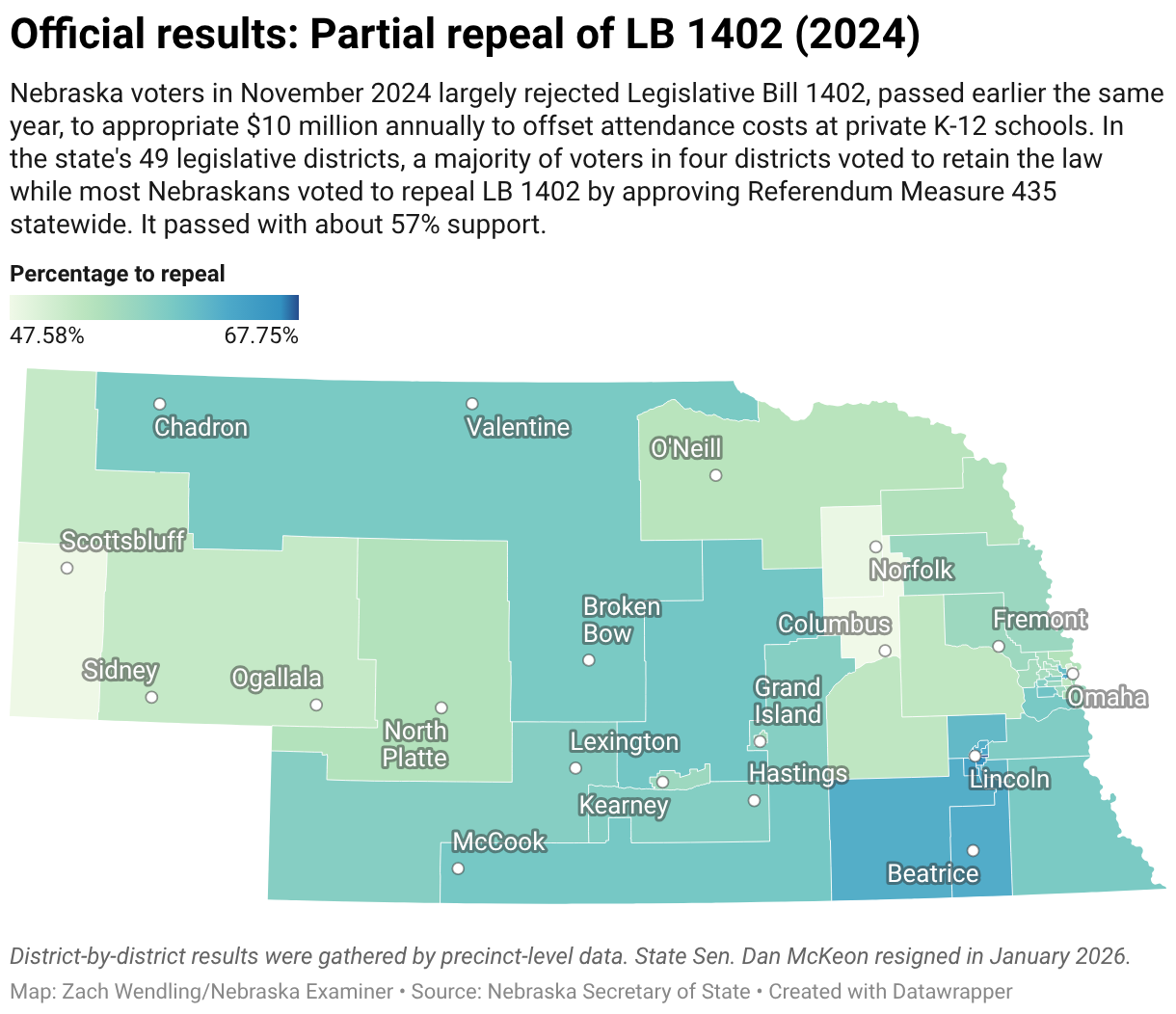
LINCOLN — A majority of Nebraska voters in 45 of 49 legislative districts repealed the state’s last program allowing state funds to support students attending private schools in 2024.
Some lawmakers have suggested reviving or trying new school choice programs since. This session, with Nebraska Gov. Jim Pillen’s backing, supporters seek $3.5 million in the state budget with a primary goal of supporting students caught in the “gap” from recent programs voters rejected.
“We have to stand up for things that we believe in,” Pillen told the Nebraska Examiner in February.

Pillen’s budget proposal had originally requested $7 million for the Nebraska Department of Labor for these “gap students,” arguing that the one-time state funding would help keep students in their schools this fall until a new federal tax credit kicks in next year for public, private and home school K-12 students, with federal income tax credits of up to $1,700 per taxpayer each year.
Tim Royers, president of the Nebraska State Education Association, the state’s largest teachers union that led opposition to Nebraska’s 2023 and 2024 school voucher laws, said Pillen’s latest budget proposal reinforces opponents’ arguments that one voucher program “is never going to be enough.”
“It’s always going to snowball,” Royers told the Examiner.
‘Behind the eight ball’
Nebraska became the first state to opt into the Trump administration’s federal program, with Pillen estimating 200,000 Nebraska taxpayers might participate, which could net Nebraska $340 million each year. The federal tax credits are routed through scholarship-granting organizations that give donors tax breaks for providing private funds for Nebraska students attending private schools, similar to Nebraska’s initial school choice law in 2023.

Pillen said he supports allowing the federal tax credits to be used to donate to support any type of K-12 education — public, private or home schooling.
Since taking office, Pillen has deviated from his predecessors in seeking more federal funds.
“Yeah, we’re the first,” Pillen said of the tax credits. “We want to really make this happen, because we’ve been behind the eight ball [in] asking the federal government to be a part of things.”
U.S. Rep. Adrian Smith, R-Neb., helped Congress usher the tax credits provision onto President Donald Trump’s desk. Voters in Smith’s sprawling, largely rural 3rd Congressional District also rejected the 2024 state-level law.
Pillen: Nebraska’s ballot measure process ‘does not represent the people speaking’
The Legislature’s Appropriations Committee, while navigating a budget deficit that has ballooned to $646 million, put in half of Pillen’s budget request, plus $150,000 from the state for administrative costs. The Appropriations Committee narrowed eligibility to up to 185% of the federal poverty level. For 2026, that’s $40,034 for a family of two, or $61,050 for a family of four.
The new state program, as designed, would route state help through state educational savings accounts. The Labor Department would retain broad authority to implement the program and support additional students after helping those caught in the “gap,” if additional funds were still available.
As debate on the budget begins Monday, lawmakers are still short $140 million, and the $3.65 million toward private schools has been seen as a possible target to cut spending.
‘They know how voters feel’
Royers said the NSEA is willing to “play in the sandbox” of the federal tax credit program. And opponents, such as Royers, thought the federal changes meant the debate would shift at the statehouse away from vouchers.
He suggested that if supporters want to assist “gap” students, they could do so by raising private funds.

The NSEA led opposition to Nebraska’s 2023 tax-credit-based program of up to $25 million — of which $9.57 million was ultimately claimed — and the 2024 successor for $10 million in direct appropriations to help cover private school attendance, which outright replaced the 2023 law.
Former State Sen. Lou Ann Linehan of Elkhorn led both laws, the first measures of their kind to pass in Nebraska.
Royers said putting the current program only in the budget and sending it to the Labor Department rather than the Nebraska Department of Education is telling as a way to avoid a designated hearing or possible third referendum campaign.
“I think that speaks very plainly to the fact that they know how voters feel,” Royers said. “They don’t want the voters to be able to weigh in.”
The Nebraska Constitution prohibits referendums of “appropriations for the expense of the state government,” which might prevent a repeal effort. But the NSEA has argued that a referendum would still be allowed, and that the organization might pursue other options, such as a direct lawsuit.
If passed, a referendum would need valid signatures from at least 5% of registered voters by mid-July, 90 days after the Legislature adjourns. With the next fiscal year starting July 1, supporters would likely need 10% of voters to sign to block a new voucher law from taking effect. Nebraska, as of March 1, had 1.25 million registered voters.
The total would need to include at least 5% valid signatures from 38 of Nebraska’s 93 counties.
Daniel Russell of Stand For Schools, which advocates for public schools, said it would be difficult for the Labor Department to monitor thousands of students’ education accounts when its focus is on the workforce, not K-12 academic accountability.
Royers and Lisa Albers, representing Grand Island Public Schools and the Nebraska Association of School Boards, were among those to oppose the budget proposal at a public hearing in mid-February. Both have noted that the school choice proposal comes amid another Pillen recommendation to cut $18.5 million in special education funding, which appropriators advanced.
‘One-year funding gap’
State Sens. Rob Clements of Elmwood, Christy Armendariz of Omaha, Rob Dover of Norfolk, Loren Lippincott of Central City and Paul Strommen of Sidney were the five Appropriations members who supported the $3.65 million school choice provision. All five are Republicans.

Nebraska Labor Commissioner Katie Thurber, testifying before the committee in mid-February, said there are about 2,500 “gap students” who previously received scholarships but might not be able to afford attendance at their school without state support this fall.
“This is truly just a one-year funding gap provision,” Thurber said.
If the state supported all “gap” students, it would cost the state just over $5 million, Thurber said. She said about half of the students’ families who previously received state support were at or below 185% of the federal poverty level.
Thurber said the program would be administered similarly to other grant programs within the department, which she said was one reason her department was selected. She said stronger educational outcomes would lead to a more prepared workforce and increase workers’ lifetime earnings.
Family, private school speak out
Anthony Williams, superintendent and principal of Omaha Street School, was one testifier who urged state support for “gap” students. His high school supports 35 to 40 “at-promise” students, those who face significant challenges but have a high potential for success. He said nearly all transferred from public schools after years of struggling.
Williams said 14 families used the previous school choice laws, describing “gap” funding as not a “luxury” but a “bridge.”
“Remove the bridge and you create casualties, casualties with names and faces,” Williams said. “They are not just data points in a spreadsheet. They are Nebraska children.”

Irma Lopez of Crete said the state funding helped her afford a parochial school for her two children. She said there came a time when every morning her daughter was in tears because she didn’t want to be at school, and while doing OK academically, she needed something different.
“I never thought they would be in a parochial school, but now I don’t imagine them anywhere else,” Lopez said in January, at an event when Pillen proclaimed “National School Choice Week.”
Lopez said her daughter became much happier, and her son, who had been behind in reading, soon caught up.
‘Why are we even messing around?’
Some rural Republicans still see issues in supporting the law and vow to oppose it again.
State Sen. Tom Brandt of Plymouth, a Republican who opposed Linehan’s previous proposals, said he is opposed to using any public money for private school choice. He’s still waiting to see how the federal tax credit program includes public schools.
“With that in place, why are we even messing around with this other one?” Brandt asked.
“The referendum simply eliminated that. Period, end of story,” he continued on the state policy. “There’s no other interpretation you can draw from that.”

State Sen. Myron Dorn of Adams, who voted for the 2024 law but did not support the 2023 version, opposed adding any such funding to the budget. He is the only Republican member of Appropriations who did not support the proposal.
Dorn said he bases his opposition on the public’s vote, the new federal program and because of the policy decision to create a new state program through the budget, a rare and relatively new tactic. He wants his committee to reconsider including the spending.
“I’ve been opposed to them before, and I’m definitely opposed to doing it this way,” Dorn said.
State Sen. Ashlei Spivey of Omaha, a Democratic member of the Appropriations Committee, similarly said she had heard from constituents that the latest idea was a “reinvention of killed ballot initiatives where it was really clear by Nebraska voters that they did not want this type of program.”
‘Economic segregation’
Armendariz and Dover, the biggest supporters on the committee, see the funding as critical for students caught in the “gap” situation.
Armendariz, vice chair of the Appropriations Committee, told the Examiner it is Nebraskans’ responsibility to support children through high school, “whatever that education looks like.” She said lawmakers are “getting lost” in the debate over whether tax dollars should go only to public schools, a debate she said focuses on the “system” more than the child.
“We need to consider what best fits the learning styles of the individual, not the assumption that the one option will fit all children,” Armendariz said.
Some opponents to such programs have argued that if families want the option, they should pay for it.

But Armendariz said that doesn’t address families who can’t afford to attend private school or to physically move to a different public district. She called it “economic segregation,” educational “redlining” and “educationally marginalizing the poor.”
“When we confine poor children to one educational system that does not work for them but allow more economically advantaged families [with] mobility to find and pay for the best options for their children, we perpetuate generational poverty,” Armendariz said.
Dover, at the Jan. 28 event where Pillen proclaimed “National School Choice Week,” called the fight a “parental right” and “one of the most important justice issues of our day.”
Dover’s legislative district was one of four that narrowly voted to keep the 2024 vouchers bill, at 51.87%. The others were State Sens. Terrell McKinney of North Omaha (50.76%), Brian Hardin of Gering (52.21%) and Mike Moser of Columbus (52.42%). Pillen is also from Columbus.
“When you fight for the cause of justice, never give up, even when times get tough,” Dover said. “Instead, keep your eyes on the prize, stay determined to achieve your goals.”
Pillen has argued the campaign against Nebraska’s 2023 and 2024 school choice laws — which spent a combined $7.5 million — was not done in the spirit of Nebraska’s ballot measure laws. It was the fourth time Nebraska voters have rejected efforts to allow public funds to cover private school costs of attendance.
Inside Nebraska’s budget: What lawmakers are considering to fix $646 million deficit
To others who supported Linehan’s previous laws but are hesitant now, Pillen repeated a frequent phrase: “We all agree our kids are our future, and we can never give up on one kid.”
Amendment could end funding
Debate on adjustments to Nebraska’s current two-year budget begins Monday, with Royers watching for an amendment to strip the Labor Department funding from the budget — Section 13 of the Appropriations amendment to Legislative Bill 1071. No senator had yet introduced that amendment by the end of Friday. The change would need 25 votes.
Armendariz said education is the “great equalizer” and that investments so a child reaches their “full potential” can reduce future taxes to corrections or programs like Medicaid, SNAP or CHIP.
“All these programs provide ‘maintenance’ for people living in poverty,” she said. “Educational opportunities LIFT people OUT of poverty.”
Royers said voters were not “hoodwinked” in 2024, and he is rallying people to oppose that section of the budget.
“We’re disappointed that we’re here again, but we’re confident the outcome will be different this time,” Royers said. “We don’t think they [lawmakers] have the stomach for doing this again.”