
Read the full article on Nebraska Examiner
LINCOLN — Dozens of Nebraskans converged at the State Capitol Friday for a rally and back-to-back hearings on five immigration-related measures aimed at reining in ICE tactics in the state and increasing public scrutiny.
Advocates for greater restrictions on U.S. Immigration and Customs Enforcement activities dominated the roughly four hours of testimony before the Legislature’s Judiciary Committee.
Only two people spoke against any of the five bills. Both were agency heads in Gov. Jim Pillen’s administration.
The first two hearings — on Legislative Bills 854 and 906, which seek to halt mask-wearing by immigration agents in Nebraska, except in certain circumstances — drew more than 20 supporters.
“It is un-American to have a secret masked police force in our country,” State Sen. Megan Hunt of Omaha said in discussing her LB 854. “The reasons why are manifold.”

State Sen. Margo Juarez of South Omaha introduced the similar LB 906. Both bills include certain exceptions. Sponsors said they intend also to stop ICE impersonators from concealing their faces to try and commit crimes.
Mia Perales, a student at the University of Nebraska-Lincoln, was among proponents who said she wanted to give lawmakers a feel for what was on young peoples’ minds. She said she would not be part of any “brain drain” fleeing Nebraska because of high taxes or housing costs.
Rather, she said, her concern is transparency and respect for people of all backgrounds. If she left, Perales said, it would be because “my values aren’t being upheld.”
The two people opposing the bills on Friday were Col. Bryan Waugh, superintendent of the Nebraska State Patrol, and Rob Jeffreys, director of the Nebraska Department of Corrections.
They took issue with Legislative Bills 963 and 881, introduced by State Sen. Terrell McKinney of North Omaha and State Sen. Dunixi Guereca of Omaha, respectively.
McKinney’s LB 963 would prohibit state agencies and officials from entering into agreements related to immigration enforcement without legislative approval and seeks to void a Nebraska deal with the federal government that last fall converted a rehabilitative-focused state prison in McCook into an ICE detention facility for migrants. He has been a vocal opponent of Pillen’s decision to partner with federal officials in the arrangement, saying the Legislature should have had oversight.

“ICE is out of control in the United States of America,” McKinney said. “They are killing U.S. citizens.”
Jeffreys, as he has on previous occasions, said the governor had the authority to convert the Work Ethic Camp into the ICE detention center. He contends that the change did not “disrupt” WEC inmates who had to be relocated to other facilities and said the federal government has been timely in reimbursing the state for costs. Pillen’s office has estimated ICE reimbursements will net Nebraska $14.5 million annually.
Over the next month or so, Jeffreys said, the facility should finish construction that would allow for 100 more detainees, up from the current capacity of about 200, he said.
Several speakers protested the lack of public input on the conversion, however. Among them was Phil Lyons, a McCook lawyer and Red Willow County deputy county attorney who said he was speaking for himself.
Lyons said he resented that community members were not consulted.
“I think it’s a bad picture,” he said. “I don’t want to be associated with a concentration camp. I don’t want that to be associated with McCook. We deserve better.”
Guereca, in describing his LB 881, focused on local and state law enforcement agencies entering into 287(g) agreements with the federal government to enforce immigration laws. The legislation would require prior notification to a local governing body and calls for a public hearing.
Waugh said the new requirements could “unintentionally hinder public safety operations, delay time-sensitive decision-making and create administrative burdens.”

“Many agreements or interactions with federal partners occur in urgent situations,” he said. “The bill’s framework may limit the flexibility agencies need to respond.”
The State Patrol leader challenged Guereca’s assertion that such agreements cost Nebraskans. He said six state troopers have gone through 40 hours of Department of Homeland Security training and have made 65 immigration-related arrests.
Waugh said the federal government has reimbursed the state for car mileage and other costs.
Guereca said, however, reimbursement is not guaranteed. He said he was concerned about county sheriff’s departments entering into agreements and local residents shouldering expenses. He offered examples, including Harris County in Texas, which ended its program in 2017 because it cost $675,000 a year.
Guereca said the DHS Office of Inspector General estimated that ICE saves $120,000 to $250,000 a year for every 287(g) agreement because “local law enforcement agents perform similar functions” to ICE officers.
“Taxpayers deserve the right to have a voice in the process,” Guereca said.
Another Juarez legislative proposal aired Friday would prohibit law enforcement agents from entering certain “community safe spaces” to enforce immigration law without a judicial warrant. Legislative Bill 907 drew multiple supporters, including Daniel Russell of the Nebraska nonprofit Stand for Schools.

The measure aims to ensure that places such as schools, child and health care facilities are not “disrupted by warrantless immigration enforcement.”
Russell said families and students are on edge in Nebraska, seeing immigration enforcement activities unfolding in cities such as Minnesota and Los Angeles.
When parents are worried, he said, “Kids don’t show up or don’t fully engage in the school day.”
He said that while ICE hasn’t reached into Nebraska schools, the Juarez bill could help alleviate tension and be preventative.
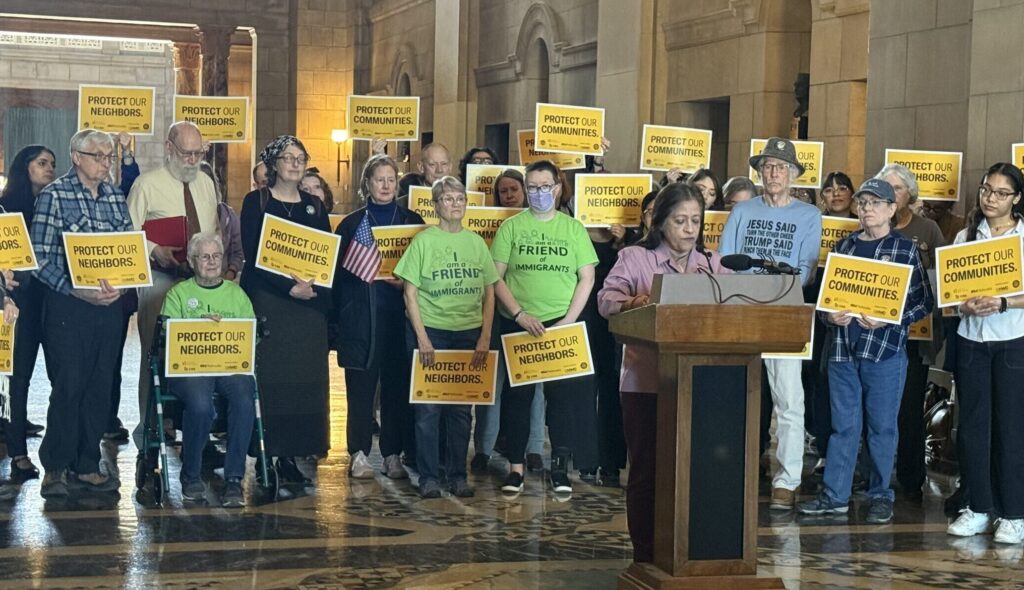
Lina Traslaviña Stover, executive director of the Heartland Workers Center, joined Russell and others at a State Capitol rally prior to the hearings. She said many in the Latino community in Nebraska are living in fear. “Men in masks and unmarked cars are taking our neighbors away.”
“Fear is not public safety,” she said.
Juarez spoke to the roughly 50 rallygoers, many of whom carried signs saying, “Protect our Communities” and others who wore T-shirts saying, “I am a Friend of Immigrants.”
She said the country and Nebraska are in unprecedented times.
As lawmakers, she said, “We are here to show them we care.”
The Judiciary Committee took no immediate action Friday on any of the proposals. Friday was the last day of public hearings, and the rest of the 60-day legislative session that ends in mid-April will be full days of debate.
SUBSCRIBE: GET THE MORNING HEADLINES DELIVERED TO YOUR INBOX