
Read the full article on Nebraska Examiner
LINCOLN — An avenue has opened that would nearly close Nebraska’s projected budget deficit, but it will require the state Legislature to approve a slate of revenue-generating bills and a collection of spending cuts and cash transfers.
The Legislature’s Appropriations Committee met for the third day in a row to revisit ways to balance the state’s two-year budget. Lawmakers have just seven legislative days left before they must send their state budget adjustments to Gov. Jim Pillen’s desk for final approval and possible line-item vetoes.
Lawmakers began the session with a projected $471 million deficit, which ballooned to more than $646 million following new economic forecasts in February. Approved adjustments by the committee brought the expected deficit down to about $125 million, but in reality it’s closer to $140 million.
The committee voted on new adjustments Thursday that would reduce the deficit by about $8 million, according to Legislative Fiscal Analyst Keisha Patent. Among the latest changes was a $750,000 reduction from the Secretary of State’s budget, a $1.3 million interest transfer from the state Department of Water, Energy and Environment and the inclusion of an existing child care subsidy bill into the budget package.
Combined with other adjustments the committee greenlit earlier this week, Patent said that would bring the projected deficit to roughly $40.7 million. Patent noted the Legislature also is considering several revenue bills for debate which would generate about $39.7 million, so, if taken together, that could shrink the deficit down to an estimated $1 million.
However, that assumes legislative majorities would approve both the revenue bills and the committee’s proposed adjustments — and that the measures could overcome possible filibusters.
The largest portion of Thursday’s approved adjustments was a $22 million transfer from the state’s rainy day fund. Two weeks ago, the committee approved a $130 million transfer from the cash reserve. This would bring the total reserve transfer this session to $152 million.
Last year, lawmakers approved a separate $152 million transfer from the reserve to balance another deficit. This would bring the total amount transferred out of the reserve this biennium to $304 million.
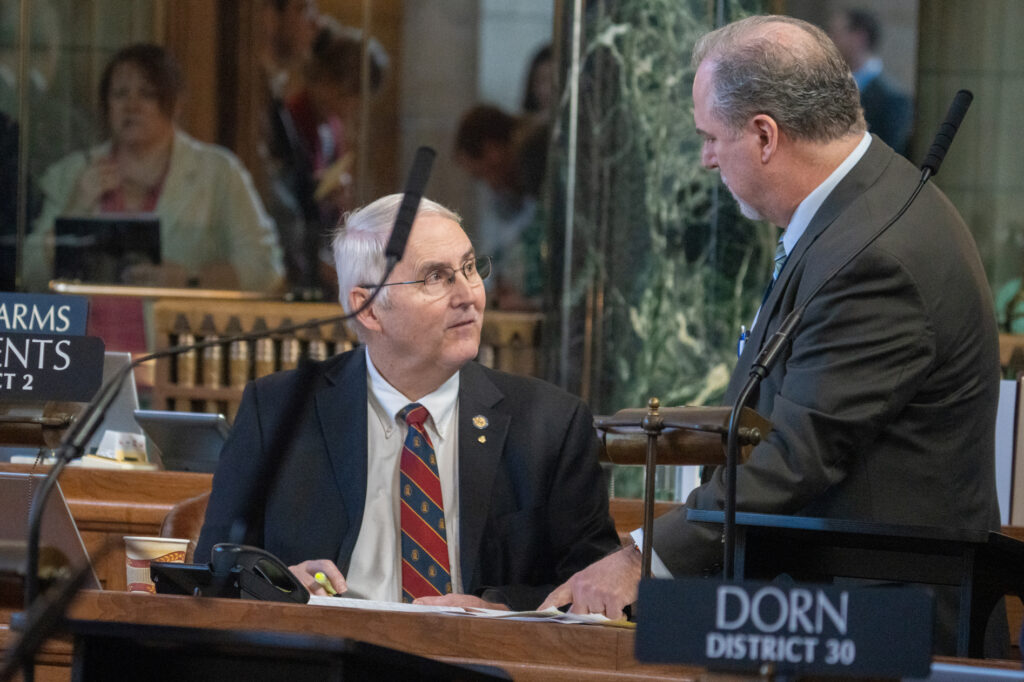
While State Sen. Rob Clements of Elmwood, the Appropriations Committee chair, said he was uncomfortable with reducing the rainy day fund further after the $130 million transfer, the latest transfer was taken from new dollars that had recently reached the reserve fund.
SUPPORT: YOU MAKE OUR WORK POSSIBLE
Of the $22 million, $2 million comes from unutilized funding from a state construction project, and the remaining $20 million is excess revenue projected by Nebraska’s Economic Forecasting Advisory Board.
At the board’s last meeting in late February, members increased Nebraska’s revenue projections for the current fiscal year by about $20 million. Until recently, those dollars would have gone directly into the rainy day fund, but legislation passed during the 2024 special session changed the process to send excess revenues to the School District Property Tax Credit Fund.
Earlier this session, Clements said pulling the $20 million out of the fund in order to fill the deficit was an option he viewed as a “last resort.”
Among other adjustments approved Thursday was a $2 million cut to the Nebraska Department of Correctional Services. A fiscal analyst said Corrections officials have said this cut would lead to staffing adjustments, most likely reducing the number of staff manning prison towers during hours when fewer inmates are outside.
State Sen. Ashlei Spivey of Omaha, who voted against the cut, said she didn’t trust that Corrections was being truthful about the impacts of the reduction. She said often when prison facilities encounter staffing issues, they increase the use of restrictive housing and worsen conditions for inmates.
One approved change that didn’t impact the deficit was the reversal of a $1.5 million transfer from the state’s Education Savings Plan Administrative Fund, and a $2 million transfer from the Education Savings Plan Expense Fund, both of which were slated to go into the Education Future Fund.
The Education Future Fund has a documented sustainability problem, as it currently spends more dollars than it gains year-over-year. On its current track, the fund will not be able to cover its expenses by fiscal year 2027-2028 without a significant infusion of money.
Pillen proposed adding about $60 million to the Education Future Fund this biennium as a temporary fix, which included transfers out of both education savings plan funds.
The Appropriations Committee initially approved the transfers, but on Thursday fiscal analysts brought up a 2018 opinion from former Attorney General Doug Peterson. In the opinion, Peterson said the education savings plan funds were not considered public dollars and could not be transferred by the Legislature for savings.
State Sen. Machaela Cavanaugh of Omaha noted that she proposed an amendment during Wednesday’s floor debate on the budget bills to remove this provision, citing similar reasons. The amendment was shot down by the Legislature, with all five Republican Appropriations members voting against it.
“You’re welcome,” Cavanaugh told the committee.
She said they could have done the same thing Wednesday.
SUBSCRIBE: GET THE MORNING HEADLINES DELIVERED TO YOUR INBOX