

Read the full article on Nebraska Examiner
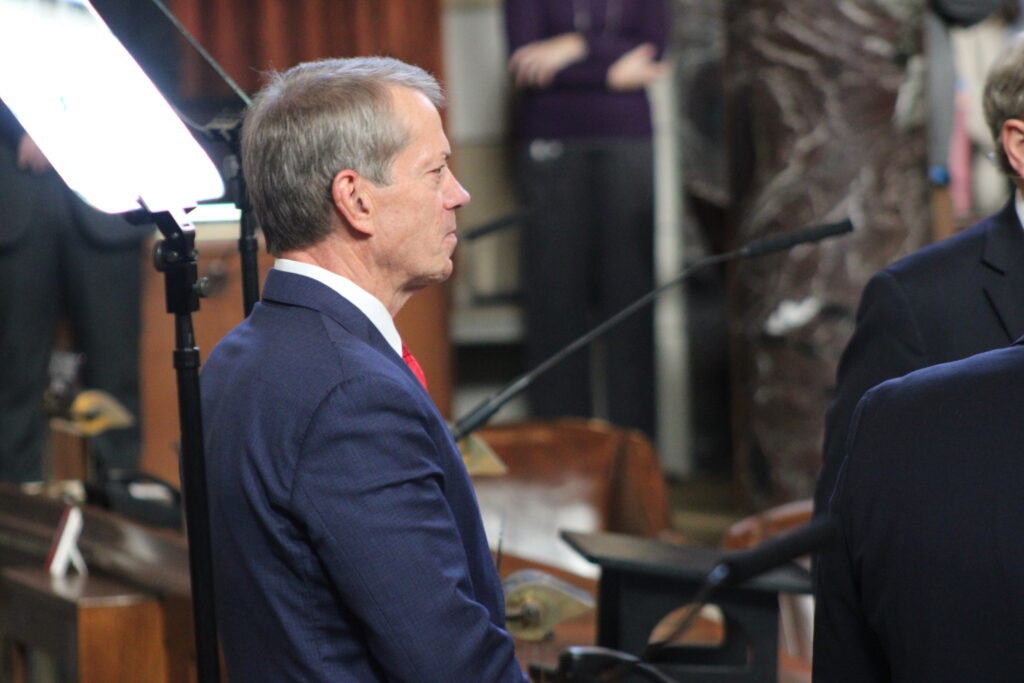
Nebraska Gov. Jim Pillen before his State of the State address in the Capitol on Jan. 15, 2026. (Juan Salinas II/Nebraska Examiner)
LINCOLN — Nebraska Gov. Jim Pillen’s mid-biennium budget proposal drew no supporters at a public hearing Monday, with many testifiers sharing concerns about the governor’s continued reliance on cash fund sweeps to balance a projected deficit.
Both of Pillen’s mainline budget bills, Legislative Bills 1071 and 1072, had a combined public hearing before the Nebraska Legislature’s Appropriations Committee. The bills aim to close a projected $471 million deficit and, if adopted, would leave Nebraska with an estimated $125 million surplus by the end of the budget cycle in mid-2027, according to Pillen’s office.
Overall, the governor’s changes would reduce state spending by 0.4% in the current fiscal year and by 1.8% in fiscal year 2027. Across the whole of state government, Pillen proposes $495 million in spending cuts, with the largest agency reductions to the state Department of Health and Human Services, which would see a net loss of about $152 million over both years.
State Budget Administrator Neil Sullivan, speaking on behalf of the governor, was the only testifier in support of both bills, aside from two written comments in support. In comparison, the bills drew 25 opposing testifiers and more than 600 written comments in opposition. An additional three people spoke in a neutral capacity, along with seven written comments.
This is the second year in a row that lawmakers have spent much of the legislative session working to fill a large projected deficit. Sullivan maintained the governor’s position that the projected shortfalls are a result of government spending, but several testifiers offered a different take.
Craig Beck, research director for progressive thinktank OpenSky Policy Institute, argued that the repeated deficits are due to increases in transfers out to support property tax relief spending. Over the past seven fiscal years, Beck said the state’s transfers grew nearly 650%, compared to a 23% rise in general fund spending over the same period.
Former State Sen. Al Davis, representing Nebraska’s chapter of the Sierra Club, argued the deficits are linked to lawmakers’ focus on what he called “tax gimmicks,” including various sales tax and income tax exemptions, which reduce state revenues and don’t directly address the state’s property tax crisis.
Additionally, Davis said Pillen’s strategy of sweeping cash funds is an unsustainable method for balancing Nebraska’s budget. Davis was one of many testifiers who questioned the long-term feasibility of the transfers.
“Eventually there won’t be any cash funds to raid,” Davis said. “What will you do then?”
Sullivan said the Governor’s Office expanded its review to over 900 state cash funds this year, looking specifically for excess balances and cash he claimed was sitting idly.
Multiple opponents argued the proposed transfers fix a temporary budget issue but would lead to long-lasting negative consequences for a variety of projects and industries across Nebraska.
SUPPORT: YOU MAKE OUR WORK POSSIBLE
Several testifiers raised concerns about the governor’s proposal to reduce annual allocations to the Compulsive Gamblers Assistance cash fund by nearly $650,000 per year. Additionally, Pillen proposed eliminating the Commission on Problem Gambling and would fold its duties into the behavioral health division of DHHS.
Mike Sciandra, executive director of the Nebraska Council on Problem Gambling, said it was irresponsible to “tear apart” these services when casinos and sports betting are growing throughout Nebraska.
“Without the treatment I received through the gamblers assistance program, I believe I would either be in prison or dead,” said Sciandra, who described himself as a problem gambler in recovery.
Several other testifiers took issue with provisions of LB 1071 that would restrict the Legislature and Nebraska’s higher education institutions from using funds “for the purpose of diversity, equity and inclusion programs.”
Spike Eicholt, testifying on behalf of the Education Rights Counsel, said he is certain Pillen, a former University of Nebraska regent, included this for political purposes but argued it would lead to broad unintended consequences.
Matthew Martin, director of programs for the Nonprofit Association of the Midlands, backed up Eicholt’s point, saying that the restrictions would negatively impact a host of local nonprofits. He said many nonprofits focus on aiding people from historically marginalized demographics but also offer a range of services like job training and mental health resources.
“Nebraska’s charities rely on a diversity of funding streams to carry out their important work,” Martin said. “Prohibiting state funding to nonprofits working with our most vulnerable and unrepresented populations would have serious negative consequences for our communities.”
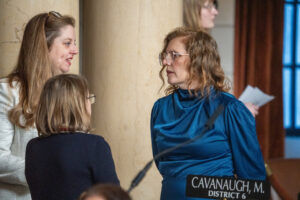
State Sen. Machaela Cavanaugh of Omaha, a member of the Appropriations Committee, has repeatedly raised concerns with what she views as “sweeping policy” changes included in Pillen’s budget proposal. She accused the governor of attempting to repeal legislation through the budget, circumventing the more traditional approach of going through a separate bill.
Cavanaugh pressed Sullivan at Monday’s hearing about why Pillen was pushing for the changes. Sullivan said the adjustments were meant to efficiently balance the budget, but Cavanaugh said it is inappropriate to cut policy language in a budget proposal and argued it undermines the purpose of other legislative committees.
“It categorically is not the right way,” Cavanaugh said.
Later in the hearing, Cavanaugh challenged Sullivan on the governor’s proposed cash fund sweeps, arguing that they risk eroding public trust in state government. Sullivan disagreed, saying many of the dollars transferred out of cash funds would still be used for similar purposes.
“I believe we are honoring the purpose of these funds that we are using another way,” Sullivan said.
Cavanaugh said monies allocated to cash funds are meant to be used for a specific purpose. So while the reallocation would still use the funding in a similar way, it would not be used for what Nebraskans set out to use it for.
Multiple testifiers agreed with Cavanaugh’s point, particularly when expressing concerns about Pillen’s proposed $40 million transfer out of the Nebraska Environmental Trust. More opposing testifiers spoke about concerns with the Trust than any other proposed change.
“Diverting [the funding] is not just unwise, it’s a fundamental breach of public trust,” said Katie Torpy, representing The Nature Conservancy.
Pillen’s proposal would use $40 million from the voter-created Trust to finance a new boat marina, along with bank stabilization work at Lewis & Clark Lake, and to pay for water conservation projects. Sullivan specifically pinpointed the Trust transfer as an example of the governor’s proposal repurposing funds for similar uses.
However, opponent Jarel Vinduska noted that the projects the Governor’s Office identified as worthy were originally supposed to be financed through the state’s general fund, so the transfer would still reduce funding for environmental projects overall.
Traci Bruckner, senior policy manager for Audubon Great Plains, argued that the funding’s new use would be mainly for recreational purposes, which is not aligned with the Trust.
Multiple testifiers said the governor’s proposal had thrown multiple pending projects into limbo. Bruckner said just by suggesting the transfer, 53 recently approved projects had been put on hold.
Alex McKiernan, co-owner of Robinette Farms in Martell, Nebraska, said the Trust currently has about $70 million in its account, and roughly $50 million of that money is already obligated. Of the obligated funds, he said about $20 million is on pause. He argued the shift also would reduce federal and private match dollars coming to Nebraska through the Trust.
McKiernan said that the Trust largely invests in Nebraska’s rural working lands, and argued depleting dollars from it would likely hurt farmers and ranchers more than any other group.
“My wife and I will pay over $28,000 in property taxes this year,” McKiernan said. “Do I want that to go down? Yes, I would love to see that drop. But not by ignoring a constitutional process or destroying investments made in natural resources that farmers, ranchers and rural Nebraskans depend on.”
SUBSCRIBE: GET THE MORNING HEADLINES DELIVERED TO YOUR INBOX