Read the full article on Nebraska Examiner
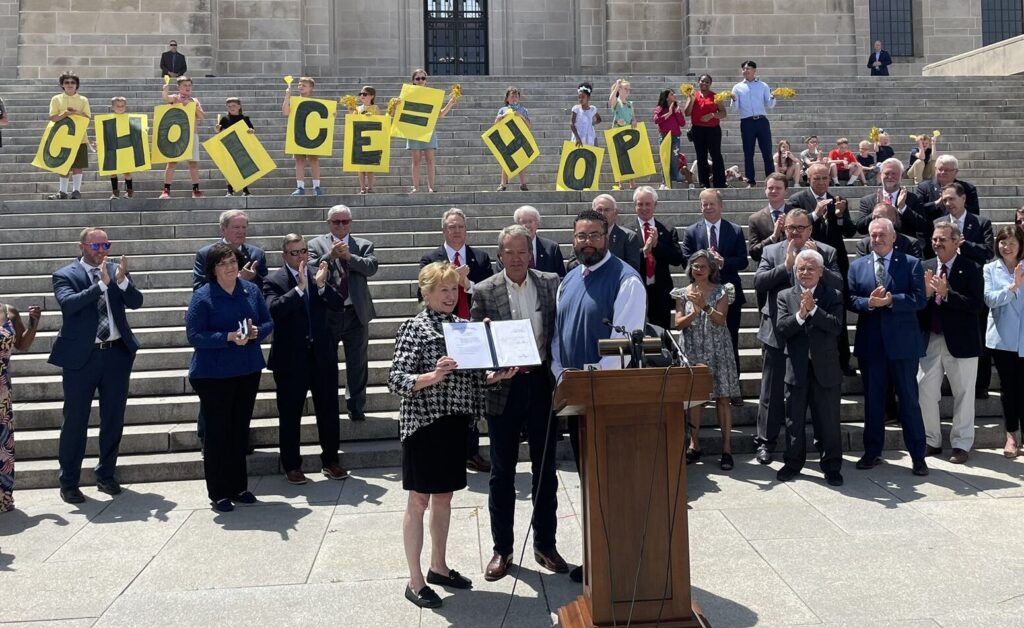
State Sens. Lou Ann Linehan and Justin Wayne of Omaha flank Gov. Jim Pillen after he signed into law LB 753, the Opportunity Scholarships Act, on May 30, 2023. (Courtesy of the Nebraska Governor’s Office)
LINCOLN — Nebraska Gov. Jim Pillen downplayed the mandate of ballot measures in Nebraska as he asked lawmakers to debate a budget proposal to divert public dollars to help cover some costs of attending private schools.
Pillen said he is “guilty” of not studying ballot measures before voting, which he estimates is “pretty normal.” He thinks 90% of Nebraska voters are like him and show up to vote without having fully studied the issues ahead of time.
“I believe the ballot initiative process today does not represent the people speaking,” Pillen said in a Feb. 5 interview with the Nebraska Examiner.
He continued, “Somebody has enough money, you can pass anything because you buy the signatures. Buy the signatures and you get it on the ballot. Something gets on the ballot, very rarely does ‘Nebraska Nice’ say, ‘No.’ It’s fascinating.”
Nebraska braces for latest private school funding, vouchers fight, now eyeing $3.5M
The Nebraska Secretary of State’s Office is the repository for those petitioning to get measures onto the general election ballot, including the full text of proposed changes. There are currently 11 petitions certified to gather signatures for November 2026. Signatures are due July 2.
Measures eyeing the 2026 ballot address property taxes, abortion, how Nebraska awards its Electoral College votes for president votes, online sports wagering and the future of voters’ right to run petition campaigns.
If potential ballot measures receive enough signatures, the Secretary of State’s Office hosts public hearings in each of the state’s three congressional districts leading up to the November election.
In the 2022 and 2024 election cycles, Nebraskans weighed in on voter ID, minimum wage, paid sick leave, abortion, private school funding and medical cannabis. Each of those issues has since returned to the Nebraska Legislature.
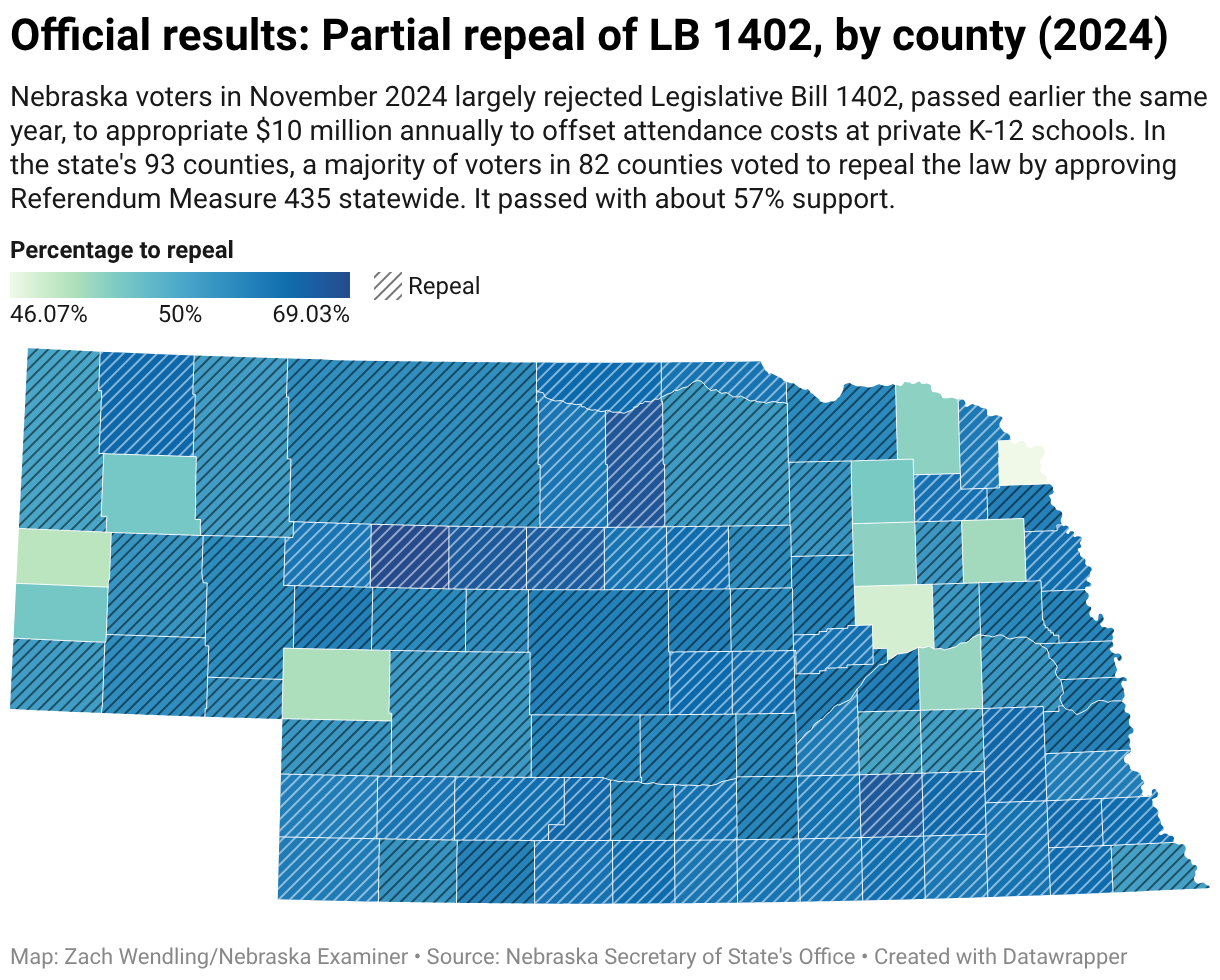
On the topic of private school funding and school choice, Pillen argued that, “If you go out west, where the media did not get influenced, it wasn’t even close.”
However, 82 of Nebraska’s 93 counties voted to repeal the 2024 law. Of those that voted to keep the law, four were in western Nebraska, and Scotts Bluff County had the highest support, at 52.74%.
It was the fourth time Nebraska voters have rejected efforts to allow public funds to cover private school costs of attendance.
Asked if he would support restrictions on ballot measure funding or restricting paid signature gatherers, Pillen said “self-funding” is not the elective process and that the original intent of ballot measures was volunteers.
He said that’s what the state ought to get back to.

The “Support Our Schools” campaign, primarily financed by the Nebraska State Education Association and National Education Association, spent $7.5 million total between its 2023 and 2024 petition efforts.
Tim Royers, NSEA president, said Pillen’s argument on funding and signature gathering shows Pillen has his “head in the sand.” He said the idea that voters got “hoodwinked” isn’t true.
“I was out in communities all over the state helping to gather signatures, and when you do petition drives, there’s a statement you have to read,” Royers said. “I was out in Bertrand, it’s a town of less than 1,000 people, and I would try and read the object statement and they would stop me and say, ‘This is about the vouchers?’ Yeah. ‘OK, I’m signing.’”
SUBSCRIBE: GET THE MORNING HEADLINES DELIVERED TO YOUR INBOX