

Read the full article on Nebraska Examiner
LINCOLN — The Democratic-led Lincoln City Council is going on the defensive with charter amendments offering alternatives to three conservative-backed measures that aim to reshape local elections in the second-largest city in Nebraska.
The City Council voted unanimously Monday to approve both its alternatives and the Good Government Lincoln initiatives to appear on the Nov. 3 ballot. The initiatives with the most votes will be adopted if two competing initiatives both pass.
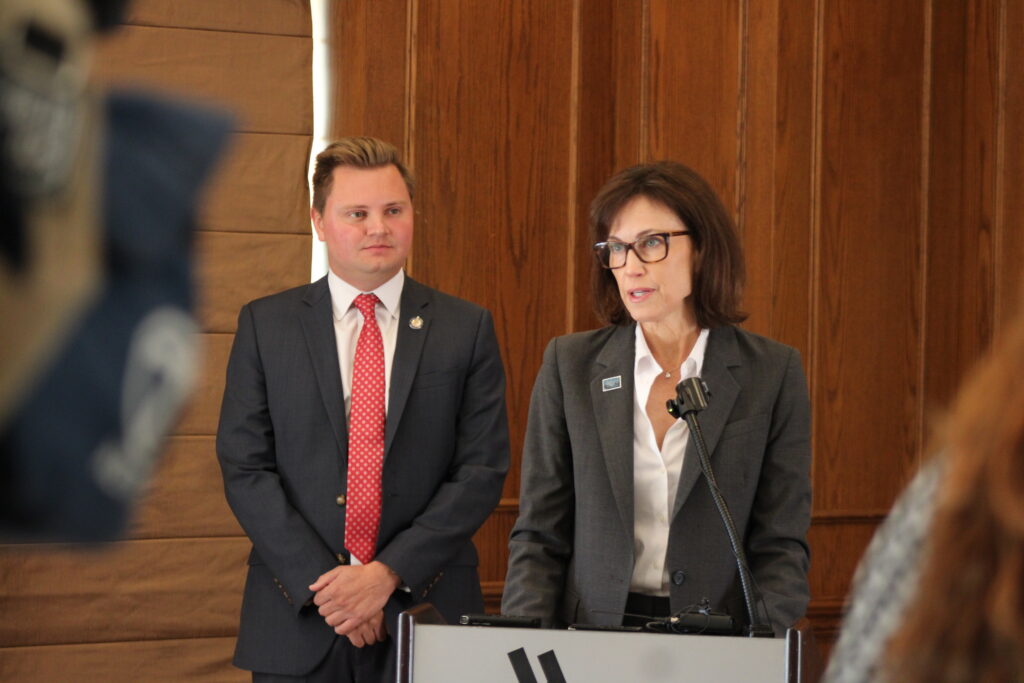
Earlier in the day, Lincoln Mayor Leirion Gaylor Baird, in a press conference at the Cornhusker Hotel, attacked the Good Government Lincoln group for the “chaos” it has caused and called it a political scheme.
“The people behind these amendments have not been able to win mayoral or city council races on the merits of their ideas,” Gaylor Baird said. “So their proposals will shorten the terms of the people whom they have not been able to beat.”
The city’s alternative charter amendments are tweaks to the Good Government Lincoln initiatives — such as giving the mayor and council members more time to serve than the group proposes in transitioning to city elections in even years, and proposing that term limits for council members match the mayor’s three consecutive four-year terms, instead of the proposed two terms.
Gaylor Baird, a Democrat, said the city’s alternatives are “reasonable” and “nonpartisan.”
The Good Government Lincoln ballot initiatives seek to limit Lincoln City Council members to two consecutive four-year terms, move city elections from odd to even years, and let certain residents within a 3-mile buffer around Lincoln city limits vote in municipal elections, excluding bond votes.
SUBSCRIBE: GET THE MORNING HEADLINES DELIVERED TO YOUR INBOX.
The local issue has drawn attention from the state’s top legal officer and chief law enforcement official.
These alternatives follow a state Supreme Court order requiring the city to place its qualifying proposals on the Nov. 3 ballot. Nebraska Attorney General Mike Hilgers had sued the Lincoln City Council after city officials claimed there wasn’t enough time to get the proposals on the ballot after the group had to scramble to find more valid signatures. The three petitions initially fell short when most of the original signatures were flagged as possibly fraudulent.
Hilgers has acknowledged his support for the Good Government Lincoln effort. He said he had spread the word and encouraged voter support.
In the same order, the high court also opened the door for the City Council’s alternatives. Lincoln City Councilman Brodey Weber said at the press conference that the Good Government proposal to let people who live outside of the city vote would be an “unprecedented move” and unfair to Lincoln property taxpayers.
The Good Government Lincoln has said the purpose of its initiatives is “to give residents of Lincoln a stronger voice in city government, prevent the pitfalls of career politicians, and ensure more voters are engaged with our city elections.”
The group’s sponsor, former State Sen. Tony Fulton, released a statement saying, “Despite their about-turn on process and timing, it is good to see city officials support term limits and the normalizing of our city elections.”
“Though they differ on the duration of one’s hold on power, all these initiatives will increase voter participation and government savings. Now the voters decide,” Fulton said.
The general election is Nov. 3.
SUPPORT: YOU MAKE OUR WORK POSSIBLE
- September 15, 20263:05 pmEditor note: The story has been updated to clarity comment from Lincoln City Councilman Brodey Weber
- September 14, 20265:42 pmEditor note: the story have been update with Monday’s Lincoln City Council vote.