

Read the full article on KETV 7
LIVE: Blanche confronts skeptical questioning of fund, tax deal for Trump at Senate confirmation hearing

WASHINGTON —
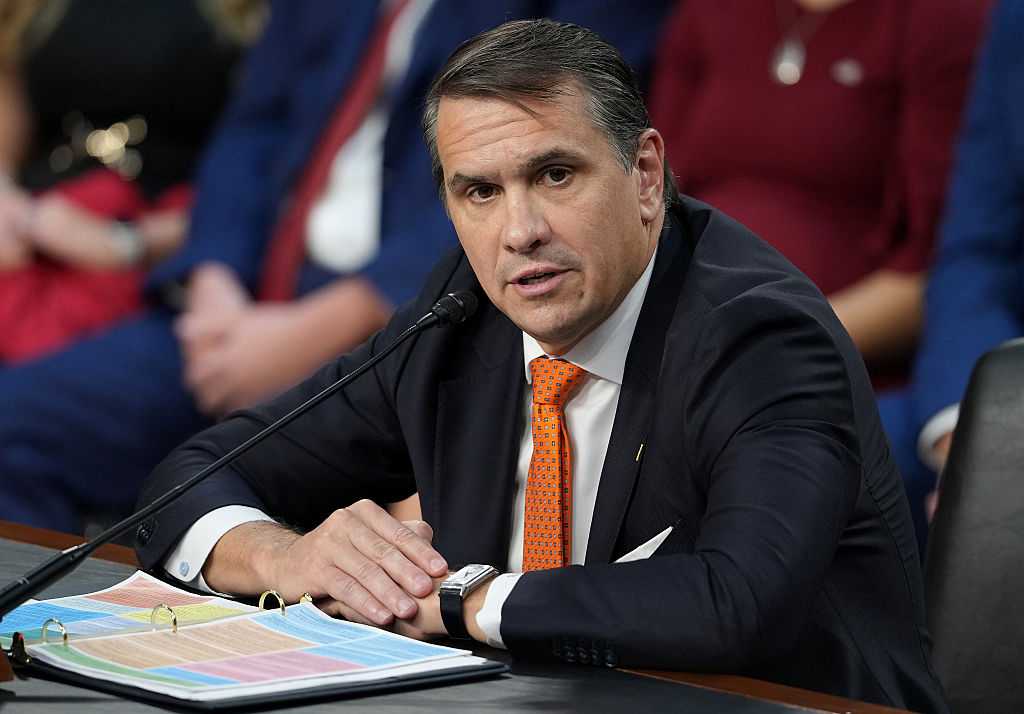
Acting Attorney General Todd Blanche confronted skeptical questioning at a Senate confirmation hearing Wednesday about the creation of a fund to compensate allies of President Donald Trump and a tax immunity deal for the president as he aimed to lock down the Republican support needed to advance his nomination.
Watch a livestream of the confirmation hearing in the video player above.
Advertisement
Blanche insisted that the $1.776 billion “Anti-Weaponization Fund,” which was scrapped after fierce bipartisan backlash, was “not moving forward.” But lawmakers, including Republican Sen. John Cornyn, raised concerns that the Trump administration has yet to commit in writing that the fund is dead and that it could therefore conceivably be resurrected.
“Just to be clear, the president of the United States, who’s a plaintiff in this lawsuit, has not agreed in writing to delete the ‘Anti-Weaponization Fund’ and there’s no guarantee that he won’t raise it in the future?” Cornyn asked. Blanche replied that Trump has no power over the fund, which was to have been administered by the Justice Department but never launched.
Cornyn’s questions were closely watched given that Blanche requires the support of all Republicans on the Judiciary Committee and the Texas Republican has said he won’t make up his mind until after the hearing.
Trump’s former personal attorney, Blanche has run the department on an interim basis since April, during which time he has accelerated investigations into Trump foes, functioned as the public face of the maligned and later-withdrawn fund and oversaw the release of files in the Jeffrey Epstein sex-trafficking investigation. Those actions received fresh scrutiny Wednesday as Blanche testified for the opportunity to serve out the duration of Trump’s term.
The stakes are high given the upheaval inside the department, where mass firings and resignations have hollowed out the workforce. More than 1,200 department alumni have come out against his nomination.
Sen. Dick Durbin, the committee’s top Democrat, told Blanche: “In less than 18 months at the Department of Justice, you’ve shown you’re still President Trump’s personal attorney. Your tenure can be summed up in the four words you said — ‘I love you, sir’ — to President Trump.” That was a reference to remarks Blanche made at an April news conference.
Blanche, for his part, insisted that he has presided over a course correction at the department following years of investigations into Trump during the Biden administration.
“In recent years, we watched the Justice Department turned against many of you and a former president, and it damaged the public’s faith in justice,” Blanche argued. “We are fixing that.
Blanche will need the support of each Republican on the panel
Blanche, who is expected to be uniformly voted down by Democrats on the committee, must win the support of all Republicans on the panel for his nomination to advance.
A particular focus is on Cornyn of Texas, who in May lost his primary and Sen. Thom Tillis, a North Carolina Republican who has opted not to seek reelection. Tillis, like Cornyn, has been an outspoken critic of the fund that the Trump administration created to compensate people who feel unjustly persecuted by the criminal justice system and then quickly withdrew.
Tillis has said he will not support for attorney general anyone who equivocates on the events of Jan 6, 2021, when pro-Trump rioters stormed the U.S. Capitol in a bid to halt the congressional certification of Trump’s election loss to Democrat Joe Biden. The senator, however, recently said he doesn’t have any concerns about Blanche’s record regarding the events of that day.
With the death of South Carolina Republican Sen. Lindsey Graham, who was a member of the Senate Judiciary Committee, there are 11 Republicans and 10 Democrats on the panel. If even one Republican on the committee votes against Blanche, it could scuttle his nomination.
Blanche insists that the fund is dead. Lawmakers aren’t so sure
The fund created a particularly rocky moment for Blanche. He initially defended it during congressional appearances only to reveal later that it was being scrapped — even while resisting calls to give those reassurances in writing. The turnabout followed fierce bipartisan backlash that came to a head during a tense closed-door meeting he had with lawmakers.
The fund arose out of a settlement of Trump’s $10 billion lawsuit against the Internal Revenue Service over his leaked tax returns. The Florida judge overseeing that case issued a scathing ruling that said Trump and his lawyers had manipulated the court system in bringing the lawsuit in the first place. The judge, Kathleen Williams, said Monday she was troubled by Blanche’s involvement in the settlement given that he previously represented Trump.
Blanche also face questioning over a separate element of the settlement that afforded Trump and members of his family protection from tax audits and that, he has said, remains on track despite outrage over it from even Republicans.
Epstein files are also under scrutiny
Other testimony focused on Blanche’s handling of the Epstein files, especially after his predecessor Pam Bondi told lawmakers behind closed doors after her ouster as attorney general that Blanche was the department’s point person on the release of documents from the sex trafficking case into the late financier.
The staggered release, mandated by an act of Congress, was beset by problems, including redaction errors that left exposed nude photos showing the faces of potential victims. Some names, email addresses and other identifying information were either unredacted or not fully obscured. About 1 percent of the records had redactions that needed to be fixed, he said.
Blanche said that though “mistakes were made,” the disclosure of the documents was an exercise in unprecedented transparency.
“I want to make sure that the American people know that this administration, when it comes to Jeffrey Epstein, has been more transparent than any administration,” he said.
A former federal prosecutor and key member of Trump’s defense team as the Republican battled four indictments between his first and second terms, Blanche arrived at the Justice Department last year as deputy attorney general. He then ascended to the top job after Trump ousted Bondi, who had frustrated the White House by struggling to bring successful cases against Trump’s political opponents.
Blanche has tried to satisfy the president in that regard. He has appointed a new prosecutor to spearhead a Florida-based investigation centered on former government officials Trump dislikes. The Justice Department under Blanche’s watch also secured an indictment of ex-FBI Director James Comey, another adversary of Trump, on charges of threatening the 47th president by posting a social media photograph of seashells in the numerical arrangement of “86 47.” Comey has said he assumed the numbers reflected a political message, not a call to violence.
Blanche has denied accusations that he has been weaponizing the department. But he has also insisted that he sees no problem with the president’s interest in Justice Department matters and that he feels no pressure to placate him.
“We have thousands of ongoing investigations and prosecutions,” Blanche told a press conference in May. “And it is true that some of them involve men, women and entities that the president in the past has had issues with and believes should be investigated. That is his right, and indeed it is his duty to do that.”
Blanche has also presided over an aggressive enforcement of news media leaks, with prosecutors most recently issuing subpoenas demanding that a group of New York Times journalists testify before a federal grand jury after they reported on security concerns involving the new Qatari-gifted Air Force One. The Times’ executive editor, Joseph Kahn, criticized the subpoenas, praised his journalists’ work and said: “We expect to prevail.”