Read the full article on Nebraska Examiner
LINCOLN — The Nebraska Medical Cannabis Commission will move forward with requiring fees for registered cannabis establishments and applicants in the coming weeks.
Commissioners released the first draft of updated regulations Monday. The proposal would create a $5,000 application fee, license and renewal fees based on license type, a $1,500 relocation fee and a $13,000 fee for participation in the state’s seed-to-sale inventory tracking system. There would also be a $250 fee to license a new product, plus a $100 renewal fee.
The latest proposal would no longer include a specific license type for transporters. Instead, as commissioners hinted previously, product manufacturers could apply for a transporter certification to be part of their business.
Proposed fees
Initial and renewal fees per license type would be as follows:
- Cultivators — $20,000 for a new license; $23,500 annual renewal fee.
- Transporter — $10,000 for a new certification.
- Product manufacturers — $20,000 for a new license; $23,500 annual renewal fee if the licensee does not have a transporter certification or $28,500 if the licensee does.
- Dispensary — $15,000 for a new license; $18,000 annual renewal fee.

Commission regulations permit up to four cultivators, four product manufacturers and 12 dispensaries, arranged by judicial district. That would mean one dispensary each in Douglas County (584,526 residents), Lancaster County (322,608 residents), Sarpy/Cass Counties (217,202 residents) and Buffalo/Hall Counties (112,979 residents), according to 2020 census data. All four cultivators have been licensed. One cultivator is approved to start growing.
Licensees would need to pay the seed-to-sale $13,000 fee at each renewal period. This means an annual payment of at least $30,000 to more than $40,000 each year for licensees.
The commission opened applications for product manufacturers shortly after its last meeting in mid-June. At least two businesses have applied so far. Commissioners extended the deadline for more applications to Aug. 17, the next commission meeting. Applications can be submitted through the commission’s website.
The commission hasn’t yet indicated when it will approve its first product manufacturer licenses. That likely won’t happen until at least September now, based on monthly commission meetings.
The commission has not indicated when it would license its first in-state dispensaries either.
‘Thinking more proactively’
Multiple members of the public, many of whom were involved with the successful 2024 voter-led effort to legalize and regulate medical cannabis, said commissioners needed to move faster and more diligently. Voters created the Medical Cannabis Commission at the 2024 election.

Crista Eggers, executive director of Nebraskans for Medical Marijuana, which led the 2024 effort, said commissioners had a choice whether to reinforce a belief that commissioners were standing in the way of what Nebraskans voted for.
“I can tell you, it is a certain type of hell to be a parent who has given the last decade of my life to this effort and now have serious concerns of whether my son is ever helped,” Eggers said.
Troy Burgess, a Nebraska resident who has worked in the medical cannabis industry for about six years in other states, including Oklahoma, told the commission that “just because we have plants in the ground doesn’t mean patients will ever have medicine.” He is one of the two applicants who have submitted for a product manufacturer license.
Burgess and Eggers said commissioners should start preparing now to work with state lawmakers to button up holes in January, such as around testing, confidentiality and legal or professional protections for health care providers wishing to recommend medical cannabis.
“We need to start thinking more proactively and working to remove roadblocks, eliminate them,” Burgess said. “We’re here to help. Ask.”

Earlier this month, regulations that had been in progress over the past year took the force of law after Nebraska Attorney General Mike Hilgers and Nebraska Gov. Jim Pillen signed off. Placing them into the state administrative code opened the door for more changes, such as new fees.
The Nebraska Legislature authorized the commission to issue fees this spring and appropriated dedicated funding to the commission. Lawmakers fell short of doing so in 2025.
‘Foundational efforts’
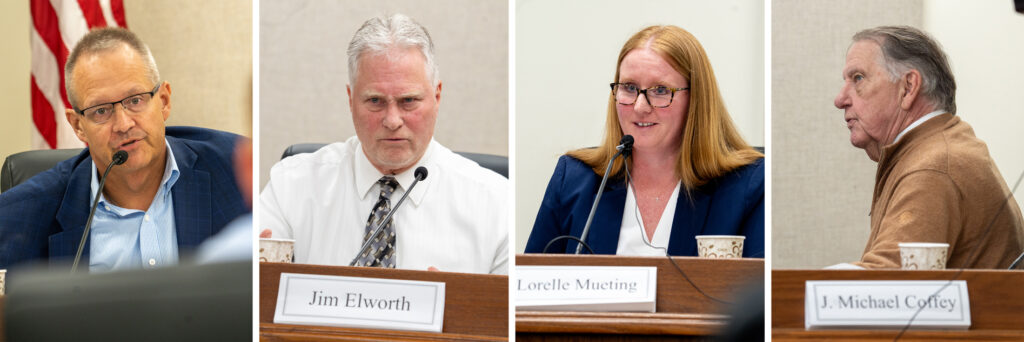
Commissioner Lorelle Mueting of Gretna, who is interim commission chair, said Monday’s meeting demonstrated the “foundational efforts” the commission has achieved in its first year of running.
“Building a new regulatory agency is much like constructing a house,” Mueting said.
The commission hired its first dedicated staff this month: a program manager, who started July 6, and a new in-house legal counsel, who started Monday. Commissioners are also in the process of hiring an executive director.

Mueting motioned that the fees be approved, after review by the commission’s new attorney first. The motion passed 3-0. Commissioner Bud Synhorst of Lincoln was not in attendance.
The fees would allow the commission to continue hiring staff, Mueting said, and were designed after reviewing programs in other states with “similar populations, regional considerations and regulatory structures.”
Mueting told the Examiner after the meeting that she did not know how a recent Pillen memo for state agencies to cut spending and require approval for new hires would impact her agency. Commissioner Jim Elworth of Nebraska City will assist commission staff in preparing the commission’s budget request to the governor before the next legislative session in January.
Cultivator dispute progress
In June, Kent Rogert, a former state senator and leader of one of the commission-licensed cultivators, said he has reached a “tentative” resolution over a dispute with Washington County officials. Officials had issued a stop-work order against Rogert’s operation after Rogert said planning officials changed course and wouldn’t allow him to use an agricultural permit.
“We have a path set forward through which we can apply for a conditional use permit for the building permits,” Rogert said of a meeting with the Washington County attorney.
Rogert told commissioners the process could take a “little bit of time” and some county meetings, but he hopes that by August, he could provide an updated “good report.”
Said Rogert: “We’ve agreed to disagree on the agricultural issue, but … they’ve given us a path forward, assuming everything works and we get a positive vote from the county board.”
The next Medical Cannabis Commission meeting is scheduled for 1 p.m. Aug. 17.
SUBSCRIBE: GET THE MORNING HEADLINES DELIVERED TO YOUR INBOX.