
Read the full article on Nebraska Examiner
Concerns are growing about a 5,000-head hog confinement barn being planned near Valentine, 2.7 miles from the scenic Niobrara River, one of Nebraska’s top tourist destinations.
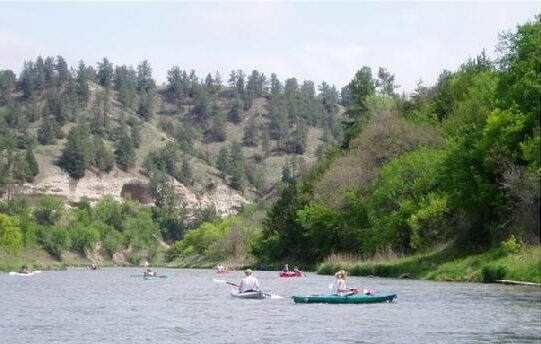
Critics say the area’s sandy soils and shallow groundwater make it highly susceptible to contamination from hog manure leaching into groundwater or washing into the river, threatening float trips for the 60,000 paddlers who visit the Niobrara each year.
“We don’t really think it’s going to be possible to build enough safeguards to assure that it will be run safely,” said Sandy Benson, the president of Friends of the Niobrara. “Those Sandhill soils are so different than other parts of the state.”
But the head of the family planning the hog site maintains that complaints are unfounded, and that the design of the facility – capturing manure in a deep pit and piping it to nearby farm fields – will eliminate any issues with odors or leaks.
“It’s all hearsay,” said Tim Marlatt, whose family operation, TK Angus, has raised cattle on the proposed site for 13 years.
Marlatt said that he is hoping to expand into hog production to keep his family in farming, and to utilize the manure as natural fertilizer on his fields of corn and alfalfa.
“It’s a way to generate more income with the same acres, and keep more people still in production agriculture,” Marlatt said.
The planned hog site, southeast of Valentine and adjacent to the Fort Niobrara National Wildlife Refuge, was first proposed 2 ½ years ago. It has stirred controversy since.
But the project now is at its final step of approval – a review by the Nebraska Department of Water, Energy and Environment . That agency has said it intends to approve the project, though is reserving a final decision until reviewing written comments.
Those written comments are due by July 31, and those concerned that a hog confinement operation isn’t safe in the Sandhills are urging others to submit comments.
“Everybody’s voice matters,” said Sunny Elliott of Valentine, a science teacher who has put up a website, “Protect Cherry County,” about the project. “This is our absolutely last hope.”
As of Monday, five letters have been submitted to the state, all in opposition.
Cherry County is known as “God’s Own Cow Country,” where cowboys on horseback herd cattle to new pastures. Its rolling, grass-covered Sandhills and wet meadows nurture the nation’s largest beef cattle herd, estimated at 165,000 head last year.
But in recent years at least a couple hog sites have begun to be built in the vast county, which – at over 6,000 square miles – is larger than some entire U.S. states, including Connecticut, Delaware and Rhode Island.
The Marlatts’ operation includes three, center-pivot irrigation systems.
Tim Marlatt said that new land is hard to come by, so to increase the profits from their existing property – and to provide a future living for a son and grandchildren – the hog confinement, holding 5,000 hogs weighing 55 pounds or larger, was planned.
He said that because the hog manure will be confined in a pit and then injected into the soil, the chances of odor problems are “slim to none.”
The organic, hog waste, Marlatt maintains, is better for the environment than commercial fertilizer because it will “bind” with the soil, thus retarding any leaching into groundwater.
“We are regulated to apply hog manure. We have zero restrictions on chemical fertilizer,” he said.
But critics of the project question whether there is adequate monitoring of groundwater to detect any leaks and whether steps will be taken to prevent runoff from fields to reach the Niobrara.
In written comments to the Department of Water, Energy and Environment , Casey King said that several nearby homes rely on private wells for their drinking water, and there would be no warning if groundwater became contaminated.
“The proposed confinement is simply too close to existing homes and to the Niobrara River, one of Nebraska’s most valuable natural resources,” King wrote.
The project got an initial OK from the Cherry County Planning Commission but then was rejected by the three-member Cherry County Board.
That generated a lawsuit by the Marlatts and TK Angus.
A year ago, Cherry County District Judge Mark Kozicek overruled the County Board, stating that the county had failed to provide testimony from “one neighboring property owner, user of the river, member of a chamber of commerce or tourist board” about perceived adverse impacts of the hog confinement.
Cherry County was ordered to approve a conditional use permit for TK Angus, and the project proceeded to a final review by the Water, Energy and Environment department .
Tim Marlatt said the family’s hog confinement proposal would not have advanced this far if it wasn’t being built within state environmental standards. Such facilities help the county’s tax base, he added, and keep families on farms.
But critics like Friends of the Niobrara and the Sierra Club disagree, and question if such operations are appropriate in an area of sandy soils that overlie the Ogallala Aquifer. Groundwater is 10 feet or less from the surface, they said.
“The proposed site’s highly permeable soils, shallow groundwater, and direct hydrological connection to the Niobrara River make contamination likely and irreversible,” stated the Friends of the Niobrara in its submission to the Department of Water, Energy and Environment.