

Read the full article on KETV 7
What to know about testosterone replacement as Pete Hegseth pursues a ‘High-T Department of War’

Defense Secretary Pete Hegseth said he plans to test U.S. service members’ testosterone levels each year.
This story was originally published on PolitiFact.com.
Advertisement
In a July 15 X post, Hegseth called for a “High-T Department of War” and said in a video that “war fighters age 30 and older” would be screened as part of their existing annual health assessments. Service members under age 30 could voluntarily opt in, he said.
If low testosterone treatment is recommended, Hegseth said a patient can choose whether to receive testosterone replacement therapy.
“This initiative — it’s not about artificial enhancement,” he said. “It’s about restoring and optimizing your natural capabilities, protecting your longevity and ensuring you have the biological foundation required to sustain the fight.”
But when it comes to testosterone levels, optimization isn’t so straightforward. Scientists don’t agree on a single value that is too low. It depends on a person’s sex, age and symptoms, among other factors. Not everyone who receives one blood test showing lower testosterone levels needs testosterone replacement therapy, which can have benefits but also comes with risks.
There’s also not a lot of clarity about what this policy will look like in practice, and the Defense Department declined to answer many of our specific questions. A July 15 Pentagon spokesperson statement confirmed the testosterone deficiency screening Hegseth spoke about would be mandatory for all active duty and reserve personnel 30 and older.
What is a healthy testosterone level?
How much testosterone a body needs and naturally makes varies from person to person. No single number represents whether a person’s testosterone level is healthy, but doctors have identified some acceptable ranges.
For adult men, the Endocrine Society says normal testosterone levels span from about 300 to 1,000 nanograms per deciliter. This measurement is used in medical lab testing; a nanogram is one billionth of a gram and a deciliter is one-tenth of a liter. A 2017 study of more than 9,000 men in the U.S. and Europe found normal testosterone levels in a similar range, 264 to 916 nanograms per deciliter.
Adult women’s testosterone levels are naturally lower and vary with factors such as age. Women generally have from 15 to 46 nanograms of testosterone per deciliter, Cleveland Clinic reported. The University of Rochester Medicine and Medical News Today’s ranges are a little larger: 15 to 70 nanograms of testosterone per deciliter.
Sometimes, a person’s reproductive or sexual anatomy doesn’t fit the typical definitions of male or female (often called intersex), which can also affect someone’s natural hormone production and needs.
As people age, their testosterone levels naturally decrease. Between roughly 30 and 40 years old, men’s testosterone levels begin to drop by about 1% to 2% per year.
When are someone’s testosterone levels too low?
There’s no consensus on a single value as being too low. Testosterone levels are typically checked using a blood test. (At-home saliva tests are also available, but their accuracy is uncertain.)
A man who doesn’t make enough testosterone by clinical standards can be diagnosed with hypogonadism or low testosterone, which means he has low hormone levels coupled with testosterone deficiency symptoms. These symptoms include lowered sex drive, erectile dysfunction, low sperm count or infertility, breast enlargement and tenderness, fatigue and lost muscle mass. The benchmark is typically that a man’s testosterone level repeatedly falls somewhere below 280 to 320 nanograms per deciliter, according to a 2017 study published in the journal Baylor University Medical Center Proceedings.
But testosterone levels constantly fluctuate. To confirm low testosterone levels in men, doctors require at least two morning tests on different days that show low testosterone.
“For people with borderline-low testosterone levels, a repeat test would show a normal range about 30% of the time,” Harvard Health reported.
There’s no clear benchmark for testosterone deficiency in women, and most testosterone tests are bad at detecting testosterone at the low levels present in women. For these reasons, a low testosterone diagnosis is made based on her symptoms and blood test results.
Symptoms of low testosterone in women include lowered sex drive, fatigue, loss of strength and muscle tone, depression and anxiety, irregular menstrual cycles, vaginal dryness, hair thinning and insomnia. A doctor might recommend testing a woman’s testosterone on specific days of her menstrual cycle because the levels can fluctuate.
“It is a challenge to definitively base treatment off of a number,” said Katie Horner, a physician assistant at Internal Medicine and Family Physicians in Omaha Nebraska. “I always say, treat the patient, not the lab value.”
What is testosterone replacement therapy?
Sometimes called TRT, testosterone replacement therapy involves taking external forms of testosterone to increase a person’s natural levels. It can come in many forms, including patches, injections, pellets, pills and creams or gels.
The treatment can vary from patient to patient, depending on what form of testosterone is prescribed. People might apply gel daily, administer a weekly or biweekly injection or take pills twice a day.
Dr. Ravi Iyengar, an endocrinologist at UC San Diego Health, said that the best candidates are people with lab-confirmed low testosterone and actual deficiency symptoms.
“But our first goal as endocrinologists is always to help your body produce its own testosterone if possible, as there are significant implications to taking outside (exogenous) hormones,” he said.
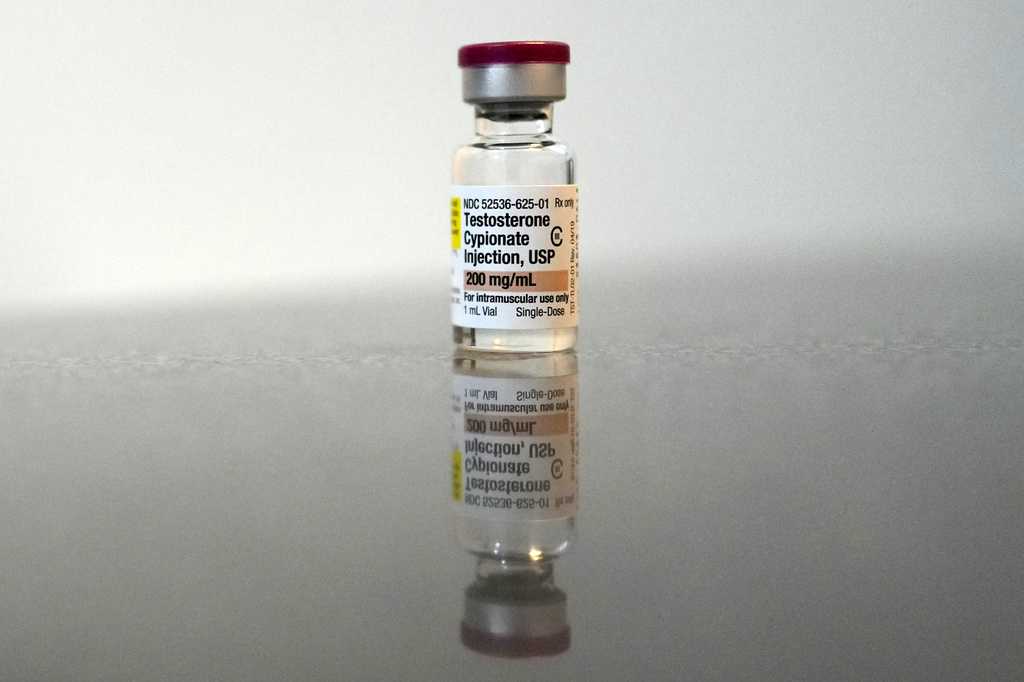
A vial of testosterone cypionate in Columbus, Ohio, on Jan. 18, 2024.
What are the benefits of testosterone replacement therapy?
For people with a testosterone deficiency, replacement therapy can improve the symptoms that often prompt people to seek out the treatment. “It can restore energy, protect bone density, support healthy metabolic function, and improve libido and sexual health,” Iyengar said.
What are the risks of testosterone replacement therapy?
The most significant risk is that once someone starts testosterone replacement therapy, it could eventually be difficult or impossible to opt out without side effects, including infertility.
“When you take outside testosterone, your body stops making its own,” Iyengar said.
Because the body needs its own testosterone to produce sperm, external testosterone use can lead to decreased sperm production and testicle shrinkage. The therapy can also worsen a man’s sleep apnea, cause acne, stimulate prostate growth and cause breast tenderness or enlargement. It can also increase red blood cell production, thickening the blood and increasing the risks of clots or stroke.
For women, side effects can include acne, excessive sweating, and increased facial or body hair growth.
What are the options for a woman whose screening shows low testosterone?
There is no FDA-approved testosterone replacement treatment specifically for women, but off-label treatments can be prescribed to women with dose adjustments.
Research supports off-label use of testosterone replacement therapies (often creams) to treat women experiencing low sex drive, particularly during and after menopause.
Is testosterone replacement therapy gender-affirming care?
It can be considered gender-affirming care, yes.
Gender-affirming care is an individualized approach to health care that encourages and supports a person’s gender identity. Although people might think this type of care is only for transgender or gender diverse people, that’s not necessarily the case.
Since the 1940s, hormone therapies have been prescribed to boys considered too short and girls considered too tall. A July 2024 JAMA Network Open paper found that males who are cisgender — meaning their gender identity matches the sex they were assigned at birth — received far more breast reductions, a surgery that can be gender-affirming, than transgender and gender diverse people.
In their 2023 paper, bioethicists Theodore Schall and Jacob Moses argued that a key element of deciding whether a medical intervention is considered gender-affirming care hinges on the patient’s perspective.
They examined medical procedures cisgender people receive that can be gender-affirming, including breast reconstruction after mastectomy, penile implants after testicular cancer and hormone replacement therapy.
“These common treatments allow cisgender people to live more comfortably in their bodies and to realize authentic versions of themselves,” Schall, a University of Massachusetts Amherst health policy and management professor, told The Hastings Center for Bioethics. “Gender is an important part of that full human experience, and giving people the gendered bodily experiences that align with who they are contributes to overall well-being.”
This story was originally published on PolitiFact.com.
It is republished here as part of a reporting and fact-checking partnership between PolitiFact and Hearst Television.