

Read the full article on KETV 7

It’s been a busy year-plus for the Justice Department under President Donald Trump, but the past month has seen an especially sizeable wave of headlines. The department, which falls under the executive department, has made quick and aggressive work of implementing the president’s political priorities via the law. Political opponents, including James Comey, have also faced investigations and prosecutions, and Trump has asserted more control over the executive department’s independent agencies.Previous video coverage above: Pam Bondi out as attorney generalHistorically, the Justice Department has been viewed as relatively independent from political pressure, according to the nonpartisan Center for American Progress. The department lists “independence and impartiality” first on its list of values.Though lawyers are appointed by presidents and attorneys general have resigned or been pushed out in history, the bulk of the department’s employees enjoyed stability. That and established civil-service protections decrease the appearance of loyalty to specific politicians or parties.After Trump took office for a second term, those norms changed. The Justice Connection, a network of alums of the department, estimates that more than 230 lawyers, agents and other employees from across the department were fired last year, “apparently because of their work on cases they were assigned or past criticism of Trump, or seemingly no reason,” the AP reported. More than 6,400 employees are estimated to have left a department that at the end of 2025 had roughly 108,000, the group says. Here are the biggest stories from the past month, starting with the firing of Pam Bondi.April 2: Attorney General Pam Bondi ousted by administrationPresident Donald Trump announces that Attorney General Pam Bondi is leaving the administration. He says then-Deputy Attorney General Todd Blanche, previously Trump’s personal attorney, will take over as acting attorney general.It’s unclear how long Blanche will remain in office. There are several possible paths forward, including Trump nominating someone else as a permanent attorney general or using various methods to keep Blanche in the role.April 14: DOJ moves to toss seditious conspiracy convictions of Proud Boys, Oath KeepersThe Justice Department asks a federal appeals court to throw out the seditious conspiracy convictions of Proud Boys and Oath Keepers leaders who were sentenced to prison terms for leading members of the far-right extremist groups in the Jan. 6, 2021, attack on the U.S. Capitol.Trump commuted those leaders’ prison sentences, along with the 1,500-plus people charged in the attack, last January. This move would erase the leaders’ convictions.April 21: SPLC indicted on federal fraud charges related to use of paid informantsActing Attorney General Blanche announces the Southern Poverty Law Center, an Alabama-based nonprofit legal advocacy organization, has been indicted on federal charges of fraud and money laundering. DOJ prosecutors say the group misled donors by using their money to pay informants who served undercover as leaders in the hate groups that the organization was founded to fight.The SPLC told a federal court on April 28 that law enforcement agencies knew that the nonprofit paid informants, saying, “The Department of Justice also knows that these confidential informants helped law enforcement put violent extremists in jail.””The SPLC is manufacturing racism to justify its existence,” Blanche said.April 23: Acting attorney general signs executive order reclassifying state-licensed marijuanaBlanche signs an executive order from Trump reclassifying state-licensed medical marijuana as a less dangerous drug. The move drops marijuana from Schedule I, a class for drugs with high potential for abuse and no medical use that includes drugs like heroin and LSD, to Schedule III, which includes ketamine and anabolic steroids.The order doesn’t legalize recreational or medical marijuana on a federal level, but it makes it less strictly regulated. Criminal penalties could still apply for possessing, using or selling it, especially in states where it’s still illegal.April 24: Justice Department drops criminal probe of Fed chairThe Justice Department officially ends a probe it began months before into Federal Reserve Chair Jerome Powell and the Fed’s $2.5 billion building renovation.A DOJ prosecutor handling the case conceded at a closed-door court hearing in March that the government hadn’t found any evidence of a crime, and a judge subsequently quashed subpoenas issued to the Federal Reserve.In announcing that her office was dropping the case, U.S. Attorney for the District of Columbia Jeannine Pirro said the Fed’s inspector general would probe the renovations instead.April 24: Justice Department to allow death penalty by firing squad in move to increase executionsJustice Department officials announce that death by firing squad will now be an accepted execution method. They also said it would reauthorize the use of single-drug pentobarbital injections to carry out executions. The Biden administration had removed it from the federal protocol over concerns of unnecessary pain and suffering.Five states already allowed firing squad executions, but the practice was not previously in the federal government’s protocols.The pentobarbital protocol was adopted by Bill Barr, attorney general during Trump’s first term, to replace a three-drug mix used in the 2000s, the last time federal executions were carried out before Trump was in office. The Trump administration carried out 13 federal executions in Trump’s first term, more than under any president in modern history. April 26: DOJ pushes for White House ballroom construction after attempted assassination at correspondents’ dinner After a man charged through the lobby at the White House Correspondents’ Association Dinner attended by Donald Trump on April 25, the Justice Department pressures preservationists to drop their lawsuit over his plan to build a ballroom on the site where the White House’s East Wing used to be.The ballroom would cost $400 million. Trump’s press secretary said in October that the project would be privately funded, but three Republican senators announced legislation after the dinner that would pay for the construction of a ballroom, including a “Secret Service annex” and security infrastructure underneath the ballroom.”It’s time to build the ballroom,” acting Attorney General Todd Blanche said Sunday on X, posting a letter in which Assistant Attorney General Brett Shumate gave the National Trust for Historic Preservation, which sued to block construction, until 9 a.m. Monday to dismiss its lawsuit.The White House ballroom, Shumate wrote, “will ensure the safety and security of the President for decades to come and prevent future assassination attempts on the President at the Washington Hilton.”April 29: DOJ indicts former FBI Director James Comey for a second timeJames Comey, who was the FBI director from 2013 to 2017, is indicted by the Justice Department for the second time. The two-count indictment charges Comey with “knowingly and willfully” making a threat to “take the life of, and to inflict bodily harm upon” Trump and with transmitting a threat in interstate commerce. It refers to a photo Comey posted a year ago of seashells on a beach that appear to read “86 47.” “86” is slang meaning “to throw out,” “to get rid of” or “to refuse service to,” according to Merriam-Webster, and Trump is currently the 47th president.Comey was first indicted in September on charges that he lied to and obstructed Congress related to testimony he gave in 2020 about whether he had authorized inside information about an investigation to be provided to a journalist. The case was dismissed when a judge found that the prosecutor who brought those charges had been appointed illegally.Trump fired Comey while he was overseeing an FBI investigation into potential ties between Russia and Trump’s presidential campaign. The inquiry was later taken over by special counsel Robert Mueller and found that while Russia interfered in the 2016 election and the Trump campaign “expected it would benefit electorally” from its actions, there wasn’t enough evidence to prove a criminal collaboration.Because the second indictment came months after the previous one was dismissed, the government could be challenged with claims of vindictive prosecution targeting Comey for his role in the Russia interference probe. The Associated Press contributed reporting for this story.
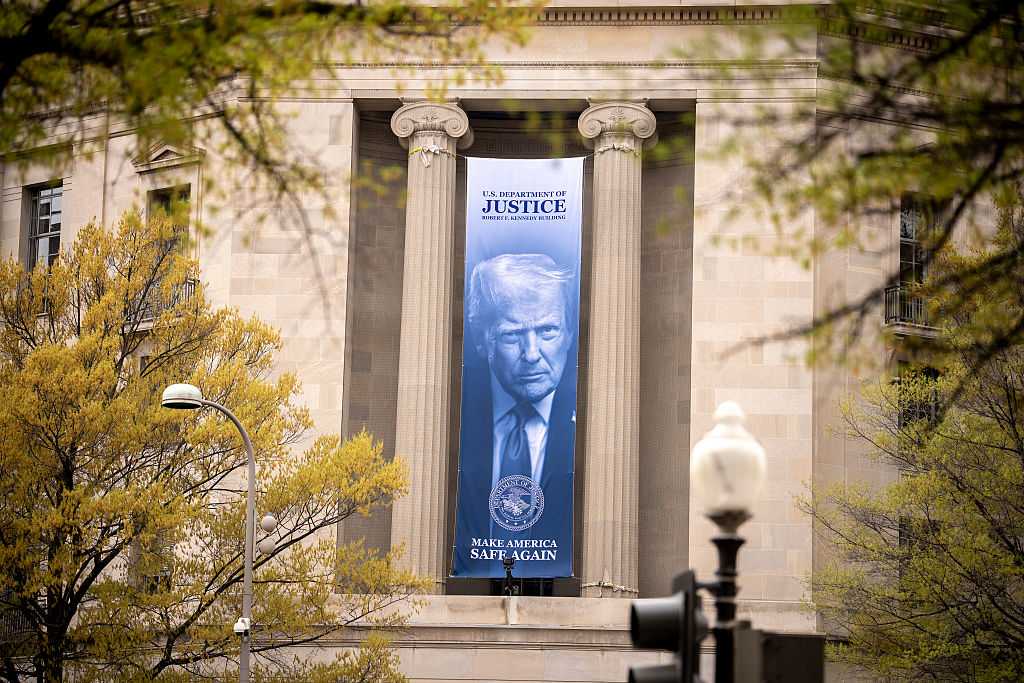
It’s been a busy year-plus for the Justice Department under President Donald Trump, but the past month has seen an especially sizeable wave of headlines.
The department, which falls under the executive department, has made quick and aggressive work of implementing the president’s political priorities via the law. Political opponents, including James Comey, have also faced investigations and prosecutions, and Trump has asserted more control over the executive department’s independent agencies.
Advertisement
Previous video coverage above: Pam Bondi out as attorney general
Historically, the Justice Department has been viewed as relatively independent from political pressure, according to the nonpartisan Center for American Progress. The department lists “independence and impartiality” first on its list of values.
Though lawyers are appointed by presidents and attorneys general have resigned or been pushed out in history, the bulk of the department’s employees enjoyed stability. That and established civil-service protections decrease the appearance of loyalty to specific politicians or parties.
After Trump took office for a second term, those norms changed. The Justice Connection, a network of alums of the department, estimates that more than 230 lawyers, agents and other employees from across the department were fired last year, “apparently because of their work on cases they were assigned or past criticism of Trump, or seemingly no reason,” the AP reported. More than 6,400 employees are estimated to have left a department that at the end of 2025 had roughly 108,000, the group says.
Here are the biggest stories from the past month, starting with the firing of Pam Bondi.
April 2: Attorney General Pam Bondi ousted by administration
President Donald Trump announces that Attorney General Pam Bondi is leaving the administration. He says then-Deputy Attorney General Todd Blanche, previously Trump’s personal attorney, will take over as acting attorney general.
It’s unclear how long Blanche will remain in office. There are several possible paths forward, including Trump nominating someone else as a permanent attorney general or using various methods to keep Blanche in the role.
April 14: DOJ moves to toss seditious conspiracy convictions of Proud Boys, Oath Keepers
The Justice Department asks a federal appeals court to throw out the seditious conspiracy convictions of Proud Boys and Oath Keepers leaders who were sentenced to prison terms for leading members of the far-right extremist groups in the Jan. 6, 2021, attack on the U.S. Capitol.
Trump commuted those leaders’ prison sentences, along with the 1,500-plus people charged in the attack, last January. This move would erase the leaders’ convictions.
April 21: SPLC indicted on federal fraud charges related to use of paid informants
Acting Attorney General Blanche announces the Southern Poverty Law Center, an Alabama-based nonprofit legal advocacy organization, has been indicted on federal charges of fraud and money laundering.
DOJ prosecutors say the group misled donors by using their money to pay informants who served undercover as leaders in the hate groups that the organization was founded to fight.
The SPLC told a federal court on April 28 that law enforcement agencies knew that the nonprofit paid informants, saying, “The Department of Justice also knows that these confidential informants helped law enforcement put violent extremists in jail.”
“The SPLC is manufacturing racism to justify its existence,” Blanche said.
April 23: Acting attorney general signs executive order reclassifying state-licensed marijuana
Blanche signs an executive order from Trump reclassifying state-licensed medical marijuana as a less dangerous drug. The move drops marijuana from Schedule I, a class for drugs with high potential for abuse and no medical use that includes drugs like heroin and LSD, to Schedule III, which includes ketamine and anabolic steroids.
The order doesn’t legalize recreational or medical marijuana on a federal level, but it makes it less strictly regulated. Criminal penalties could still apply for possessing, using or selling it, especially in states where it’s still illegal.
April 24: Justice Department drops criminal probe of Fed chair
The Justice Department officially ends a probe it began months before into Federal Reserve Chair Jerome Powell and the Fed’s $2.5 billion building renovation.
A DOJ prosecutor handling the case conceded at a closed-door court hearing in March that the government hadn’t found any evidence of a crime, and a judge subsequently quashed subpoenas issued to the Federal Reserve.
In announcing that her office was dropping the case, U.S. Attorney for the District of Columbia Jeannine Pirro said the Fed’s inspector general would probe the renovations instead.
April 24: Justice Department to allow death penalty by firing squad in move to increase executions
Justice Department officials announce that death by firing squad will now be an accepted execution method. They also said it would reauthorize the use of single-drug pentobarbital injections to carry out executions. The Biden administration had removed it from the federal protocol over concerns of unnecessary pain and suffering.
Five states already allowed firing squad executions, but the practice was not previously in the federal government’s protocols.
The pentobarbital protocol was adopted by Bill Barr, attorney general during Trump’s first term, to replace a three-drug mix used in the 2000s, the last time federal executions were carried out before Trump was in office. The Trump administration carried out 13 federal executions in Trump’s first term, more than under any president in modern history.
April 26: DOJ pushes for White House ballroom construction after attempted assassination at correspondents’ dinner
After a man charged through the lobby at the White House Correspondents’ Association Dinner attended by Donald Trump on April 25, the Justice Department pressures preservationists to drop their lawsuit over his plan to build a ballroom on the site where the White House’s East Wing used to be.
The ballroom would cost $400 million. Trump’s press secretary said in October that the project would be privately funded, but three Republican senators announced legislation after the dinner that would pay for the construction of a ballroom, including a “Secret Service annex” and security infrastructure underneath the ballroom.
“It’s time to build the ballroom,” acting Attorney General Todd Blanche said Sunday on X, posting a letter in which Assistant Attorney General Brett Shumate gave the National Trust for Historic Preservation, which sued to block construction, until 9 a.m. Monday to dismiss its lawsuit.
The White House ballroom, Shumate wrote, “will ensure the safety and security of the President for decades to come and prevent future assassination attempts on the President at the Washington Hilton.”
April 29: DOJ indicts former FBI Director James Comey for a second time
James Comey, who was the FBI director from 2013 to 2017, is indicted by the Justice Department for the second time.
The two-count indictment charges Comey with “knowingly and willfully” making a threat to “take the life of, and to inflict bodily harm upon” Trump and with transmitting a threat in interstate commerce. It refers to a photo Comey posted a year ago of seashells on a beach that appear to read “86 47.” “86” is slang meaning “to throw out,” “to get rid of” or “to refuse service to,” according to Merriam-Webster, and Trump is currently the 47th president.
Comey was first indicted in September on charges that he lied to and obstructed Congress related to testimony he gave in 2020 about whether he had authorized inside information about an investigation to be provided to a journalist. The case was dismissed when a judge found that the prosecutor who brought those charges had been appointed illegally.
Trump fired Comey while he was overseeing an FBI investigation into potential ties between Russia and Trump’s presidential campaign. The inquiry was later taken over by special counsel Robert Mueller and found that while Russia interfered in the 2016 election and the Trump campaign “expected it would benefit electorally” from its actions, there wasn’t enough evidence to prove a criminal collaboration.
Because the second indictment came months after the previous one was dismissed, the government could be challenged with claims of vindictive prosecution targeting Comey for his role in the Russia interference probe.
The Associated Press contributed reporting for this story.