
Read the full article on KETV 7
Ever since the 2024 election, Democrats have been searching for answers as to what went so wrong to possibly have reinstalled Donald Trump as president.And for much of that time, there’s been anticipation about an “autopsy” from the Democratic National Committee that drilled down on that precise question.Related video above: Jan. 6 rioters and election deniers celebrate Trump’s $1.8 billion compensation fundExcept that the autopsy never actually arrived. And eventually, DNC Chairman Ken Martin said he wouldn’t release it.But now Martin is reversing course and releasing an incomplete version of the document, after an outcry from some in the party.Martin told CNN that the report wasn’t close to being ready for public consumption, and that its lack of source material meant that recreating it would mean starting over. He said he didn’t want to release something like that or create a distraction, but he has now concluded he created a distraction by not releasing it.”For full transparency, I am releasing the report as we received it, in its entirety, unedited and unabridged,” Martin said. “It does not meet my standards, and it won’t meet your standards, but I am doing this because people need to be able to trust the Democratic Party and trust our word.”Indeed, the document contains factual inaccuracies and is sometimes hard to follow, and there isn’t a coherent strategy laid out for the future so much as a series of disparate points of analysis.A disclaimer atop the document notes that the report reflects the views of the author, Democratic consultant Paul Rivera, and not the DNC. Rivera, who people familiar with the matter say wrote the report as a part-time volunteer, declined to comment.Here’s what the document shows.It paints a pretty dismal picture for DemocratsEarly in the report, it acknowledges that recent elections, including 2024, have been pretty close. And it acknowledges this might lead some Democrats to argue for changes around the edges rather than a wholesale re-thinking of the party’s approach.But it rejects that more sanguine approach.”This kind of thinking — denialist at its core — prevents the Party from seeking real accountability, and from making the changes we need to deliver on our promises to the American people,” the report says.It says that since Barack Obama’s big 2008 win, the party has “vacillated between stagnation and retrogression.” And it notes that, on the whole, Democrats have steadily lost ground since Obama’s success.”These losses are the direct result of missed opportunities to invest in our states, counties, and local parties and candidates,” the report says.It says Democratic “candidates have proven incapable of projecting strength, unity, and leadership, and voters have drifted away.”It even waves away any optimism coming from strong results in the 2025 elections, arguing that “some of these elections were tighter than Democrats should be comfortable with.”And it says that when Democrats have won big races in recent years, the wins can often “be attributed to negative partisanship — where Republicans have nominated deeply flawed candidates.”It casts the Biden operation as having neglected HarrisFormer Vice President Kamala Harris had to run a highly unusual campaign, in that she was thrust to the top of the ticket with just three and a half months to go before the election.The autopsy says former President Joe Biden’s campaign and White House failed to set her up for success.For instance, it says that ahead of the 2022 midterm elections, the White House asked the DNC to poll how first lady Jill Biden could best help her husband politically. But it did no such research about Harris.It said failing to conduct that research, even while Harris, as vice president, was taking on difficult issues like immigration, “was a massive missed opportunity.” “As a result, at the moment of the candidate switch, the polling team discovered there was no self-research on the Vice President to guide the development of the research instruments,” the autopsy says.But that wasn’t the only criticism of the Biden operation.It also faulted the Biden White House for not more aggressively working to “contradict or correct” the right-wing labeling of Harris as Biden’s “border czar.” (Her task instead dealt with the root causes of migration from Central American countries.)And the report suggests it failed to sufficiently drive messages about her.”The national campaign did not effectively drive Trump’s negatives, and the White House did not effectively support Vice President Harris over three and a half years to improve her standing before the candidate switch,” the autopsy says.It points to a broader failure to define TrumpBut when it came to defining Trump, there’s apparently blame to go around.The autopsy says there was a broader failure to remind Americans why they disliked Trump in his first term.”The idea Trump’s negatives were ‘baked in’ is a major failure of analysis and reality,” it says, “given how his favorability has cratered less than a year into this term.”The report says Democrats didn’t match the “negative firepower” with which Trump managed to go after Harris, concluding that “it was essential to prosecute a more effective case as to why Trump should have been disqualified from ever again taking office.””The grounds were there, but the messaging did not make the case,” the report says.It says Harris and her campaign took too much for grantedWhen it comes to more specific criticisms of the Harris campaign, there’s also plenty there.Much of the report seems to point to assuming things and taking things for granted.To wit:”Harris’s focus on college-educated suburbs left gaps at unwinnable levels.””Harris lagged in rural areas nationally, which proved to be insurmountable in swing states. … Harris wrote off rural America, assuming urban/suburban margins would compensate.””The Harris campaign appears to have relied on Trump being unacceptable rather than building an affirmative case for Harris.”And perhaps most significantly, it said she couldn’t adequately define either herself or Trump.”Harris struggled with definition beyond ‘not Trump’ and ‘prosecutor vs. felon,'” the report says. “The truncated campaign timeline didn’t help, but the campaign did not quickly resolve on how to tag Trump and define Harris.”It cast Trump’s transgender ad as very damaging to HarrisPerhaps no ad is more closely associated with the 2024 campaign than the Trump campaign’s anti-transgender spot, with the tagline of “Kamala is for they/them, President Trump is for you.”And the autopsy casts the ad — and Harris’ comments, which it was based on — as an irreconcilable problem.It said the campaign’s pollsters “all recognized the attack as very effective.””If the Vice President would not change her position — and she did not — then there was nothing which would have worked as a response,” the autopsy says.The report then adds: “The pollsters generally concurred with the opinions shared by campaign leadership — given the stakes and timing, the focus needed to be on attacking Trump.”But it says Harris at least helped other Democrats more than BidenBiden has claimed he still thinks he could have won the 2024 election.But in a rare judgment about the decision to switch candidates, the autopsy suggests replacing him with Harris at least helped other Democrats win. “Having Kamala Harris on the ballot actually helped down-ballot Democrats maintain part of their base support,” it says. “Had Biden remained on the ballot, down-ballot Democrats might have faced even steeper challenges.”It suggests a shift away from identity politics and towards middle-class appealOne phrase repeatedly gets mentioned derisively, and that’s “identity politics.”It’s repeatedly cast as a crutch that Democrats need to move away from, in favor of kitchen-table issues like affordability and middle-class appeal.The report says Stein’s huge win showed how to “focus less on abstract issues and identity politics, and connect with voters on the issues they say matter most, including the economy, disaster relief, and addressing housing affordability.”It says Sen. Jacky Rosen, of Nevada, and now-Sen. Ruben Gallego, of Arizona, showed how “year-round presence, economic messaging, and addressing cost-of-living concerns resonate more than identity politics.”It tells Democrats who want to win male voters to deploy male messengers and “don’t assume identity politics will hold male voters of color.”And it casts Stein, Gallego and Sen. Elissa Slotkin, of Michigan, all as candidates who were able to speak effectively to middle-class voters, rural voters, and/or Latino voters in ways other Democrats could not. It also greatly credits Rosen’s tireless political operation and her ties to Nevada’s all-important service industry.The message seems to be: Find candidates who match their states or districts and have actual appeal to middle-class voters in their areas.It casts Republicans as just better at politicsIn addition to being sour on how Democrats are doing politically, it casts Republicans as just, well, better at this.It paints the GOP as more successfully flooding the zone with its messaging and Democrats as too feeble and limited to fight back as hard.”At times, it seems Democrats are trying to win arguments while Republicans are focused on winning elections,” the report says. “Democrats operate in an ecosystem defined by reason even in cycles when the electorate is defined by rage.”It repeatedly faults Democrats for not being “always on” and messaging harder.”The difference is right-wing interests take a longer-term approach and amplify polarizing messaging and candidates within the Democratic family with the intention of ‘othering’ all Democrats,” the report says. “Without aggressive pushback and tactics, it works.”And finally, it paints Republicans as better at learning the lessons of past campaigns — including one Democrats won.”The GOP’s victory in 2024 largely came down to its ability to learn more from President Obama’s victory than Democrats did,” the report concludes. “The GOP’s campaign was powered by data, amplified by social media, and enabled by ardent supporters at every level.”But there are few hard-and-fast solutionsIf anyone is reading this report looking for any silver bullets for Democrats — or even just hard recommendations — they’re likely to come away disappointed.The report is mostly summarizing what happened. It contains many judgments about why Democrats lost. But when it comes to solutions for making things better, it generally just suggests the party needs to rethink things and do certain things better — without necessarily detailing how.Near the end of the 192-page report comes an instructive paragraph.”Building to win requires new thinking, and building to last requires thinking about more than the next election,” the report says. “It requires finding the best way to connect with the right voters in the right places, and if 2024 has proven anything, there is enough money to do it all the right way.”It contains many errorsTo Martin’s point about this document not being ready for primetime, it contains lots of errors and curious inclusions – even some that are puzzling to have in a draft.For instance, it lists two separate vote percentages for North Carolina GOP gubernatorial candidate Mark Robinson – 45% and 42.7% – neither of which was his actual share (40.1%).It at one point lifts up Washington Gov. Bob Ferguson as an example of a candidate who did the right things, before later noting that he actually underperformed Harris.It misspells the names of politicians like Republican former Kentucky Gov. Matt Bevin (“Brevin”) and Democratic former New Jersey Gov. Jon (“John”) Corzine.Errors can happen, but it suggests the report to this point didn’t involve a super high level of care, which might impact how seriously people take its conclusions.It says Democrats need to spend earlierOne pretty clear recommendation, though, is that Democrats need to spend their resources on a more constant basis and earlier in the cycle.The autopsy noted that Democrats have managed to outraise Republicans pretty consistently in the highest-profile races, and that they shouldn’t be saving that money until the end of the campaign.The report asked when Democratic candidates would “invest earlier in the campaign cycle, and between elections.”It connects this to a theme of the report, which is that Democrats need to be “always on” – always preparing for the next campaign and messaging and building the things they need to win.”We have enough money to think and act differently,” the report says. “Democrats must break with stale and counterproductive practices to Build to Win and Build to Last.”What wasn’t includedThe report is silent on some of the biggest and potentially juiciest aspects of the 2024 campaign.That includes any judgment about Biden’s decision to run again, the impact of the war in Gaza (which split Democrats), and the fact that Harris was allowed to take over the ticket without anything amounting to an electoral process for choosing a replacement.It also doesn’t weigh in on Harris’ failure to do an interview with podcast host Joe Rogan, which many analysts have regarded as a major mistake.It says Democrats failed to act on another postmortem after the 2022 electionAutopsies like this can be valuable in figuring out what happened.But like the Republican Party’s 2012 autopsy, they can also be disregarded. That autopsy instructed the party to moderate on immigration in order to win Latino voters; Trump took very much the opposite approach in 2016 and won anyway.And this new Democratic autopsy actually notes that Democrats conducted a review after the 2022 midterms but failed to follow through on it.It says key DNC staff sought to isolate areas for improvement and wrote a report with seven findings and five recommendations.”Unfortunately, none of these recommendations were implemented on the proposed timeline, if at all,” the report says.
Ever since the 2024 election, Democrats have been searching for answers as to what went so wrong to possibly have reinstalled Donald Trump as president.
And for much of that time, there’s been anticipation about an “autopsy” from the Democratic National Committee that drilled down on that precise question.
Advertisement
Related video above: Jan. 6 rioters and election deniers celebrate Trump’s $1.8 billion compensation fund
Except that the autopsy never actually arrived. And eventually, DNC Chairman Ken Martin said he wouldn’t release it.
But now Martin is reversing course and releasing an incomplete version of the document, after an outcry from some in the party.
Martin told CNN that the report wasn’t close to being ready for public consumption, and that its lack of source material meant that recreating it would mean starting over. He said he didn’t want to release something like that or create a distraction, but he has now concluded he created a distraction by not releasing it.
“For full transparency, I am releasing the report as we received it, in its entirety, unedited and unabridged,” Martin said. “It does not meet my standards, and it won’t meet your standards, but I am doing this because people need to be able to trust the Democratic Party and trust our word.”

Indeed, the document contains factual inaccuracies and is sometimes hard to follow, and there isn’t a coherent strategy laid out for the future so much as a series of disparate points of analysis.
A disclaimer atop the document notes that the report reflects the views of the author, Democratic consultant Paul Rivera, and not the DNC. Rivera, who people familiar with the matter say wrote the report as a part-time volunteer, declined to comment.
Here’s what the document shows.
It paints a pretty dismal picture for Democrats
Early in the report, it acknowledges that recent elections, including 2024, have been pretty close. And it acknowledges this might lead some Democrats to argue for changes around the edges rather than a wholesale re-thinking of the party’s approach.
But it rejects that more sanguine approach.
“This kind of thinking — denialist at its core — prevents the Party from seeking real accountability, and from making the changes we need to deliver on our promises to the American people,” the report says.
It says that since Barack Obama’s big 2008 win, the party has “vacillated between stagnation and retrogression.” And it notes that, on the whole, Democrats have steadily lost ground since Obama’s success.
“These losses are the direct result of missed opportunities to invest in our states, counties, and local parties and candidates,” the report says.
It says Democratic “candidates have proven incapable of projecting strength, unity, and leadership, and voters have drifted away.”
It even waves away any optimism coming from strong results in the 2025 elections, arguing that “some of these elections were tighter than Democrats should be comfortable with.”
And it says that when Democrats have won big races in recent years, the wins can often “be attributed to negative partisanship — where Republicans have nominated deeply flawed candidates.”
It casts the Biden operation as having neglected Harris
Former Vice President Kamala Harris had to run a highly unusual campaign, in that she was thrust to the top of the ticket with just three and a half months to go before the election.
The autopsy says former President Joe Biden’s campaign and White House failed to set her up for success.
For instance, it says that ahead of the 2022 midterm elections, the White House asked the DNC to poll how first lady Jill Biden could best help her husband politically. But it did no such research about Harris.
It said failing to conduct that research, even while Harris, as vice president, was taking on difficult issues like immigration, “was a massive missed opportunity.”
“As a result, at the moment of the candidate switch, the polling team discovered there was no self-research on the Vice President to guide the development of the research instruments,” the autopsy says.
But that wasn’t the only criticism of the Biden operation.
It also faulted the Biden White House for not more aggressively working to “contradict or correct” the right-wing labeling of Harris as Biden’s “border czar.” (Her task instead dealt with the root causes of migration from Central American countries.)
And the report suggests it failed to sufficiently drive messages about her.
“The national campaign did not effectively drive Trump’s negatives, and the White House did not effectively support Vice President Harris over three and a half years to improve her standing before the candidate switch,” the autopsy says.
It points to a broader failure to define Trump
But when it came to defining Trump, there’s apparently blame to go around.
The autopsy says there was a broader failure to remind Americans why they disliked Trump in his first term.
“The idea Trump’s negatives were ‘baked in’ is a major failure of analysis and reality,” it says, “given how his favorability has cratered less than a year into this term.”
The report says Democrats didn’t match the “negative firepower” with which Trump managed to go after Harris, concluding that “it was essential to prosecute a more effective case as to why Trump should have been disqualified from ever again taking office.”
“The grounds were there, but the messaging did not make the case,” the report says.
It says Harris and her campaign took too much for granted
When it comes to more specific criticisms of the Harris campaign, there’s also plenty there.
Much of the report seems to point to assuming things and taking things for granted.
To wit:
- “Harris’s focus on college-educated suburbs left gaps [with Democratic North Carolina gubernatorial candidate Josh Stein] at unwinnable levels.”
- “Harris lagged in rural areas nationally, which proved to be insurmountable in swing states. … Harris wrote off rural America, assuming urban/suburban margins would compensate.”
- “The Harris campaign appears to have relied on Trump being unacceptable rather than building an affirmative case for Harris.”
And perhaps most significantly, it said she couldn’t adequately define either herself or Trump.
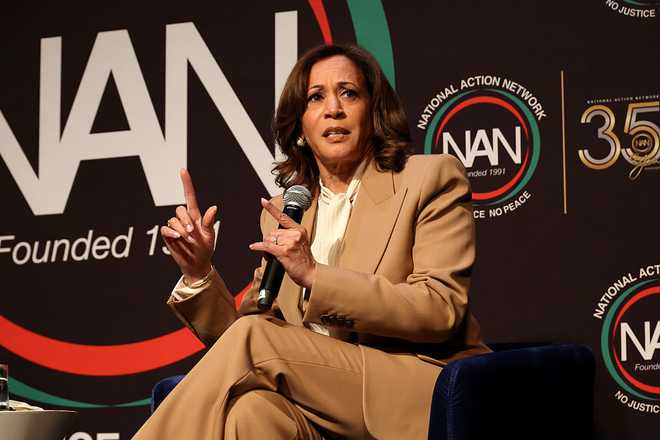
“Harris struggled with definition beyond ‘not Trump’ and ‘prosecutor vs. felon,'” the report says. “The truncated campaign timeline didn’t help, but the campaign did not quickly resolve on how to tag Trump and define Harris.”
It cast Trump’s transgender ad as very damaging to Harris
Perhaps no ad is more closely associated with the 2024 campaign than the Trump campaign’s anti-transgender spot, with the tagline of “Kamala is for they/them, President Trump is for you.”
And the autopsy casts the ad — and Harris’ comments, which it was based on — as an irreconcilable problem.
It said the campaign’s pollsters “all recognized the attack as very effective.”
“If the Vice President would not change her position — and she did not — then there was nothing which would have worked as a response,” the autopsy says.
The report then adds: “The pollsters generally concurred with the opinions shared by campaign leadership — given the stakes and timing, the focus needed to be on attacking Trump.”
But it says Harris at least helped other Democrats more than Biden
Biden has claimed he still thinks he could have won the 2024 election.
But in a rare judgment about the decision to switch candidates, the autopsy suggests replacing him with Harris at least helped other Democrats win.
“Having Kamala Harris on the ballot actually helped down-ballot Democrats maintain part of their base support,” it says. “Had Biden remained on the ballot, down-ballot Democrats might have faced even steeper challenges.”
It suggests a shift away from identity politics and towards middle-class appeal
One phrase repeatedly gets mentioned derisively, and that’s “identity politics.”
It’s repeatedly cast as a crutch that Democrats need to move away from, in favor of kitchen-table issues like affordability and middle-class appeal.
The report says Stein’s huge win showed how to “focus less on abstract issues and identity politics, and connect with voters on the issues they say matter most, including the economy, disaster relief, and addressing housing affordability.”
It says Sen. Jacky Rosen, of Nevada, and now-Sen. Ruben Gallego, of Arizona, showed how “year-round presence, economic messaging, and addressing cost-of-living concerns resonate more than identity politics.”
It tells Democrats who want to win male voters to deploy male messengers and “don’t assume identity politics will hold male voters of color.”
And it casts Stein, Gallego and Sen. Elissa Slotkin, of Michigan, all as candidates who were able to speak effectively to middle-class voters, rural voters, and/or Latino voters in ways other Democrats could not. It also greatly credits Rosen’s tireless political operation and her ties to Nevada’s all-important service industry.
The message seems to be: Find candidates who match their states or districts and have actual appeal to middle-class voters in their areas.
It casts Republicans as just better at politics
In addition to being sour on how Democrats are doing politically, it casts Republicans as just, well, better at this.
It paints the GOP as more successfully flooding the zone with its messaging and Democrats as too feeble and limited to fight back as hard.
“At times, it seems Democrats are trying to win arguments while Republicans are focused on winning elections,” the report says. “Democrats operate in an ecosystem defined by reason even in cycles when the electorate is defined by rage.”
It repeatedly faults Democrats for not being “always on” and messaging harder.
“The difference is right-wing interests take a longer-term approach and amplify polarizing messaging and candidates within the Democratic family with the intention of ‘othering’ all Democrats,” the report says. “Without aggressive pushback and tactics, it works.”
And finally, it paints Republicans as better at learning the lessons of past campaigns — including one Democrats won.
“The GOP’s victory in 2024 largely came down to its ability to learn more from President Obama’s victory than Democrats did,” the report concludes. “The GOP’s campaign was powered by data, amplified by social media, and enabled by ardent supporters at every level.”
But there are few hard-and-fast solutions
If anyone is reading this report looking for any silver bullets for Democrats — or even just hard recommendations — they’re likely to come away disappointed.
The report is mostly summarizing what happened. It contains many judgments about why Democrats lost. But when it comes to solutions for making things better, it generally just suggests the party needs to rethink things and do certain things better — without necessarily detailing how.
Near the end of the 192-page report comes an instructive paragraph.
“Building to win requires new thinking, and building to last requires thinking about more than the next election,” the report says. “It requires finding the best way to connect with the right voters in the right places, and if 2024 has proven anything, there is enough money to do it all the right way.”
It contains many errors
To Martin’s point about this document not being ready for primetime, it contains lots of errors and curious inclusions – even some that are puzzling to have in a draft.
For instance, it lists two separate vote percentages for North Carolina GOP gubernatorial candidate Mark Robinson – 45% and 42.7% – neither of which was his actual share (40.1%).
It at one point lifts up Washington Gov. Bob Ferguson as an example of a candidate who did the right things, before later noting that he actually underperformed Harris.
It misspells the names of politicians like Republican former Kentucky Gov. Matt Bevin (“Brevin”) and Democratic former New Jersey Gov. Jon (“John”) Corzine.
Errors can happen, but it suggests the report to this point didn’t involve a super high level of care, which might impact how seriously people take its conclusions.
It says Democrats need to spend earlier
One pretty clear recommendation, though, is that Democrats need to spend their resources on a more constant basis and earlier in the cycle.
The autopsy noted that Democrats have managed to outraise Republicans pretty consistently in the highest-profile races, and that they shouldn’t be saving that money until the end of the campaign.
The report asked when Democratic candidates would “invest earlier in the campaign cycle, and between elections.”
It connects this to a theme of the report, which is that Democrats need to be “always on” – always preparing for the next campaign and messaging and building the things they need to win.
“We have enough money to think and act differently,” the report says. “Democrats must break with stale and counterproductive practices to Build to Win and Build to Last.”
What wasn’t included
The report is silent on some of the biggest and potentially juiciest aspects of the 2024 campaign.
That includes any judgment about Biden’s decision to run again, the impact of the war in Gaza (which split Democrats), and the fact that Harris was allowed to take over the ticket without anything amounting to an electoral process for choosing a replacement.
It also doesn’t weigh in on Harris’ failure to do an interview with podcast host Joe Rogan, which many analysts have regarded as a major mistake.
It says Democrats failed to act on another postmortem after the 2022 election
Autopsies like this can be valuable in figuring out what happened.
But like the Republican Party’s 2012 autopsy, they can also be disregarded. That autopsy instructed the party to moderate on immigration in order to win Latino voters; Trump took very much the opposite approach in 2016 and won anyway.
And this new Democratic autopsy actually notes that Democrats conducted a review after the 2022 midterms but failed to follow through on it.
It says key DNC staff sought to isolate areas for improvement and wrote a report with seven findings and five recommendations.
“Unfortunately, none of these recommendations were implemented on the proposed timeline, if at all,” the report says.