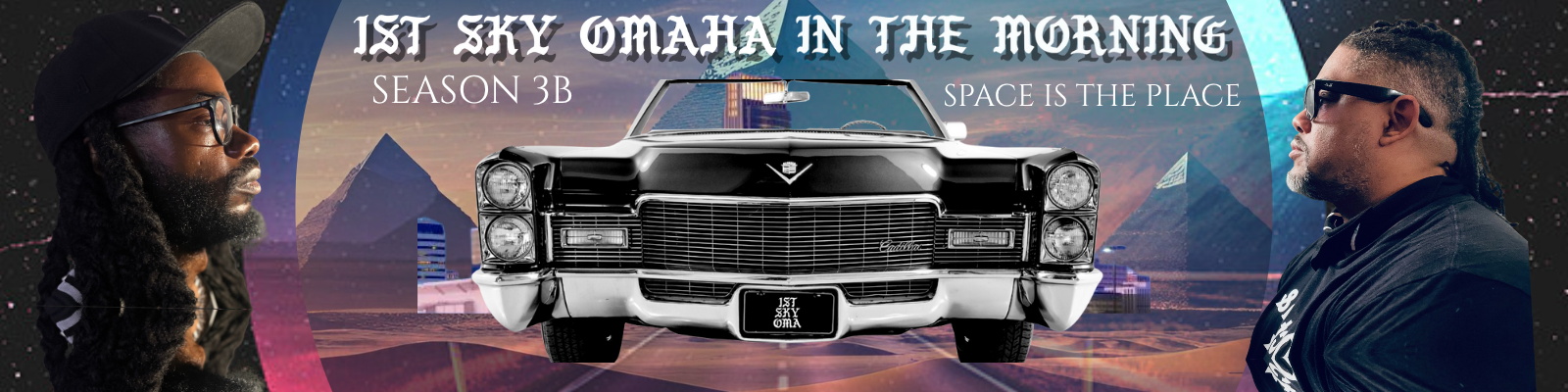
It was a Love Supreme Friday on 1st Sky Omaha in the Morning, and hosts Paul B. and Buddy the God were determined to keep the energy grounded and forward-looking — even as the conversation touched on the weight of Nebraska’s recent primary election results. “We have to make a decision,” Paul B. told viewers. “It’s going to be Love Supreme Friday today. And we’re going to change our mindsets over to something else — because it’s real easy to let your emotions take over when there’s so much to be emotional about.” It was the kind of gentle but firm redirect that regular viewers have come to expect from the show — an acknowledgment of hard realities, paired with a commitment to staying constructive.
Buddy the God didn’t shy away from the civic stakes, either. “None of this — a lot of this — doesn’t matter if everybody voted,” he said plainly. Viewer Kimber Snipes offered a nuanced counterpoint from the chat: “I’ve been having conversations with people between the ages of 20 and 35. What I hear the most is most of them don’t really know what to do and know nothing about the candidates. I don’t think we should be slamming people for not voting when the system is really what has caused this. I think we need to have more education and deep dive discussions.” It was exactly the kind of community dialogue the show is built for.
Paul B. took a moment to articulate what First Sky is really about beneath the surface. “Everything that we do has a secondary meaning, a deeper meaning,” he said. “On the surface we’re a couple of talking heads that talk about some news with the community — but what we’re really trying to do is build community, build some coalition.” Buddy echoed that long view when it came to civic life: “We got to do both — we have to build our own ecosystems and continue to do the things we’re about to talk about, but in the long run we do got to figure this out as far as a nation.”
That idea of building ecosystems from within found its fullest expression in the morning’s centerpiece interview with Dana Murray, executive director and founder of the North Omaha Music Academy — NMA for short — located on North 24th Street. A musician and educator with 20 years of teaching experience in Omaha and 11 years spent honing his craft in New York City, Murray arrived with a vision that is equal parts cultural reclamation and economic strategy.
Paul B. set the stage with characteristic directness: “I’ve always called it the most important Black corner in Nebraska. We got to serve it. We have to be of service to it.” Murray agreed, and then some. “Really, the area that has the most history and the one that can claim ‘we are a cultural and arts district’ for real is the North 24th Street corridor,” he said. “I’m more talking to the people that are there who are so far removed from what that was — it is hard to build momentum from within when a lot of the community within can’t relate to the power of what was.”
Murray spoke candidly about missed opportunities, including Native Omaha Days. While he expressed genuine affection for the tradition, he pointed to South Omaha’s Cinco de Mayo celebration as a more effective model. “I love Native Omaha Days at its core — anything that can bring us together,” he said. “But it’s a failed opportunity to showcase our culture because none of that is trying to invite the rest of Omaha down to partake in what we have to offer. All we have to do is look at South Omaha’s Cinco de Mayo and how they champion their culture — it is a festival that brings them together, but they invite everybody down to be part of that. I wish we did more of that.”
Viewer Pops added a piece of living history to the conversation: “Yes, Paul. Artists like Fats Domino used to stay at your grandfather’s home when he came to town to perform. So yes, more infrastructure for the artist around the Deuce corridor would be a godsend.” And viewer Mark Manor offered firsthand encouragement: “When I go there it is the same people at shows at Waiting Room, Slow Down, and the Jewels. So people are coming from all around town and getting down at NMA, which I find impressive as well.”
Murray’s vision for NMA reaches far beyond music lessons. He described the academy as a performance space, a community venue, and — in his long-range thinking — something akin to what Omaha Performing Arts is for downtown. “They bring in $40, $45, $50 million in revenue every year,” he said. “We’re not only raising musicians, but more importantly we’re raising more critical thinking human beings, because all these young kids are not going to become musicians by choice. Some will become doctors, some will become lawyers, some will become business owners — whatever they choose to do, they’re going to be better because they were aligned with artistry.”
That philosophy extends to how NMA teaches history. Rather than dropping names and moving on, Murray described an approach rooted in context. “They’re not going to retain it if you just tell them ‘Buddy Miles is from here and he used to play with Jimi Hendrix,'” he explained. “We’re teaching who Victor Lewis was, why he’s one of the most recorded jazz drummers in history. If you give kids context, they connect the dots for themselves — then they can see how they can be impactful within that ecosystem. Now you’ve got a critical thinking human.”
On the question of brain drain — a challenge for Omaha broadly, and North Omaha acutely — Murray was unflinching. “We’re far more adversely affected by brain drain. We’re not retaining any talent usually. So that’s not a winning proposition.” His answer is an NMA campus, backed by a $20 million first phase of a capital campaign. “Money is not our issue really in North Omaha,” he said. “It’s transformative ideas that are going to allow us to be not only sustainable but gainfully active.”
Murray closed with a thought that reframed the entire conversation. “Every music in America has been built off of our experience,” he said. “From the hardest rock music to the jazziest jazz music to the poppiest of pop music, you trace it all the way back to the music that was brought over here from Africa. And that’s equity. The sooner we look at it not as ‘oh, that’s a cool little music thing’ — no, this is equity for us to build and monetize for our community, the better we’re going to be.”
Music educators interested in joining the NMA team can reach Dana Murray at dmurray@northomahusic.org or assistant Andrew Bailey at abailey@northomahusic.org.
The show closed the way it always does — with community warmth intact. Viewer Aeros 402 shared a beautiful note from the chat: “On a love note, my only daughter gave birth to my second granddaughter. They are both new and good. I feel blessed.” It was a fitting reminder that beneath all the big conversations about culture, economics, and civic life, this show is ultimately about people — neighbors looking out for one another.
Tune in Monday morning and join the conversation. First Sky Omaha is waiting for you.