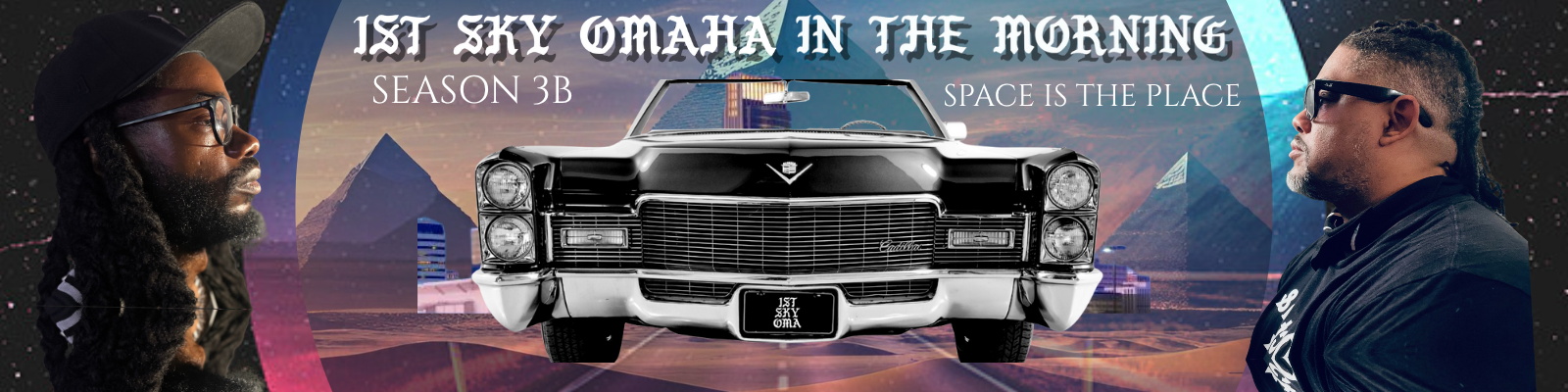
Friday mornings on 1st Sky Omaha in the Morning carry a particular kind of energy. Hosts Paul B. and Buddy the God call it “Love Supreme Friday,” and this week’s edition lived up to the name — weaving together post-primary election reflection, a bold vision for North Omaha’s future, and a conversation with one of the community’s most quietly transformative figures, Dana Murray, founder and director of the North Omaha Music Academy (NMA).
The show opened with the kind of civic honesty that has made it a staple for Omaha viewers. With Nebraska’s primary results fresh on everyone’s mind, Buddy the God didn’t mince words. “None of this — a lot of this doesn’t matter if everybody voted,” he said. “It’s the missing piece.” The sentiment landed hard, especially alongside a comment shared from viewer Raquel Henderson, who noted that only 339,000 of more than 1.2 million registered Nebraska voters had shown up. “Posting on Facebook is not enough,” Henderson wrote. “Awareness without action changes nothing.”
The conversation was nuanced, though. Viewer Kimber Snipes offered a ground-level perspective that tempered the frustration: “I’ve been having conversations with people between the ages of 20 and 35. What I hear the most is most of them don’t really know what to do and know nothing about the candidates. I don’t think we should be slamming people for not voting when the system is really what has caused this. I think we need to have more education and deep dive discussions.” It was exactly the kind of community dialogue the show seems built for.
But it was a concept Paul B. introduced early in the broadcast that set the intellectual tone for the entire hour — what he called the “secondary matrix.” The idea is simple but profound: everything meaningful has a deeper purpose operating beneath the surface. “Everything that we do has a secondary meaning, a deeper meaning,” Paul B. explained. “In Dana Murray’s case, he teaches kids music — but the secondary matrix is to create critical thinkers.” He applied the same lens to the show itself. “On the surface, we’re a couple of talking heads that talk about some news with the community. What we’re really trying to do is build community, build some coalition, be able to speak to a family of people that we can regularly talk to and come to some conclusions so we can get to some action.”
It was the perfect frame for Dana Murray’s arrival.
Murray is not a North Omaha native — he grew up in South Omaha — but he spent eleven years in New York City before coming back to plant something lasting on North 24th Street, the corridor Paul B. has long called “the most important black corner in Nebraska.” What Murray planted is NMA, formerly known as Love’s Jazz, a youth music academy and performance venue with ambitions that reach well beyond music lessons.
“NMA is obviously a youth music academy,” Murray said. “It is a performance space and a performance venue. If you think of Omaha Performing Arts and what it means to downtown — not only as a cultural and music entertainment entity that imports talent, but as an economic vehicle that brings in $40 to $50 million in revenue every year — that’s what we want to be for North Omaha.” The vision is staggering in its scope, and Murray grounds it in something even more important than economics. “We’re not only raising musicians but, more importantly, we’re raising more critical thinking human beings, because all these young kids are not going to become musicians by choice. Some will become doctors, some lawyers, some business owners. Whatever they choose to do, they’re going to be better because they were aligned with artistry.”
The programming at NMA extends well beyond instrument instruction. Students learn live sound engineering, broadcast production, podcasting, and interviewing — skills that put professional tools directly in young hands. “It’s not just telling them, ‘Oh, you can be this,'” Murray said. “No — you can be this right now.“
Murray spoke candidly about what it takes to build a sustainable cultural district on North 24th Street, calling for the full infrastructure any thriving neighborhood requires — housing, eateries, services, transportation, and destinations. He was equally candid about what has held the community back. “One of the things that holds us back is this false sense of security with pride as it pertains to North Omaha,” he said, pointing to events like Native Omaha Days as missed opportunities to invite the broader city in. He held up South Omaha’s Cinco de Mayo celebration as a model. “They invite everybody down. I wish we did more of that.” In his own work, Murray said he made it a point to be “a beacon for all of Omaha to come down to North 24th Street” — and the community responded. “People don’t have any problem coming from wherever they are in Omaha or Iowa to come hear jazz music or whatever we present.”
Perhaps the most compelling moment came when Murray tied culture directly to economics. “What we have to sell in most black communities is our culture. Because if we don’t monetize it — which 99% of the time we don’t — the rest of the country monetizes our culture for us. The sooner we understand that our culture is equity, that our artistic genius is equity, the better off we’re going to be.”
The chat was buzzing throughout. Viewer Pops drew a personal connection, recalling that jazz legends like Fats Domino once stayed at Paul B.’s grandfather’s home when performing in town. “More infrastructure for the artist around the Deuce corridor would be a godsend,” Pops wrote. And tucked into the stream of comments was a joyful note from viewer Aeros 402 (Mary Sanchez), who shared that her daughter had just given birth to her second granddaughter. “They are both new and good. I feel blessed.” On Love Supreme Friday, that felt right at home.
NMA is currently seeking music instructors who bring more than technical skill — Murray is looking for people who can inspire. Interested candidates can reach him at dmurray@northomahmusic.org or his assistant Andrew Bailey at abailey@northomahmusic.org.
Buddy the God closed the show the way he often does — with something simple and true. “All you have to do is find — get in where you fit in. The lanes are running. The lanes are wide open. Just get in where you fit in and make it happen.”
If Friday’s episode was any indication, there’s plenty of room in those lanes. Tune in Monday morning and pull up a seat at the table.