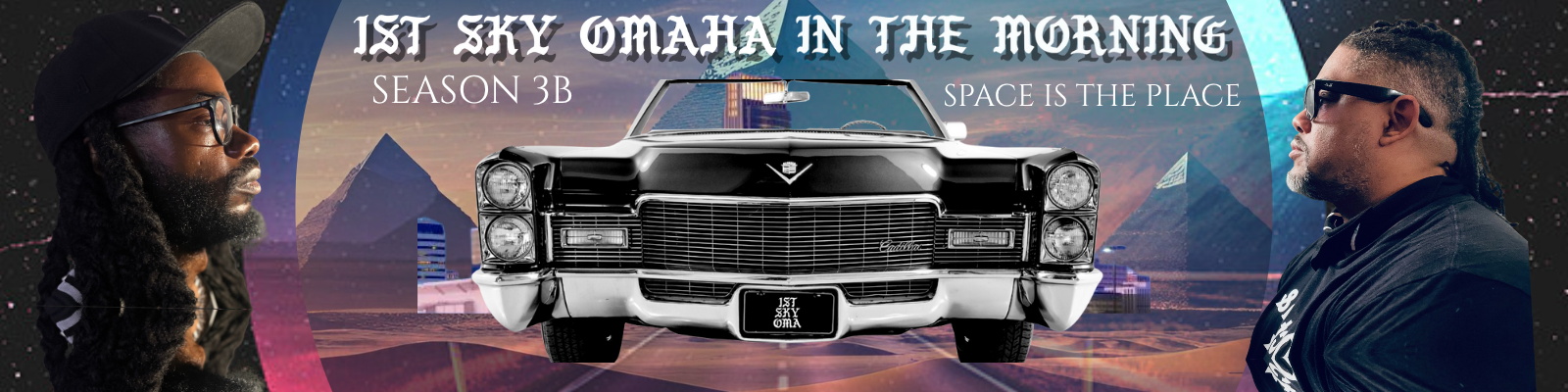
Friday morning came in warm on 1st Sky Omaha in the Morning, and hosts Paul B. and Buddy the God made sure it stayed that way. From the jump, Paul B. set the intention clearly: “We’ve been talking a lot of politics for a while and it’s time to make a decision — it’s going to be Love Supreme Friday today. We’re going to change our mindsets over to something else.” And with that, the show shifted into something that felt less like a broadcast and more like a front-porch conversation about the soul of a community.
The guest at the center of that conversation was Dana Murray, director of the North Omaha Music Academy — known to many longtime Omahans as Love’s Jazz — situated right on North 24th Street. A South Omaha native who spent eleven years making music in New York City before coming back home, Murray brings with him both the perspective of someone who left and the conviction of someone who chose to return.
Paul B. wasted no time in naming the stakes of the corridor itself. “I’ve always called it the most important Black corner in Nebraska,” he said. “We got to serve it. We have to be of service to it.” Murray agreed — and then some. He spoke candidly about the gap between what North 24th Street was and what its own community sometimes remembers it to be.
“Really, the area that has the most history and the one that can claim ‘we are a cultural and arts district’ for real is the North 24th Street corridor,” Murray said. “And we’ve been so far removed from that — not even what the rest of Omaha views North 24th Street as. It is hard to build momentum from within when a lot of the community can’t relate to the power of what was.”
That sense of unrealized potential ran through much of Murray’s conversation with the hosts. He pointed to Native Omaha Days as a beloved tradition that, in his view, stops short of its full promise. “I love Native Omaha Days at its core — anything that can bring us together,” he said. “But it’s a failed opportunity to showcase our culture because none of that is trying to invite the rest of Omaha down to partake in what we have to offer.” He held up South Omaha’s Cinco de Mayo as a model worth studying — a celebration rooted in cultural pride that extends a genuine invitation to the whole city.
Viewer Mark Manor chimed in from the chat with a note of encouragement: “When I go there it is the same people at shows at Waiting Room, Slow Down, and the Jewels. So people are coming from all around town and getting down at NMA, which I find impressive.” It was a small but telling detail — the kind of cross-community traffic that Murray is clearly working to cultivate and expand.
At its heart, Murray described NMA as far more than a music school. The academy is a performance space, a youth development engine, and — in his long vision — a potential economic anchor for the corridor in the tradition of what Omaha Performing Arts has done for downtown. “They bring in $40 to $50 million in revenue every year,” Murray noted. “We’re not only raising musicians but more importantly we’re raising more critical thinking human beings.” Paul B. called this the “secondary matrix” — the deeper purpose beneath the surface work. “In Dana Murray’s case, he teaches kids music on the surface,” Paul B. explained, “but the secondary matrix is to create critical thinkers.”
Murray was equally candid about the challenges of reaching young people in 2026. “We are in crisis with education — not just young Black kids, young kids in general — because we are losing the ability to inspire them,” he said. “Most of their learning comes from Google, ChatGPT, YouTube, Instagram. We can act like that’s going away, but it’s not.” His answer isn’t to resist that world but to meet students inside it — building curriculum that illuminates rather than lectures. Viewer Senator KML put it simply in the chat: “Thank you, Uncle Dana. You’re changing lives in big ways. We are the students.”
Murray also shared that NMA is actively seeking music instructors who bring more than technical knowledge to the classroom. Interested educators can reach him at dmurray@northomahahusic.org or his assistant Andrew Bailey at abailey@northomahahusic.org. “The why you’re doing it is everything,” Murray said, “because they don’t need us for the what — they can go to YouTube and see anything we’re trying to teach them.”
Looking ahead, Murray described an ambitious capital campaign — with a first phase targeting $20 million — aimed at building a full NMA campus. “Our culture is equity. Our artistic genius is equity,” he said. “The sooner we understand that, the better off we’re going to be.”
The chat brought its own warmth to the morning. Viewer Arrows 402 (Mary Sanchez) shared a personal joy mid-show: “On a love note, my only daughter gave birth to my second granddaughter. They are both new and good. I feel blessed.” It was exactly the kind of moment that makes Love Supreme Friday feel earned.
Buddy the God, as always, kept one eye on the bigger picture. “We got to do both — we have to build our own ecosystems and continue to do the things that we’re about to talk about,” he said. “In the long run, we do got to figure this out as a nation.” Building ecosystems within ecosystems — it’s a phrase that might just be the show’s quiet motto.
If this Friday’s episode reminded us of anything, it’s that the work of community isn’t just political or economic — it’s cultural, it’s musical, and it belongs to all of us. Join Paul B., Buddy the God, and the whole First Sky family again Monday morning, and bring a neighbor along for the conversation.