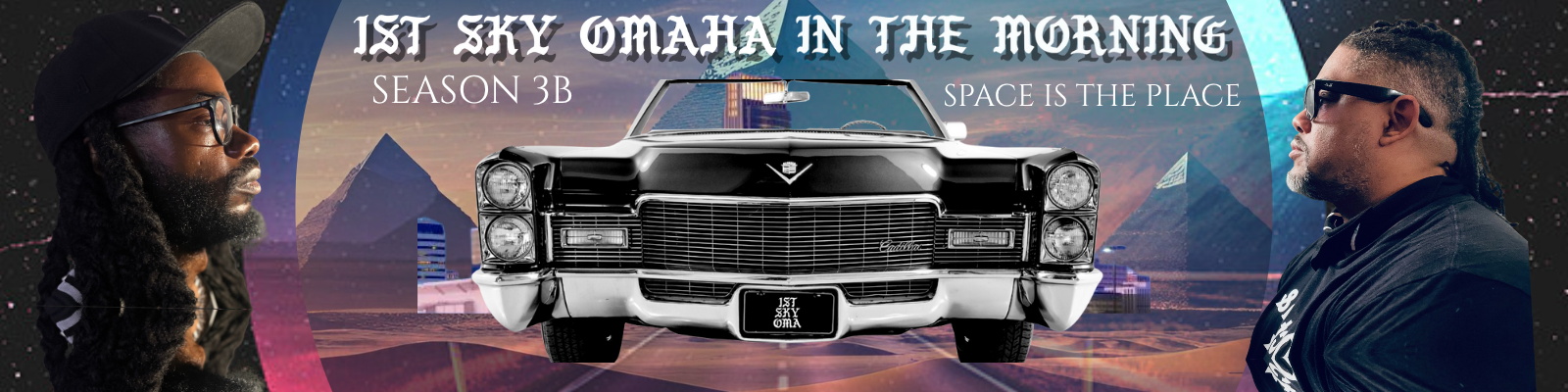
Friday morning came in warm and intentional on 1st Sky Omaha in the Morning, as hosts Paul B. and Buddy the God made a collective decision right out of the gate: whatever weight the week had carried, today was going to be different. “We have to make a decision,” Paul B. told listeners. “It’s going to be Love Supreme Friday today. And we’re going to change our mindsets over to something else.” And just like that, the tone was set.
The show opened with a brief but honest look at the aftermath of Nebraska’s midterm primary elections. Paul B. read aloud from a post by Raquel Henderson of the mayor’s office, using it as a launching pad for a broader point about civic responsibility: “Posting on Facebook is not enough. Awareness without action changes nothing.” Viewer Sean McCarthy added context from the chat, noting that Douglas County saw roughly 35 percent voter turnout in the primary — a number that quietly says everything. The conversation didn’t linger in frustration, though. Instead, it pivoted toward something the show does best: building people up.
Buddy the God grounded the discussion with a both/and philosophy that felt like a north star for the entire episode. “We got to do both,” he said. “We got to build our own ecosystems and continue to do the things that we’re about to talk about. But in the long run, we do got to figure this out as far as a nation.” Paul B. expanded on that with what he called the “secondary matrix” — the idea that everything the show does carries a deeper purpose beneath the surface. “On the surface we’re a couple of talking heads,” he said, “but what we’re really trying to do is build community, build some coalition, be able to speak to and build a family of people that we can regularly talk to and come to some conclusions and get to some action.”
That philosophy found its fullest expression in a rich, wide-ranging conversation with Dana Murray, founder and executive director of the North Omaha Music Academy (NMA), located on the corner of 24th and Lake Street — what Paul B. has long called “the most important Black corner in Nebraska.” Murray, a musician and educator who spent eleven years in New York City before returning home to Omaha, has built NMA into something that defies easy categorization. It is a youth music academy, a performance venue, and, as Murray makes clear, an economic vision.
“If you think of Omaha Performing Arts and what it means to downtown — not only as a cultural and music entertainment entity but as an economic vehicle bringing in $40 to $50 million in revenue every year — that’s what we want to be for North Omaha,” Murray said. His ambitions are backed by a planned capital campaign with a first phase of $20 million and a long-term goal of establishing a full NMA campus along the North 24th Street corridor.
But the conversation went well beyond bricks and budgets. Murray spoke candidly about the cultural moment North Omaha stands at — and the opportunities that have too often slipped by. “At every opportunity, we fail at taking advantage of showcasing our culture and highlighting the excellence of who we are,” he said, citing South Omaha’s Cinco de Mayo celebration as a model of inclusive community pride. “They champion their culture — it brings them together, but they invite everybody down.” Murray said NMA has tried to be that beacon, and the community has responded. Viewer Mark Manor backed him up from the chat: “When I go there it is the same people at shows at Waiting Room, Slow Down, and the Jewels. So people are coming from all around town and getting down at NMA.”
Perhaps the most powerful thread of the interview was Murray’s articulation of what Black culture represents as an economic asset — not just a source of pride, but of equity. “Every music in America has been built off of our experience — from the hardest rock to the jazziest jazz to the poppiest pop, you trace it all the way back to the music brought over from Africa,” he said. “The sooner we look at it not as ‘a cool little music thing’ but as equity to build and monetize for our community, the better we’re going to be.”
NMA’s youth programming reflects that same expansive thinking. Students don’t just learn to play instruments — they learn live sound engineering, broadcasting, live streaming, podcasting, and how to interview artists. “It’s not just teaching them ‘you can be this someday,'” Murray said. “No — you can be this right now.” Viewer Pops drew a vivid parallel from his own life in the chat: “I experienced my secondary matrix in junior high when I took algebra. I noticed I was suddenly able to think outside the box on several different levels. Music the same.”
Murray also put out a direct call to action: NMA is actively seeking music instructors. Interested educators can reach him at dmurray@northomahamusic.org or his assistant Andrew Bailey at abailey@northomahamusic.org. Murray was clear that technical skill alone isn’t enough. “Unless you’re able to inspire a young person, they don’t really have the attention span for it,” he said. “The instructors we bring in have to have in their arsenal the ability to inspire another human being.”
In between the big ideas and civic conversations, the chat reminded everyone that community is also built in small, sacred moments. Viewer Aeros 402 shared the best kind of news: “My only daughter gave birth to my second granddaughter. They are both new and good. I feel blessed.” The room — virtual as it was — paused to celebrate that.
By the time Love Supreme Friday wrapped up, it had delivered exactly what it promised: a morning that moved from reflection to inspiration, from local politics to local possibility, with North Omaha’s future sitting squarely at the center of it all.
Catch 1st Sky Omaha in the Morning with Paul B. and Buddy the God next week — your community is always on the air.