

Read the full article on KETV 7

The U.S. Department of Justice is investigating major meatpacking companies for anti-competitive practices as Americans are dealing with record-high beef prices, but experts say other factors are driving the sticker shock. Last fall, President Donald Trump accused some companies of driving up beef prices through what he described as illicit collusion, price fixing, and price manipulation. Acting Attorney General Todd Blanche said during a news conference on Monday that the DOJ has since prioritized investigating possible antitrust violations in cattle and beef markets. He said they’ve reviewed over three million documents and contacted hundreds of industry participants as part of the ongoing probe.The Justice Department is also looking into anti-competitive behavior in other areas, according to Blanch. He said, later this week, the DOJ will announce a “historic settlement” that “will directly affect the prices of proteins like chicken, pork and turkey.” “We will use every law enforcement tool available to help reduce food prices and vigorously enforce the antitrust laws to ensure every aspect of the agricultural industry competes on a fair playing field,” Blanche said. Secretary of Agriculture Brooke Rollins said four companies — JBS, Cargill, Tyson Foods, and National Beef — control roughly 85% of the cattle processing market. She said the level of concentration has surged from 25% in the 1970s. “As ranchers face fewer options for selling their animals, the big four grow stronger and stronger,” Rollins said. “These companies now have an unprecedented ability to wield market power and influence prices paid for cattle, definitely more so than if we had greater competition.”The Meat Institute, a trade group that represents JBS and other meat producers, didn’t immediately respond to our request for comment. Derrell Peel, an agricultural economist at Oklahoma State University, said there is no research backing up claims that big packers are abusing market power to manipulate prices. “The level of consolidation in the beef packing industry has not changed in about 30 years. It’s been at the current level with very minor variations over that time period,” Peel said. Peel said one problem driving price spikes is cattle inventory, which is currently at its lowest level in decades, in part due to recent drought conditions, coupled with high demand. “Strong consumer demand for beef is the leading economic force for why we have higher prices,” said Glynn Tonsor, who leads the Meat Demand Monitor at Kansas State University. The latest numbers from the Bureau of Labor Statistics, analyzed by our Get the Facts Data Team, show ground beef prices remain near record highs at $6.70 per pound on average, up about 16% compared to March 2025. Asked when shoppers could see some relief, Rollins said, “We are hopeful that those prices will start coming down this summer, this fall, but again, this is a massive, complicated policy challenge that we’re working to fight every single day and solve for.”Peel said, while there may be some seasonal variation, he doesn’t expect prices to come down anytime soon. “I expect them to go higher. I expect high prices to remain for the foreseeable future,” Peel said.
The U.S. Department of Justice is investigating major meatpacking companies for anti-competitive practices as Americans are dealing with record-high beef prices, but experts say other factors are driving the sticker shock.
Last fall, President Donald Trump accused some companies of driving up beef prices through what he described as illicit collusion, price fixing, and price manipulation.
Advertisement
Acting Attorney General Todd Blanche said during a news conference on Monday that the DOJ has since prioritized investigating possible antitrust violations in cattle and beef markets. He said they’ve reviewed over three million documents and contacted hundreds of industry participants as part of the ongoing probe.
The Justice Department is also looking into anti-competitive behavior in other areas, according to Blanch. He said, later this week, the DOJ will announce a “historic settlement” that “will directly affect the prices of proteins like chicken, pork and turkey.”
“We will use every law enforcement tool available to help reduce food prices and vigorously enforce the antitrust laws to ensure every aspect of the agricultural industry competes on a fair playing field,” Blanche said.
Secretary of Agriculture Brooke Rollins said four companies — JBS, Cargill, Tyson Foods, and National Beef — control roughly 85% of the cattle processing market. She said the level of concentration has surged from 25% in the 1970s.
“As ranchers face fewer options for selling their animals, the big four grow stronger and stronger,” Rollins said. “These companies now have an unprecedented ability to wield market power and influence prices paid for cattle, definitely more so than if we had greater competition.”
The Meat Institute, a trade group that represents JBS and other meat producers, didn’t immediately respond to our request for comment.
Derrell Peel, an agricultural economist at Oklahoma State University, said there is no research backing up claims that big packers are abusing market power to manipulate prices.
“The level of consolidation in the beef packing industry has not changed in about 30 years. It’s been at the current level with very minor variations over that time period,” Peel said.
Peel said one problem driving price spikes is cattle inventory, which is currently at its lowest level in decades, in part due to recent drought conditions, coupled with high demand.
“Strong consumer demand for beef is the leading economic force for why we have higher prices,” said Glynn Tonsor, who leads the Meat Demand Monitor at Kansas State University.
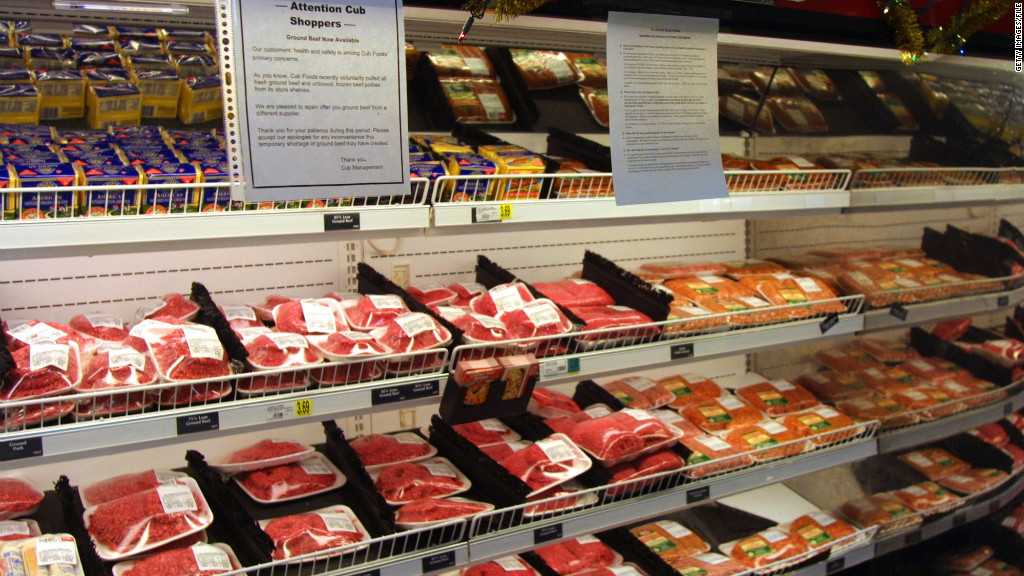
The latest numbers from the Bureau of Labor Statistics, analyzed by our Get the Facts Data Team, show ground beef prices remain near record highs at $6.70 per pound on average, up about 16% compared to March 2025.
Asked when shoppers could see some relief, Rollins said, “We are hopeful that those prices will start coming down this summer, this fall, but again, this is a massive, complicated policy challenge that we’re working to fight every single day and solve for.”
Peel said, while there may be some seasonal variation, he doesn’t expect prices to come down anytime soon.
“I expect them to go higher. I expect high prices to remain for the foreseeable future,” Peel said.