

Read the full article on KETV 7
Advertisement
May’s meteor shower peaks this week — Here’s how to watch it
No telescopes or special equipment required

Early birds are in for a celestial treat this week as the Eta Aquarid meteor shower reaches its peak.Related video above: Sonic boom caused by meteor caught on cameraThe shower will peak between Tuesday and Wednesday, with prime views before daybreak on Wednesday, according to the American Meteor Society.This spring meteor shower is usually active between April 19 and May 28, but peaks this week.It’s named for its radiant, or the point in the sky from which the meteors fall, the constellation Aquarius, and more specifically, the star Eta Aquarii. The Eta Aquarid meteors are made up of the debris and dust of Halley’s comet.No telescopes or special equipment are needed to see the Eta Aquarids. Just find a spot away from light pollution and allow some time for your eyes to adjust to the night sky. The easiest time for spotting will be after moonset and before sunrise, around 3-5 a.m. About 50 meteors can be seen per hour at peak, according to NASA.Below are some other celestial events to watch for this month.May 12-13 — Earthshine morningsOn the mornings of these two days, you should be able to see a phenomenon known as earthshine, which is sunlight that has bounced off the Earth’s oceans and back onto the moon, illuminating the moon’s darker surface. It is sometimes called the “Da Vinci Glow” on account of its discovery by Italian inventor and painter Leonardo da Vinci in the 16th century.May 16 — Super new moonThe May new moon is considered a supermoon because its elliptical orbit around Earth is at its perigee, or closest point in the orbit to our planet. When the moon is in supermoon mode, or perigee, it can appear as much as 14% larger and 30% brighter in the night sky, according to NASA. Unfortunately, we won’t be able to see the supermoon because of the new moon phase. However, no big, bright moon visible in the sky makes for ideal stargazing conditions.May 19-20 — Earthshine eveningsThe same phenomenon from mid-May, except this time it will be visible for two nights, instead of during the day. It’s also sometimes called “ashen glow.”The recent Artemis II moonshot mission captured a rare earthshine while in orbit in their capsule, Integrity.May 31 — Micro blue moonYou may have heard the expression “once in a blue moon,” but what about once in a micro blue moon? A blue moon is any second full moon that falls within a month or any third full moon of a season, due to the nature of our calendars. Most months have one full moon, so a second full moon is rare — and was traditionally considered an unlucky 13th moon. A micromoon is the opposite of a supermoon, meaning the moon is at its apogee, or furthest point from the Earth in its elliptical orbit. This makes a micro blue moon quite rare, only occurring once every few years.
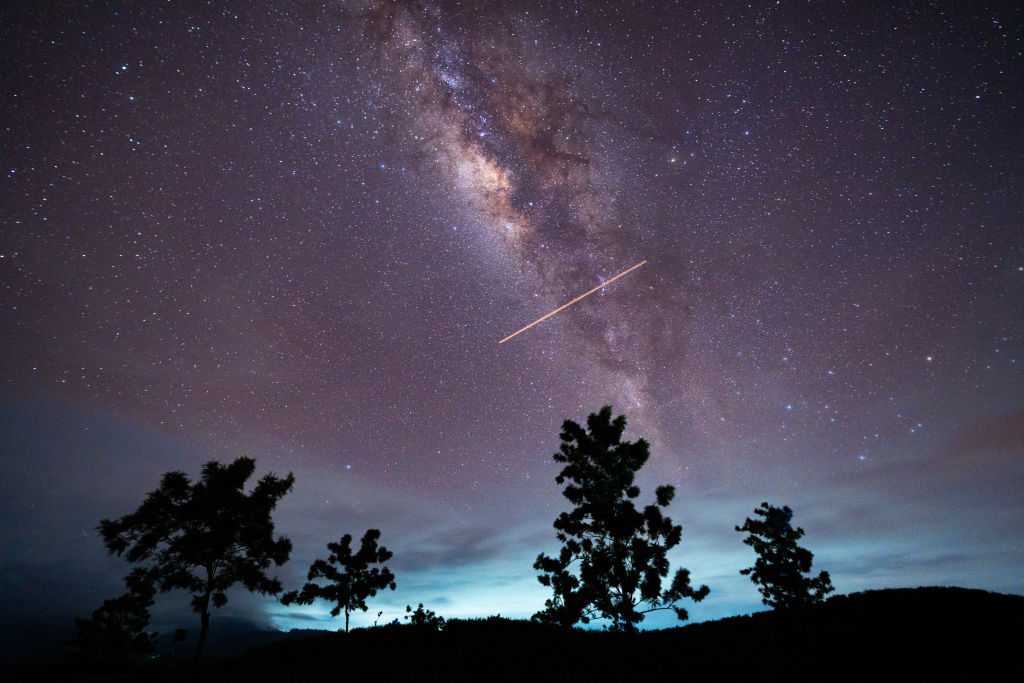
Early birds are in for a celestial treat this week as the Eta Aquarid meteor shower reaches its peak.
Related video above: Sonic boom caused by meteor caught on camera
Advertisement
The shower will peak between Tuesday and Wednesday, with prime views before daybreak on Wednesday, according to the American Meteor Society.
This spring meteor shower is usually active between April 19 and May 28, but peaks this week.
It’s named for its radiant, or the point in the sky from which the meteors fall, the constellation Aquarius, and more specifically, the star Eta Aquarii. The Eta Aquarid meteors are made up of the debris and dust of Halley’s comet.
No telescopes or special equipment are needed to see the Eta Aquarids.
Just find a spot away from light pollution and allow some time for your eyes to adjust to the night sky. The easiest time for spotting will be after moonset and before sunrise, around 3-5 a.m.
About 50 meteors can be seen per hour at peak, according to NASA.
Below are some other celestial events to watch for this month.
May 12-13 — Earthshine mornings
On the mornings of these two days, you should be able to see a phenomenon known as earthshine, which is sunlight that has bounced off the Earth’s oceans and back onto the moon, illuminating the moon’s darker surface. It is sometimes called the “Da Vinci Glow” on account of its discovery by Italian inventor and painter Leonardo da Vinci in the 16th century.
May 16 — Super new moon
The May new moon is considered a supermoon because its elliptical orbit around Earth is at its perigee, or closest point in the orbit to our planet. When the moon is in supermoon mode, or perigee, it can appear as much as 14% larger and 30% brighter in the night sky, according to NASA. Unfortunately, we won’t be able to see the supermoon because of the new moon phase. However, no big, bright moon visible in the sky makes for ideal stargazing conditions.
May 19-20 — Earthshine evenings
The same phenomenon from mid-May, except this time it will be visible for two nights, instead of during the day. It’s also sometimes called “ashen glow.”
The recent Artemis II moonshot mission captured a rare earthshine while in orbit in their capsule, Integrity.
May 31 — Micro blue moon
You may have heard the expression “once in a blue moon,” but what about once in a micro blue moon? A blue moon is any second full moon that falls within a month or any third full moon of a season, due to the nature of our calendars. Most months have one full moon, so a second full moon is rare — and was traditionally considered an unlucky 13th moon. A micromoon is the opposite of a supermoon, meaning the moon is at its apogee, or furthest point from the Earth in its elliptical orbit. This makes a micro blue moon quite rare, only occurring once every few years.