

Read the full article on KETV 7
NASA telescope captures ‘wandering’ black hole devour star
Copy Editor
A NASA telescope caught a black hole red-handed in the middle of devouring a nearby star on the outskirts of a galaxy 760 million light-years away.
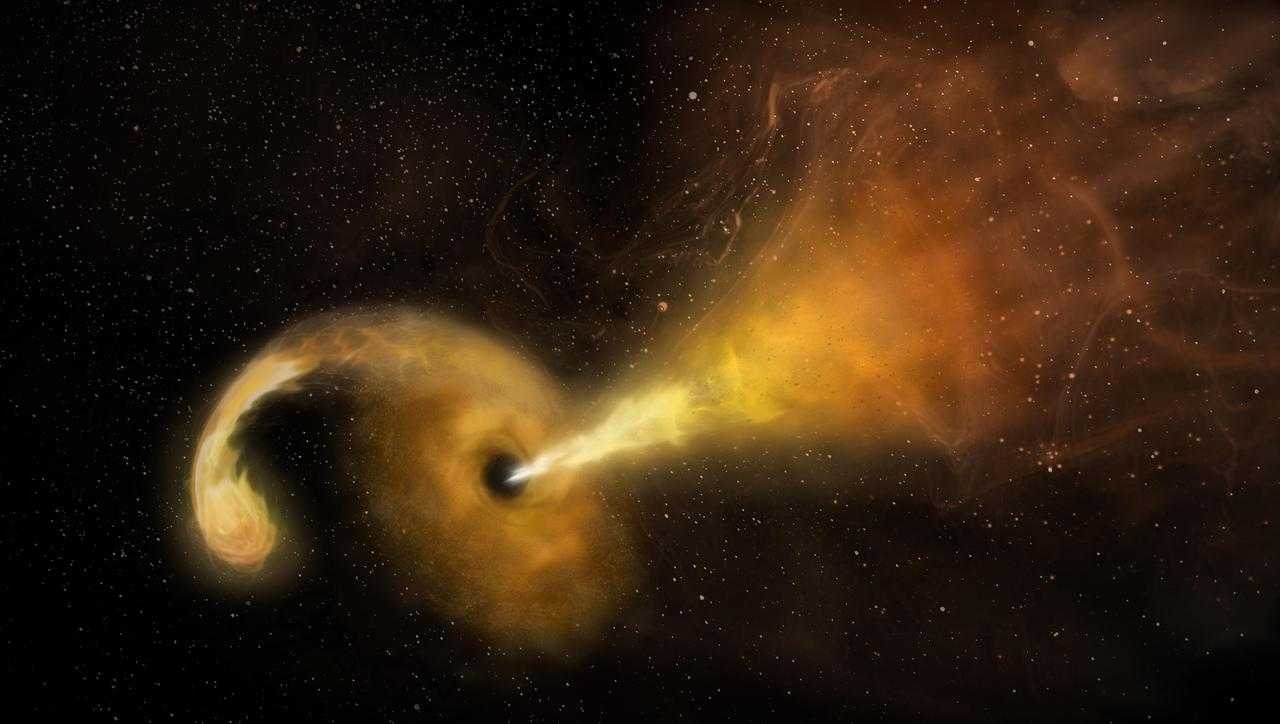
Video above: NASA illustration of a black hole devouring a star
Advertisement
The National Aeronautics and Space Administration’s Neil Gehrels Swift Observatory monitors outer space for powerful explosions and other cosmic events. In late 2025, researchers noticed a bright flare in the constellation Cetus.
After some study, that bright flare turned out to reveal a supermassive black hole, and the flare itself was caused by the black hole shredding a nearby star, known scientifically as a tidal disruption event. According to NASA, the black hole weighs in at about a million times the mass of our Sun.
The researchers published their findings on Monday in The Astrophysical Journal Letters.
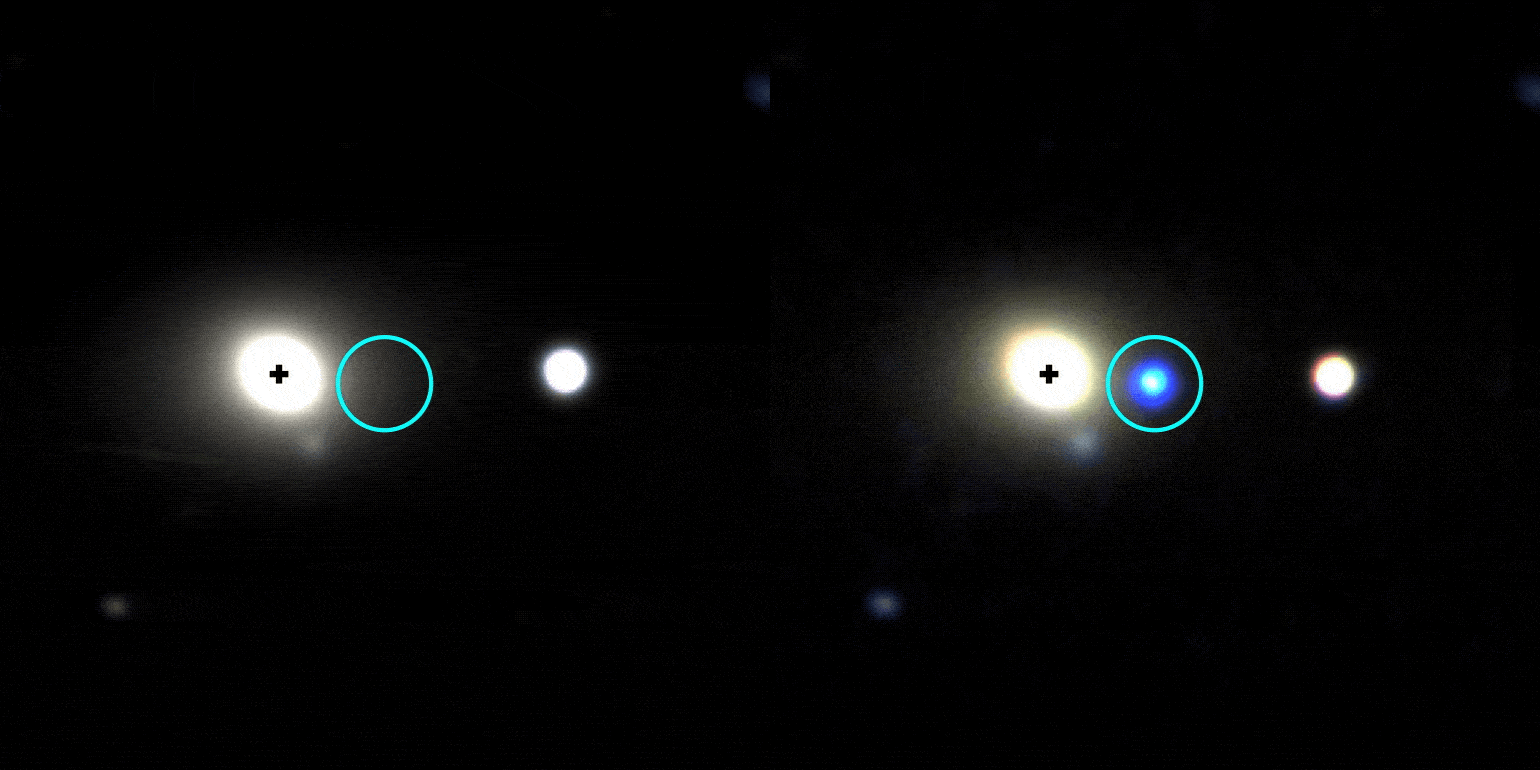
This GIF shows the galaxy WISEA J014656.04-152214.7, located about 750 million light-years away in the constellation Cetus, before and after a tidal disruption event was spotted on its outer edge in November 2025. The black + symbol marks the host galaxy and the blue circle marks the approximate area of the wandering supermassive black hole. The blue dot that appears within the circle is not a new star, but the nearby star’s energy being absorbed by the black hole.
“We were looking for these star-shredding events as a way to find otherwise invisible supermassive black holes wandering away from the galactic cores where they usually reside,” Robert Stein, the lead researcher on the paper, told NASA.
The blue dot that is visible in the GIF above is the black hole’s accretion disk, or the area where the diffuse material from the star collects as it circles the drain of the black hole’s singularity.
The flare was originally seen by the Zwicky Transient Facility (ZTF), a survey conducted by the Palomar Observatory in Southern California that scans the night sky every two days. The flare was corroborated by several other telescopes and finally confirmed as a shredding black hole by Swift’s instruments.
Stein explained that since 2024, his team has been utilizing a new artificial intelligence tool, called tdescore, to identify cosmic anomalies as they scan the sky in depth every other night.
“Out of the half million flashes ZTF detects each night, our new artificial intelligence algorithm automatically recognized a flare that looked a lot like a tidal disruption event, despite its unusual location in the outskirts of a galaxy,” Stein said.
An artist’s concept of a tidal disruption event (TDE) that happens when a star passes fatally close to a supermassive black hole, which reacts by launching a relativistic jet.
TDEs were first predicted in the 1970s and first recorded in the ’90s. So far, astronomers have observed a little over 100 TDEs in interstellar space, but more may be on the way with the premiere of new telescopes.
“With this discovery, which is one of just a couple that have been confirmed so far, we’ve validated a new technique and can use it to hunt for more,” Stein said.