

Read the full article on KETV 7
Near-total lunar eclipse will be visible in U.S. this week: When and how to watch

Digital Editor
Look to the skies this week. Now it’s the moon’s turn to pull a disappearing act.
Just weeks after a solar eclipse, the U.S. will have the best seats in the celestial house when Earth’s shadow briefly envelops the moon.
Advertisement
A partial lunar eclipse will be visible to most Americans this week as Earth passes between the moon and the sun. Although it’s not quite a total lunar eclipse, it will be close.
Above video | August’s partial lunar eclipse, illustrated
It will peak overnight Thursday into Friday, when roughly 96% of the moon’s surface passes through the umbra, the darkest part of Earth’s shadow.
Much of the moon will take on a rusty red hue, while a thin sliver of the moon remains brightly illuminated.
The partial phase of the eclipse will last more than three hours. But the entire eclipse, from the time the full moon enters the faintest, outermost edge of Earth’s shadow until it leaves, will stretch 5.5 hours.
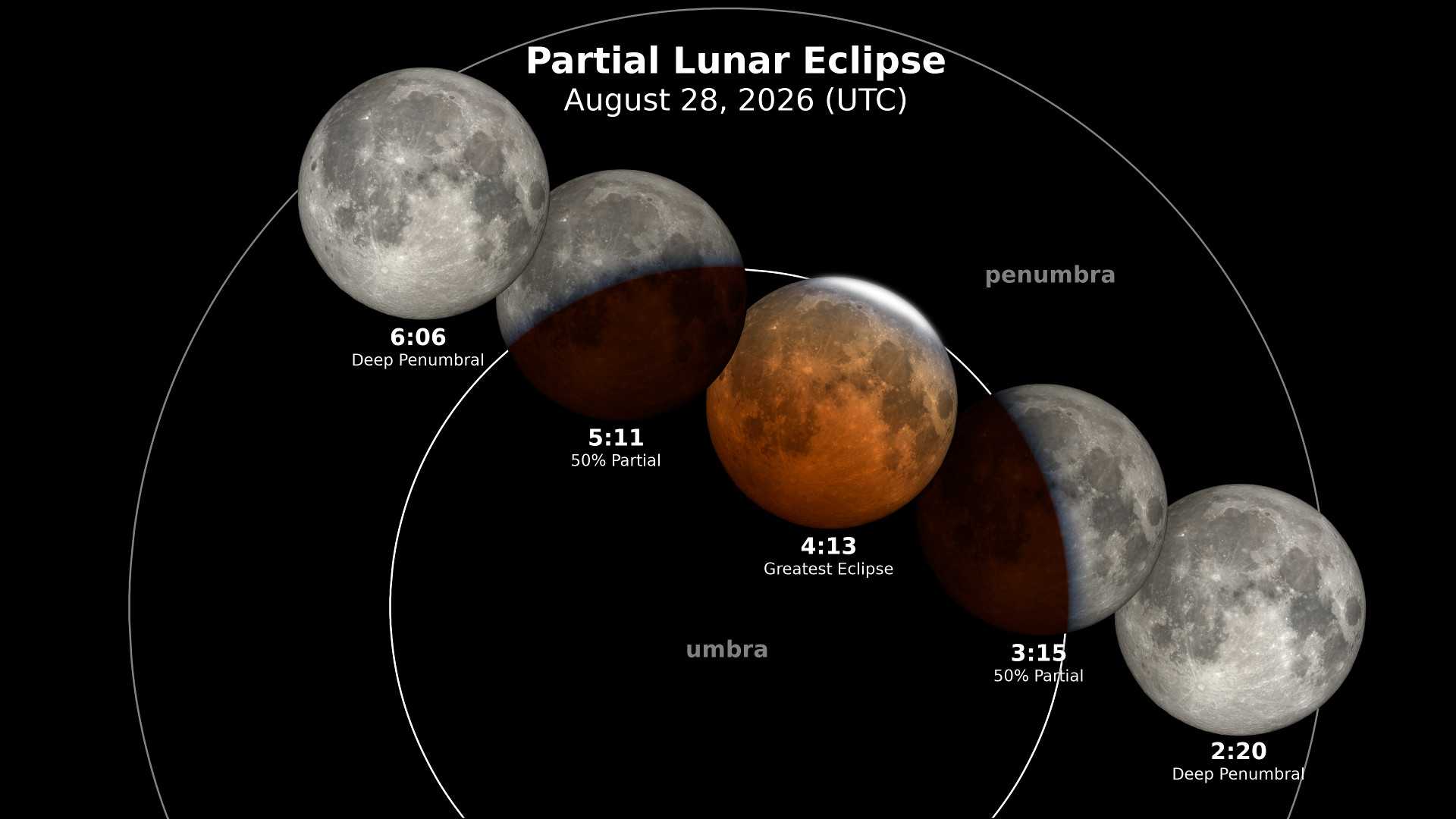
Here are stages of the Partial Lunar eclipse, with times listed in UTC.
The eclipse will peak just after midnight EDT.
Nearly 1 billion people in the U.S., Canada, and Central and South America will have front-row views for the entirety of the partial eclipse. More than 3 billion people — 44% of the world’s population — will be in position to catch at least part of it, weather permitting.
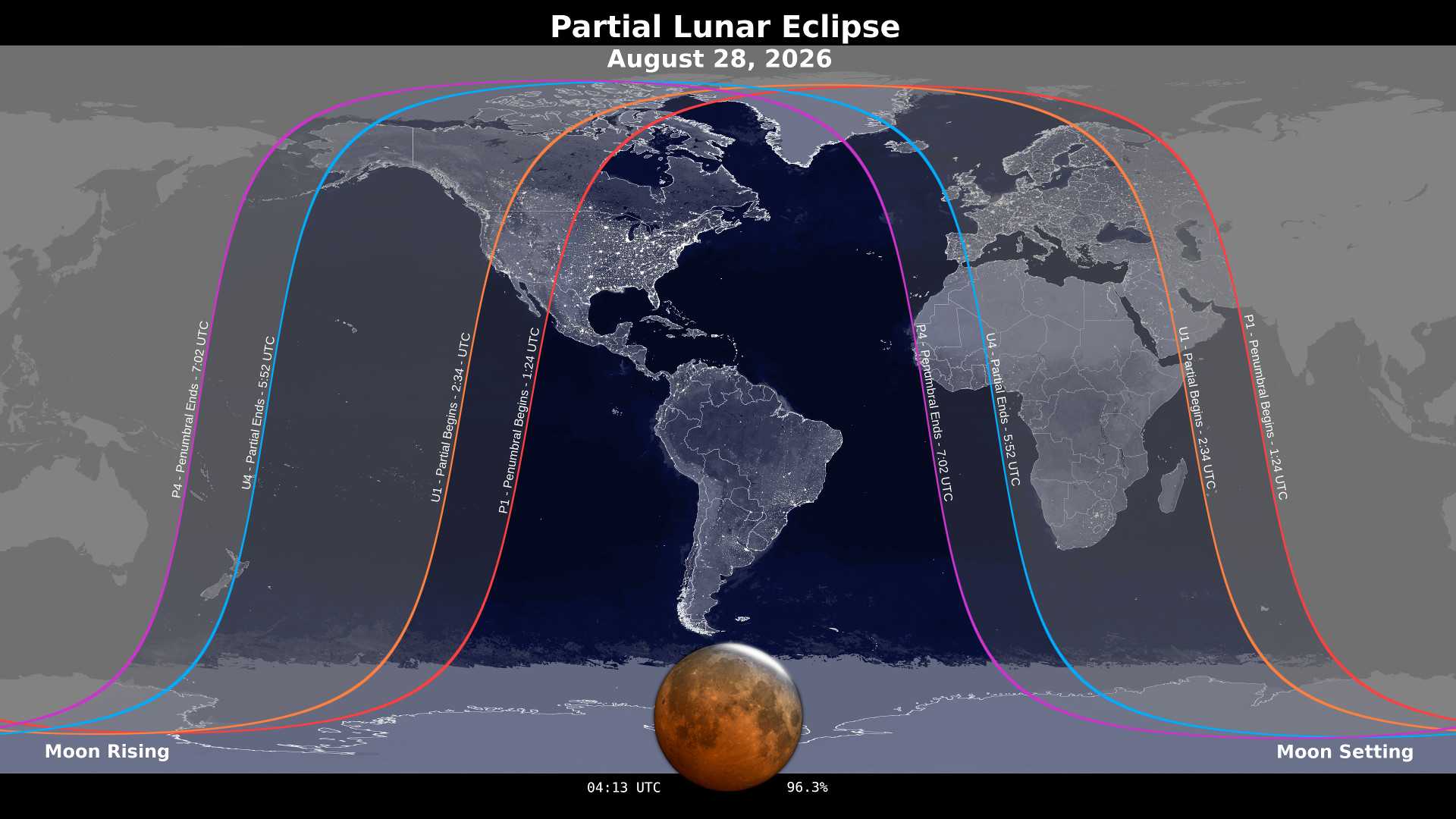
A world map showing where the eclipse is visible at different phases. Contours mark the boundary around the part of Earth where each phase is visible. The start of the partial phase, for example, is visible everywhere within the orange contour.
It’s the second act of the greatest show in the solar system, coming two weeks after a total solar eclipse paraded through Greenland, Iceland and Spain.
Eclipses always travel in pairs as the sun, moon and Earth align so precisely that one obscures the other. That’s because the moon is 400 times smaller than the sun, which is 400 times farther away, making them appear the same size — a cosmic coincidence and gift from the universe.
This eclipse is a member of Saros 138. The eclipses in a given saros series are separated by 18 years, 11 days and 8 hours. The previous eclipse in this saros series occurred on Aug. 16, 2008, and the next takes place on Sept. 7, 2044, according to NASA.