
Read the full article on Nebraska Examiner
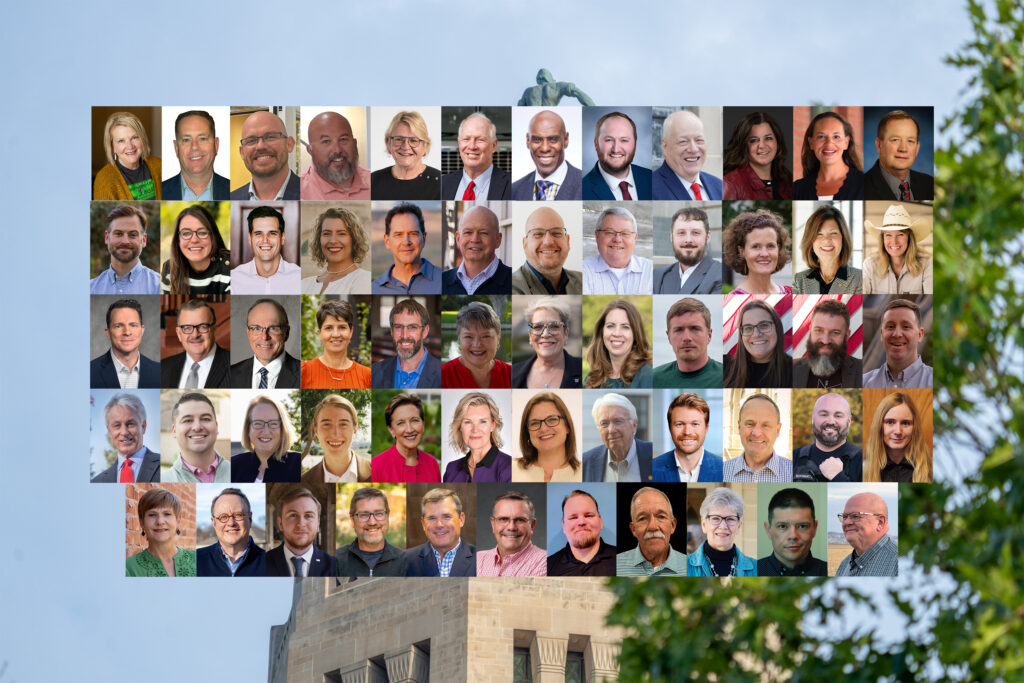
OMAHA — The 2026 elections for 25 Nebraska legislative seats could end up among the most expensive legislative races in state history, with Omaha-area races appearing likely to decide the partisan split in the officially nonpartisan Nebraska Unicameral.
Between Jan. 1, 2025, and April 27, across 61 legislative candidates, campaigns had already directly raised more than $4.1 million and spent $2.25 million. There is one more reporting period for the primary season: April 28 through June 16. Fundraising patterns usually show a large influx of funds raised and spent in that period. These reported totals do not include outside spending, such as from political action committees.
In 17 of the 25 races this year, candidates combined have already exceeded six figures in funds raised for a part-time position that pays $12,000 a year, and nine of those have already combined to spend at least six figures.
The most expensive race so far is in west Omaha and the Elkhorn area, a Legislative District 4 rematch between incumbent State Sen. Brad von Gillern of Elkhorn, a Republican, and Cindy Maxwell-Ostdiek of Omaha, a nonpartisan progressive. The duo reported raising nearly $386,000 and spending almost $310,000 by the end of April.
The next most expensive races are in Legislative District 14, in Papillion and La Vista, with almost $290,000 raised and $207,000 spent, and Legislative District 18, in northwest Omaha, with $148,000 raised and almost $175,000 spent. Thousands more have come in via PACs, including pitting Republicans against one another in currently Republican-held districts.
Two Republicans and one Democrat face off in each of those districts.
In Nebraska, legislative races are officially nonpartisan, meaning a candidate’s political party affiliation doesn’t appear on the ballot. The top two finishers advance from the primary.
The least expensive races so far come in Legislative District 22 in northeast Nebraska, an uncontested race to succeed term-limited State Sen. Mike Moser of Columbus, and in Legislative District 41 in central Nebraska, a special election for a two-year term to succeed appointee State Sen. Fred Meyer of St. Paul and former State Sen. Dan McKeon of Amherst, who resigned in January.
So far, 2026 is keeping pace with a record year for legislative campaign finance in 2024, and candidate fundraising has already outpaced 2022, when the same seats were up:
- By the end of April in 2024, with 73 total legislative candidates across 25 races, campaigns had directly raised $4.06 million and spent $2.6 million.
- By the end of April in 2022, with 65 total candidates across 24 races, campaigns had directly raised $2.67 million and spent $1.42 million.
Races to watch
The 49-member Legislature currently has 33 Republicans, 15 Democrats and one nonpartisan progressive who often sides with Democrats. Fifteen Republicans and nine Democrats are not up for election this cycle — three more Republicans are running unopposed, as is one Democrat.
Beyond the Legislative District 4 rematch and costly Legislative District 14 and Legislative District 18 races in northwest Omaha and the Papillion-La Vista area, respectively, other Omaha-area and Sarpy County races to watch include Legislative District 12 in south-central Omaha and Ralston, Legislative District 10 in central Douglas County, Legislative District 20 in central Omaha and Legislative District 36 in western and southern Sarpy County.

Legislative District 12 is the lone race this cycle where a Republican incumbent holds a district not won by President Donald Trump in 2024: State Sen. Merv Riepe of Ralston.
Riepe is seeking reelection against two Democrats and one Democratic write-in candidate. Riepe has taken a more moderate lean since his first four years in office, 2015-2019. He lost his 2018 reelection bid to former State Sen. Steve Lathrop of Omaha, a Democrat who returned to the Legislature after term limits. Riepe won his 2022 race over Robin Richards of Ralston, a Democrat, by 524 votes.
This time, Richards is running a write-in campaign after a bounced check led her to be removed from the ballot. She has surpassed Riepe in fundraising, raising $84,000 to his $68,000. Fellow Omaha Democrats Thomas Kastrup and Christy Knorr followed with about $66,000 raised and $10,400 raised.
In 2022, the three most expensive races were in Legislative District 6, held by Democratic State Sen. Machaela Cavanaugh of Omaha; Legislative District 10, held by Democratic State Sen. Wendy DeBoer of Omaha; and Legislative District 20, where newcomer State Sen. John Fredrickson of Omaha, a Democrat, flipped a moderate Republican’s seat blue.

Cavanaugh and DeBoer are term-limited, and no Republican filed for Cavanaugh’s seat this time. The race to succeed DeBoer includes Democrat Cindy Johnson and Republican Rebecca Rens, where outside spending via a PAC connected to Gov. Jim Pillen’s daughter, Sarah, is backing Rens.
Fredrickson faces two Republican opponents. He was narrowly outspent in 2022 and raised more than $341,000 and spent almost $148,000 since his previous election. Republican opponent Chris Anderson has raised almost $40,000 and spent all but $600 of that. Republican opponent Dan Witt raised $14,100 and spent nearly $5,000 of that.
Republican State Sen. Rick Holdcroft of Bellevue is also facing another costly election in Legislative District 36 against Democrat Darin Tompkins, with $250,000 raised and more than $152,000 spent between the two. Holdcroft’s race was the fifth most expensive in 2022.
Outside of Omaha, State Sen. George Dungan of Lincoln, a Democrat who won his Legislative District 26 race by 224 votes in 2022, mirrored Fredrickson in fundraising and spending heading into 2026. Since 2022, Dungan has raised $319,000 and spent $146,000. His opponent, Republican Tobias Howard of Lincoln, has not yet reported any funds raised or spent.
The threshold before needing to form a campaign finance committee with the Nebraska Accountability and Disclosure Commission is $5,000 raised, received or spent in a given year.
SUPPORT: YOU MAKE OUR WORK POSSIBLE
Legislative District 4, a rematch
Von Gillern said he is getting a “good response” while meeting with constituents and has been out six days a week since the legislative session ended in mid-April. He said, “Obviously” property taxes are coming up more than anything and that voters are interested in how lawmakers worked to balance the state budget.
When the Revenue Committee chair explains how lawmakers cut more than $500 million in government spending, von Gillern said people are “pretty happy to hear that.” When he explains it came after income tax cuts in 2023, he said that’s good news, too.

Von Gillern encouraged voters to “do their own homework.” He said he remains focused with a fiscally conservative mindset and a goal to advance the state economically and create and maintain jobs in the Cornhusker State.
“Don’t believe everything that gets mailed to you,” von Gillern said. “You can’t take things out of context and believe them all to be true.”
Maxwell-Ostdiek said this year’s campaign is “going well” and that she has enjoyed talking with voters, wishing she could talk to everybody ahead of the primary.
“Of course, my goal is keeping my eye on November,” Maxwell-Ostdiek said.
Among the top concerns for voters, she said, are “broken promises” around property taxes, insurance and rising costs, the “ongoing pattern” of state budget shortfalls and “division” from Washington, D.C., to the Nebraska Legislature and “what they see as their representatives not listening,” such as in implementing voter-approved ballot measures.

Von Gillern outraised and outspent Maxwell-Ostdiek in 2022, and she said she’s proud to have already exceeded her totals in that entire campaign. She said her focus now is listening.
“It’s unfortunate elections cost so much, and it’s increasing more and more, but what I’m trying to focus on is speaking to my neighbors directly,” Maxwell-Ostdiek said.
Some lawmakers have privately said von Gillern could be a 2028 candidate for speaker of the Legislature if reelected, to succeed term-limited Speaker John Arch of La Vista, a Republican. State Sen. Kathleen Kauth of the Millard area, another Republican, has announced she will be among those seeking the role.
“I will hold comment on that for the time being,” von Gillern said last week.
Legislative District 18, a heated race
Legislative District 18 features an open-seat race to succeed State Sen. Christy Armendariz of Omaha, who decided not to seek reelection. Armendariz, in 2022, succeeded former State Sen. Brett Lindstrom of Omaha, a former Republican now turned nonpartisan.

Republicans Taylor Royal and Derek Schwartz, both of Bennington, and Democrat Jess Goldoni of Omaha are running in the LD 18 race. Two will advance from Tuesday’s primary, where outside PACs have gotten involved around all three candidates.
One of those PACs is “Building Nebraska’s Future,” which is connected to new political consulting firm Flyover Strategies and was formed about three weeks ago. It has received $50,000 from the Arizona-based business of the father of one of the firm’s managing partners. The firm has partnered with the “We Are Nebraska” PAC run by Sarah Pillen in the Legislative District 4 and Legislative District 10 races.
Separately, Building Nebraska’s Future has also sought to boost Republican Jay Jackson of Papillion over Republican Bill Bowes of La Vista in Legislative District 14 in the race to succeed Speaker Arch. Democrat SuAnn Witt of Papillion is also in that race.
The new PAC has a similar name to that of “Build Nebraska,” a PAC formed last year with a different mission: seeking to boost Republican turnout in Nebraska’s 2nd Congressional District while staying out of contested primaries. Leaders of that turnout-focused group have called out the new organization and are calling for unity after Tuesday’s election.

Royal said he is “very excited” heading into Tuesday and hears voters excited for “what they think is change.” He said lawmakers need to do some “heavy lifting” around property taxes and affordability, as well as in supporting local schools and fighting brain drain.
“And heavy lifting to do, frankly, just to bring more unity to the state so that our Unicameral doesn’t necessarily look like Washington, D.C., and it looks a lot more like our neighborhoods,” Royal said. “And people are resonating with that.”
Schwartz said he is connecting with many voters and having “really good, meaningful and substantive conversations just every time” and that the “momentum is building.” He said the top issue is property taxes, as well as childcare and healthcare, and that he’s focused on conversations at the door and his “why” for running, not any “attack ads.”
“This campaign is about finding solutions and fixing problems for Nebraskans for Nebraskans, and in particular here in LD 18,” Schwartz said. “It’s not about an office. It’s not about ads. It’s not about notoriety or any of that. It’s about getting to work and doing the work.”

Goldoni said property taxes and affordability are the top issues “without question” and that voters are focused on money and whether increasing prices will stop. She sees “low-hanging fruit” in improving Nebraska’s state budget and hears frustration with how lawmakers have implemented ballot measures, including Armendariz.
“There’s just this frustration that it doesn’t feel like anybody’s listening and actually wanting to do good things for people in the district,” Goldoni said.
Goldoni and Schwartz are first-time candidates. Royal previously ran for Omaha mayor in 2017 and state treasurer in 2018.
Schwartz said he assumed some attacks would come, “but to see it come from someone within our own party, I was disheartened by that.” He said he’s a husband, father, son, brother, police officer, sinner, Christian, sixth-generation Nebraskan and lifelong conservative who has always voted Republican.
One ad, for instance, argues Schwartz did not vote for Trump in 2016 in Nebraska. Schwartz’s campaign has sent a cease and desist letter saying the ad is defamatory because Schwartz clearly resided in Iowa at the time, where he did vote for Trump in 2016.
“Why they choose to paint me in that light, I don’t need to spend any time entertaining,” Schwartz said. “I know the truth.”

Goldoni said she wishes the race could be a “straight game” and that she doesn’t change her messaging based on who she’s talking to, despite ads saying otherwise. She said her mom was a fan of politics, and with the unexpected death of her mom a couple of months ago, she said the last 30 to 45 days “has been intense.”
“I expected this race to be heated. We’re flipping a district that’s traditionally Republican,” Goldoni said. “We have a real shot. We have people that are resonating with our campaign and the fact that I am who I am. I don’t change who I am based on who I’m talking to.”
Royal said he is trying to run a positive campaign focused on ideas and his priorities for the district. He said his campaign itself — Royal for Legislature — has put out one contrast ad and said he is not involved with other ads, such as those from Flyover.
“There is definitely a lot that is flying around, but we want to stay focused on what we’re trying to accomplish for the district,” Royal said.
Schwartz and Goldoni agreed, each saying Nebraskans are “tired” of “political rhetoric” or “political speak” and that voters want someone who will listen to them on the issues.
SUBSCRIBE: GET THE MORNING HEADLINES DELIVERED TO YOUR INBOX.