Read the full article on Nebraska Examiner
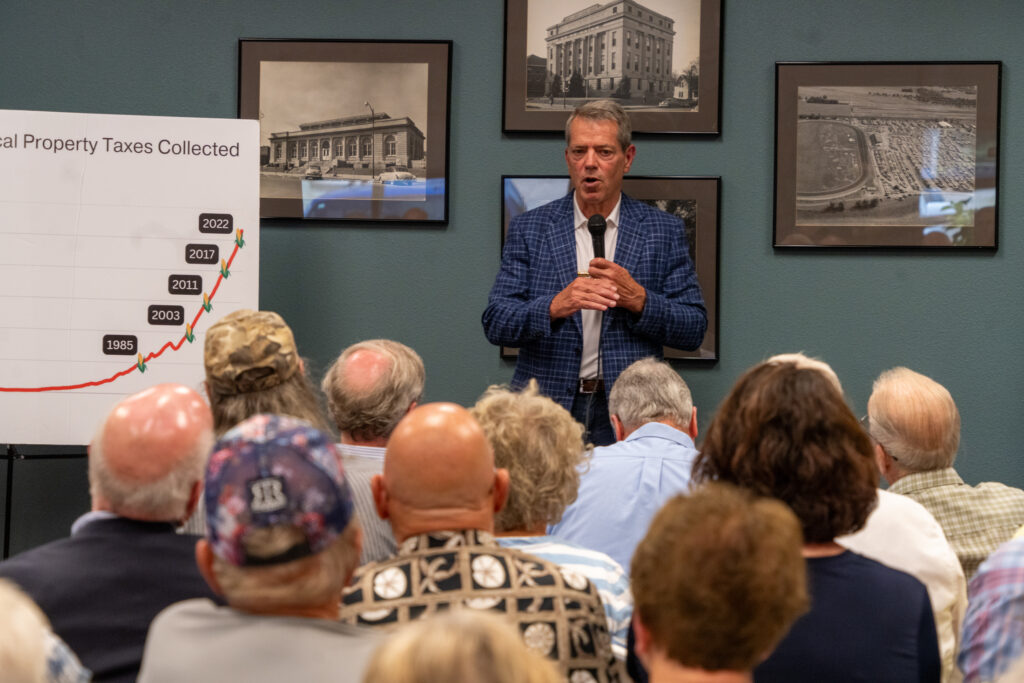
LINCOLN — Nebraska Gov. Jim Pillen unveiled a new property tax “hotline” Wednesday meant to pressure state lawmakers to act, but some senators don’t yet know if it will have an impact.
Pillen announced a new state website and phone number — 402-471-9554 — in a goal to solicit Nebraskans’ feedback on increasing property valuations and rising tax bills. Multiple of his ideas to lower property taxes the past four years have faced bipartisan opposition in the officially nonpartisan state Legislature, but Pillen again blamed lawmakers, and not his ideas, for legislation stalling over that time.
The governor’s tax relief proposals have suggested cutting state spending, raising the 5.5-cent state sales tax rate, adding sales taxes to exempt goods and services or raising tobacco taxes.
“Some of our senators don’t believe this issue to be as urgent as their constituents do,” Pillen said. “My hope is that this website will be a catalyst for getting this important message across.”
Identifying the problem
State Sens. Brad von Gillern, of the Elkhorn area, and George Dungan, of Lincoln, who sit on the Legislature’s Revenue Committee, of which von Gillern chairs, told the Nebraska Examiner that lawmakers already know property taxes are a major problem.

“I don’t think we need some hotline to determine that these are a real issue for everyday Nebraskans,” Dungan said Wednesday.
Von Gillern, who sat on a 2023 working group with the governor, as well as a 2024 task force in the lead-up to a Pillen-called special session on property taxes, said he didn’t yet know whether the hotline would help. The senator said he’d just learned about the initiative on the radio Wednesday morning and wanted to talk with Pillen’s staff to understand the intentions.
“I’m not aware of what data it’s really attempting to collect and what the end goal is of collecting that data,” von Gillern said.
Laura Strimple, a spokesperson for Pillen, said the governor will use the stories to “further demand that the Legislature take action on this important issue.” In the meantime, she said Nebraskans should protest any proposed valuation increase they believe is unfair or doesn’t reflect market value. The deadline to protest an increase or decrease is Tuesday.
Not the first time asking for help
This is not the first time Pillen has sought Nebraskans’ help during his first term in office. In summer 2024, ahead of the special session, he toured 26 cities from Scottsbluff to Auburn.
“If you don’t want to call, then don’t b— to me next year about it. If you don’t want to help, s—, I can’t do it all myself. I need everybody’s help. If you don’t want to call senators, then don’t b— to me next year. I’m working day and night,” Pillen said at a town hall in Fremont in June 2024.

Despite the blunt approach, multiple senators said the listening tour didn’t pan out as Pillen envisioned. Some lawmakers, including Dungan, scheduled their own listening sessions in Omaha and Lincoln after Pillen skipped the two largest cities.
Bickering in the Legislature has pushed various groups to the ballot box to find alternative solutions, including 2026 petitions that sought to cap annual valuation increases, limit how much of a property’s value could be included in calculating property tax bills and create a minimum salary for teachers that the state would pay. Another effort sought to eliminate property taxes.
Those petition drives fell short, but advocates behind the groups say they won’t stop fighting.
Lawmakers in the spring sidestepped major debates on property taxes but did pass Legislative Bill 803, a package of new laws meant to increase transparency for property taxpayers in the face of possible tax increases from counties, cities and schools.
Another bill that floundered this year was LB 1219, from state Sen. Tom Brandt of Plymouth, which called for “hard caps” on local spending to restrict annual increases. The proposal came up for debate at the last minute of the 2026 session and did not receive a vote.
SUPPORT: YOU MAKE OUR WORK POSSIBLE
Rising property valuations
Pillen, too, has pledged to seek hard caps if reelected this November, and he’s amped up pressure on rising property valuations. Values are set to rise an average of 5.3% statewide, excluding growth, according to preliminary data from the Nebraska Department of Revenue.
While the governor has said what’s going on with county assessors and valuations is “unacceptable,” his 2023 group pivoted from valuations quickly to spending. Pillen, too, had said valuations weren’t the issue and, in June 2024, said valuations should be going up.
“We have hard caps [on increased spending]. Then whatever the valuations are has no impact,” Pillen said during his monthly radio call-in show at the time.
The 2023 working group suggested spending caps and other measures that the Legislature implemented, Strimple said, but the laws allowed “significant exemptions.” She noted property taxes assessed in 2025 increased by 5.4% to a total of $5.59 billion, more than inflation.
“More has to be done on either the valuation or spending side,” Strimple said.
Strimple said Pillen has heard from some Nebraskans whose valuations were lowered and later saw a 52% increase the following year. She said 93 county assessors review property in slightly different ways and that it’s not “sustainable” for double-digit valuation increases year over year.
The Nebraska Department of Revenue, a Pillen-appointed property tax administrator and the Tax Equalization and Review Commission, which consists of gubernatorial appointees, help oversee the property assessment process. County assessors are also elected officials.
An increased property valuation does not automatically mean a taxpayer will pay more.

Under a 2019 law, when local leaders start crafting their next property tax request, their starting point is revenue-neutral. If valuations rise, the property tax rate should at first be lowered. Local leaders can then vote to exceed that limit and raise the property tax rate, with some limitations.
In basic terms, a property tax bill is determined by calculating various local government levies for each $100 of a property’s value. For example, the owner of a $200,000 home in the Lincoln Public Schools district, with a $1.02 levy, would pay $2,040 in property taxes.
This has caused consternation for various taxpayers, Pillen and senators, notably the former Revenue Committee chair, when leaders say they lowered or held levies flat, yet values rose.
‘Time to work together’
Von Gillern said he’s reengaged with county, municipal and school officials to determine what could be accomplished with hard caps that “would not be totally devastating to what they need to do to accomplish their goals.”
The Elkhorn area senator said he remains focused on the spending side of the tax equation.
“My thought is that unless we deal with the spending side of things,” von Gillern said, “the valuations and the levies are just math to get there.”

Dungan said Pillen’s ideas disproportionately benefit wealthy landowners or those who own more land because of across-the-board cuts. Dungan said targeted relief is better, such as expanding the state homestead exemption or offering relief based on a taxpayer’s finances.
Said Dungan: “What we need are actual solutions that I think get to the heart of helping the people who need it the most.”
The legislatively created School Financing Review Commission, championed by State Sen. Jana Hughes of Seward, is also continuing its work to find possible tweaks to school funding, the largest portion of property tax bills.
In the Wednesday news release, Pillen’s office said local spending hasn’t slowed and taxpayers “continue to feel the pain every year” when governments leave tax rates the same despite rising valuations. The governor tasked the Legislature to solve the “property tax crisis” in 2027.
“Nebraskans have been calling on the Legislature to fix this problem for decades,” Pillen said. “It’s now time to work together and find the solution.”
SUBSCRIBE: GET THE MORNING HEADLINES DELIVERED TO YOUR INBOX.