

Read the full article on KETV 7
Advertisement
A shark that can follow you onto land? Luckily, the “walking shark” poses no threat to humans at all. Now, scientists have discovered a new species of this type.Residents of eastern Papua New Guinea call this kind of shark “kadedekedewa,” translating roughly to “lazy shark” or “dog shark,” referring to the way it strolls slowly through the water.It uses its pectoral fins to meander around over coral underwater and to drag itself between exposed tide pools at low tide, leaving most of its body out of water for up to two hours. The new species, H. dudgeonae, is named after the co-author of a new study in the Journal of the Ocean Science Foundation, Christine Dudgeon, an ecologist at the University of the Sunshine Coast in Australia who has been studying the genus for more than two decades. Jess Blakeway, PhD student and lead author of the paper, realized right away when her supervisor brought the shark over that it had a different color pattern than other species she’d seen before.She and fellow researchers used genetic analysis to confirm that the new species was distinct from others in the genus.Dudgeon first spotted the meter-long shark in March 2025 in the waters of Milne Bay off the far southeastern tip of Papua New Guinea.”New shark species don’t come along that often, and it’s most definitely the first one named after me,” Dudgeon said in a statement.The researchers dove, snorkeled, and walked through reefs to catch walking sharks by hand, completing 70 surveys at 35 sites in 15 locations. In addition to discovering the new species, they also learned more about the geographic distribution of two other epaulette shark species in the area.The paper noted that it “seems plausible that this species has already faced extirpation in some locations,” referring to the eradication of a species in a specific region. Researchers wrote that the H. Dudgeonae species has the smallest geographic distribution of any walking shark. As a result, they said it was “likely” that it would be listed as endangered when assessed.”We hope to collect more data on our next research trip in October to help the International Union for Conservation of Nature (IUCN) Red List assess the species as vulnerable or endangered with extinction,” Ms Blakeway said.The paper was published in the Journal of the Ocean Science Foundation.
A shark that can follow you onto land? Luckily, the “walking shark” poses no threat to humans at all. Now, scientists have discovered a new species of this type.
Residents of eastern Papua New Guinea call this kind of shark “kadedekedewa,” translating roughly to “lazy shark” or “dog shark,” referring to the way it strolls slowly through the water.
Advertisement
It uses its pectoral fins to meander around over coral underwater and to drag itself between exposed tide pools at low tide, leaving most of its body out of water for up to two hours.
The new species, H. dudgeonae, is named after the co-author of a new study in the Journal of the Ocean Science Foundation, Christine Dudgeon, an ecologist at the University of the Sunshine Coast in Australia who has been studying the genus for more than two decades.
Jess Blakeway, PhD student and lead author of the paper, realized right away when her supervisor brought the shark over that it had a different color pattern than other species she’d seen before.
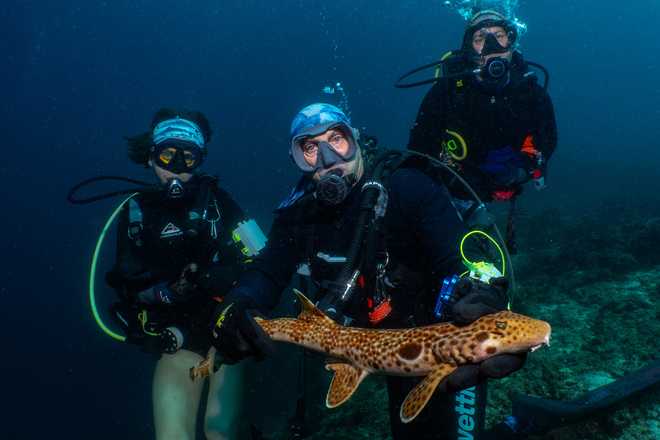
She and fellow researchers used genetic analysis to confirm that the new species was distinct from others in the genus.
Dudgeon first spotted the meter-long shark in March 2025 in the waters of Milne Bay off the far southeastern tip of Papua New Guinea.
“New shark species don’t come along that often, and it’s most definitely the first one named after me,” Dudgeon said in a statement.
The researchers dove, snorkeled, and walked through reefs to catch walking sharks by hand, completing 70 surveys at 35 sites in 15 locations. In addition to discovering the new species, they also learned more about the geographic distribution of two other epaulette shark species in the area.
The paper noted that it “seems plausible that this species has already faced extirpation in some locations,” referring to the eradication of a species in a specific region. Researchers wrote that the H. Dudgeonae species has the smallest geographic distribution of any walking shark. As a result, they said it was “likely” that it would be listed as endangered when assessed.
“We hope to collect more data on our next research trip in October to help the International Union for Conservation of Nature (IUCN) Red List assess the species as vulnerable or endangered with extinction,” Ms Blakeway said.
The paper was published in the Journal of the Ocean Science Foundation.