
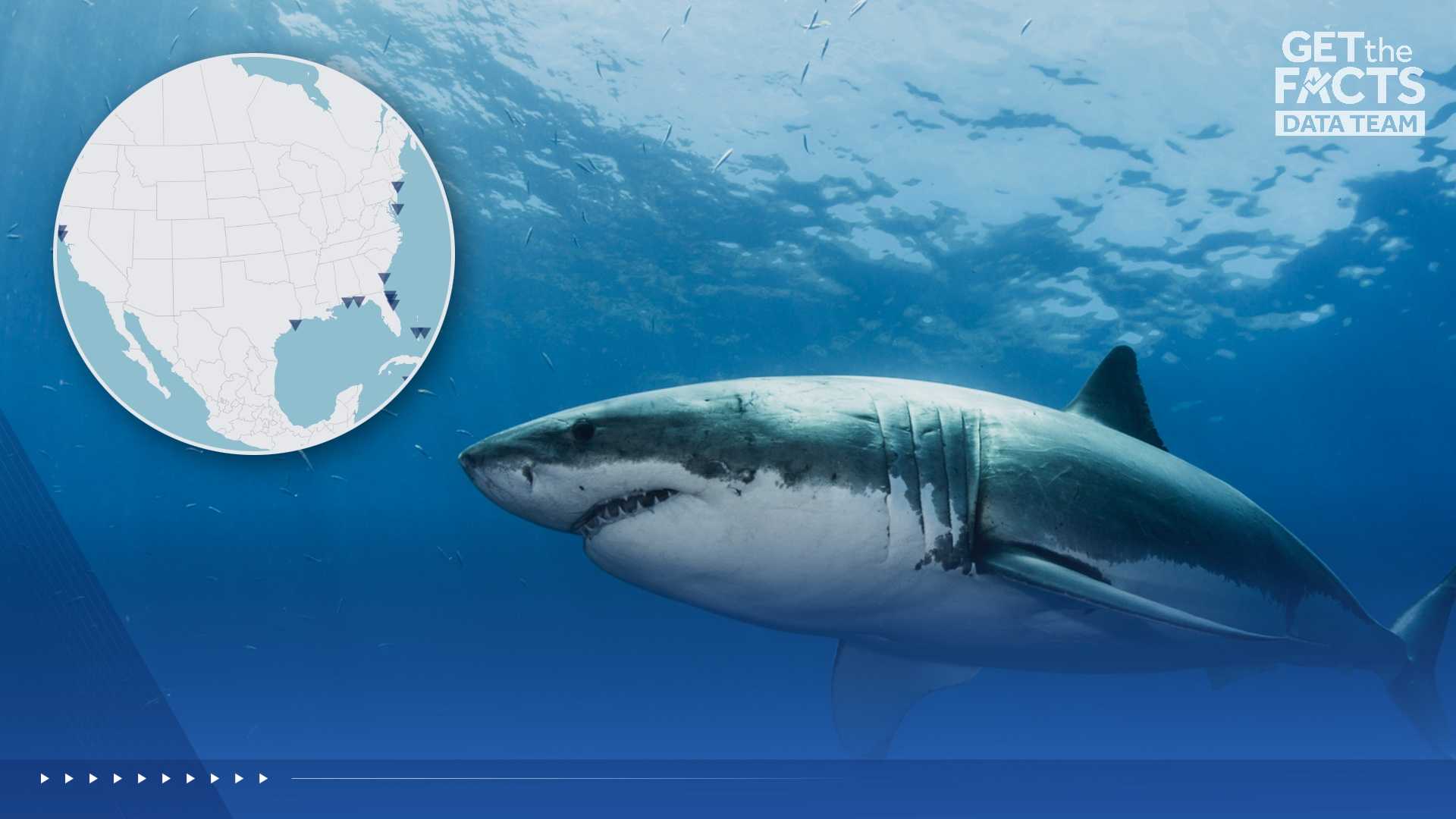

Shark attack tracker: Where bites have happened in the US this year
Data Visualization Journalist
A 21-year-old man from Georgia was bitten while saving his fiancee, a Navy base employee was attacked while swimming on his lunch break; and a Minnesotan woman died in the U.S. Virgin Islands after a shark bit her left arm.
Those are just some of the at least 13 shark attacks in the U.S. so far this year. Arlene Lillis, the woman killed in the Virgin Islands, remains the only fatality.
Advertisement
Earlier in the year, experts said that the strong El Niño could impact shark activity, including a potential influx of great white sharks off the Pacific coast as they travel north to escape warming waters.
And, in Florida and the Carolinas, experts say that warmer waters may move prey closer to shore, which sharks will follow.
Still, while there may be more sharks near coastal beaches, experts say that does not mean there will be more attacks. The likelihood of getting bitten by a shark remains incredibly rare.
“Look in your rearview mirror because you’re more likely to end up with a fender bender than a shark bite,” said Gavin Naylor, director of the International Shark Attack Files.
Recent trends in shark bites
Last year, there were 25 unprovoked shark bites in the U.S. One of those attacks — along California’s Central Coast last December — was fatal.
Across the globe, the total number of unprovoked shark bites — 65 — was up slightly from the most recent five-year average. An unprovoked bite excludes cases in which a human initiates contact with the shark, for example, by feeding it or interacting with it while fishing.
There were 29 provoked bites globally last year.
The U.S. had more unprovoked shark bites last year than any other country. Australia was the runner-up with 21 total attacks, five of which were fatal.
Within the U.S., Florida holds the greatest share of shark attacks of any state. About 58% of all historically reported unprovoked bites in the U.S. took place in the Sunshine State.
Hawaii follows with about 11% of the bites, California has 9% and together, the Carolinas account for 12% of the bites.
To see where shark attacks have occurred each year in the U.S., use the scroll bar below.
Are sharks trying to bite you?
Scientists do not have an explanation for the rare cases in which a person gets bitten for no apparent reason, but they say sharks largely ignore people.
“They’re around people a lot more than they have been before and realize we’re not food,” said Chris Lowe, director of the Shark Lab at California State University, Long Beach. “We don’t smell like food. We don’t act like food.”
Studies have shown that sharks are not attracted to human blood or menstrual blood. They know the difference between human and fish blood.
When it comes to predicting trends in shark bites, Naylor said that it’s harder than predicting the stock market. Attacks are so rare, and the period of record is so small, that it’s impossible to draw strong statistical conclusions.
So many things impact shark movements, including water temperatures, tides, toxins and human activity.
Different fads, like foiling and windsurfing, put people in new, unexpected areas where sharks may mistake them for a seal.
As for which sharks to watch out for, great white sharks, tiger sharks and bull sharks are the “Big Three” when it comes to unprovoked bites.
Naylor also said that blacktip sharks are common off the coast of Florida, but their bites are far less fatal than those of great whites.
How to stay safe
Experts say that it is safe to bring your family to the beach this summer, and that any potential changes in shark behavior due to El Niño are no reason to cancel holiday plans.
Still, if you are concerned, there are steps you can take to minimize the risk of an attack.
Go to beaches with lifeguards, stay in groups and avoid murky water. Avoid large schools of fish. If fish are jumping out of the water, that means something big is likely chasing them.
Fishers off the coast in California should keep an eye out for increased hammerhead activity this year, and if you are kayak fishing, keep your arms and legs in the boat. Spearfishers should keep any catches on a stringer far away from them.
Rip currents and drowning are still the biggest risks for any beachgoers this year. Every year, about 4,000 Americans die due to drowning, according to the Centers for Disease Control and Prevention.