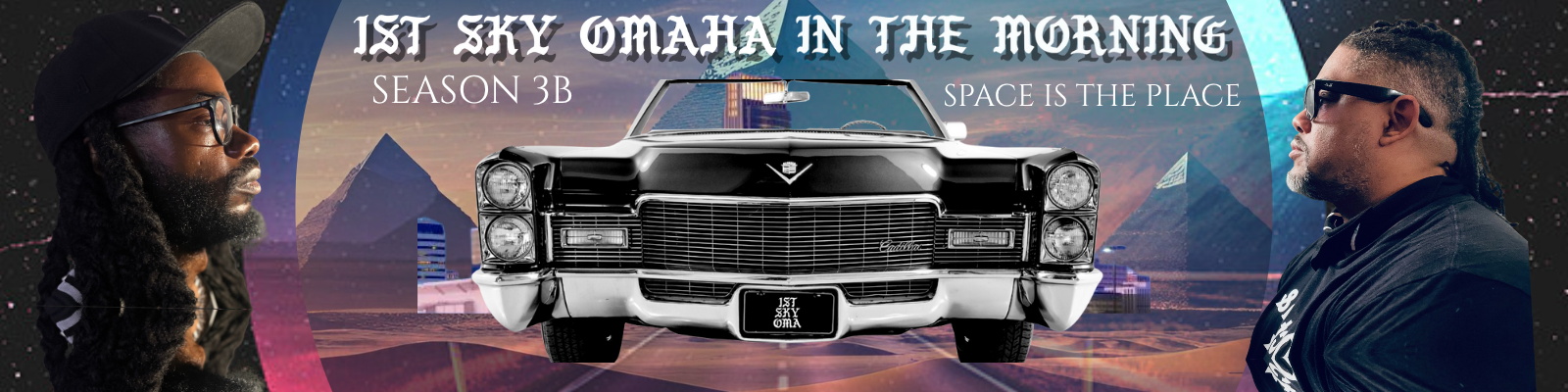
It was a “Love Supreme Friday” on 1st Sky Omaha in the Morning, and hosts Paul B. and Buddy the God were ready to shift gears. After weeks of heavy political conversation surrounding Nebraska’s midterm primary elections, the show opened with a deliberate exhale. “We’ve been talking a lot of politics for a while and it’s time to change our mindsets,” Paul B. told viewers. “Love Supreme Friday is going down today for sure.”
That didn’t mean turning away from the hard work of community building — far from it. Buddy the God set the tone for the season ahead with a simple but powerful charge: “We got to do both — build our own ecosystems and continue to do the things that support the community — in the now and in the long run.” With that, the show pivoted to one of the most substantive conversations about North Omaha’s future that this program has aired in recent memory.
The centerpiece of the morning was an extended sit-down with Dana Murray, founder and director of the North Omaha Music Academy — formerly known as Love’s Jazz — located right on the historic North 24th Street corridor. Murray, a musician and educator originally from South Omaha who spent 11 years honing his craft in New York City, returned home with a vision that stretches well beyond teaching scales and rhythm.
He didn’t mince words about what North 24th Street — “the Deuce,” as it’s known — could and should be. “Really, the area that has the most history and the one that can claim ‘we are a cultural and arts district’ for real is the North 24th Street corridor,” Murray said. “And we’ve been so far removed from that.” He painted a picture of what a fully realized cultural district looks like: housing, laundromats, grocery stores, restaurants, entertainment venues, and yes, even a hotel — so that larger festivals, conferences, and attractions can be drawn right into the heart of the community.
Paul B., who has long championed the corridor, echoed the sentiment. “I’ve always called it the most important Black corner in Nebraska,” he said, “and we have to be of service to it.”
Murray was candid about the challenges, including what he called a “false sense of security with pride” that can sometimes hold the community back from fully showcasing its culture to the wider city. He pointed to South Omaha’s Cinco de Mayo celebration as a model worth emulating — a festival rooted in cultural identity that deliberately invites everyone in. “I wish we did more of that,” he said. “One of the things I’ve tried to do was reach out and be a beacon for all of Omaha to come down to North 24th Street.” The results, he noted, speak for themselves. “People have no problem coming from wherever they are in Omaha or Iowa to come down and hear jazz music. That taboo about the area and its ability to be an attraction was false. We’ve proven that.”
Viewer Pops chimed in from the chat with a personal note that underscored just how rich that history runs: “Artists like Fats Domino used to stay at your grandfather’s home when he came to town to perform. So yes, more infrastructure for the artist around the Deuce corridor would be a godsend.”
At its core, NMA is a youth music academy, performance space, and community venue — but Murray’s ambitions for it go far beyond music instruction. He compared it directly to Omaha Performing Arts and its role as an economic engine for downtown, generating $40 to $50 million in revenue annually. “That’s what we’re trying to be for North Omaha,” he said plainly. And the ripple effects, he emphasized, are about far more than producing musicians. “We’re not only raising musicians; more importantly, we’re raising more critical thinking human beings. Not all these young kids are going to become musicians by choice. Some will become doctors, lawyers, business owners. Whatever they choose to do, they’re going to be better because they were aligned with artistry.”
Paul B. connected this to a concept he calls the “secondary matrix” — the idea that an institution’s surface mission is a vehicle for a deeper transformation. “In Dana Murray’s case, he teaches kids music, but the secondary matrix is to create critical thinkers — people who go further in their fields because they have the discipline and mind-expanding benefits of musical training.” Viewer Pops put it beautifully from personal experience: “I experienced my secondary matrix in junior high when I took algebra. I noticed I was suddenly able to think outside the box on several different levels. Music the same.”
Murray also spoke about the academy’s hands-on electives — live sound engineering, broadcast production, podcasting, and student-led artist interviews — all designed to make possibility feel tangible and immediate. “It’s not just telling them, ‘Oh, you can be this,'” he said. “No — you can be this right now. Once you remove those barriers, the sky’s the limit.”
Looking ahead, NMA is preparing to launch a capital campaign with a first phase goal of $20 million, with the long-term vision of a full NMA campus on the corridor. Murray is also actively seeking music instructors who can do more than teach technique. “They don’t need us for the ‘what’ — they can go to YouTube and see anything we’re trying to teach them,” he said. “The ‘why’ they’re doing it is everything.” Interested educators can reach Murray at dmurray@northomahamusic.org or assistant Andrew Bailey at abailey@northomahamusic.org.
Perhaps Murray’s most stirring moment came when he spoke about the economic value of Black culture itself. “The sooner we understand that our culture is equity, that our brilliance and our artistic genius is equity, the better off we’re going to be,” he said. “Every music in America has been built off of our experience… you trace it all the way back to the music brought over from Africa. And that’s equity.”
“Thank you, Uncle Dana. You’re changing lives in big ways. We are the students.”
— viewer Senator KML
Viewer Derek Higgins kept it simple and heartfelt: “Congrats, Dana, and what NMA is doing.” And in the middle of it all, viewer Aeros 402 brought a beautiful moment of pure joy to the chat: “On a love note, my only daughter gave birth to my second granddaughter. They are both new and good. I feel blessed.” On a Love Supreme Friday, that felt exactly right.
The show wrapped with a nod to Boots Riley’s film I Love Boosters and a continued conversation about voter engagement following the primary — with Paul B. reminding the audience that real change lives at the ballot box, not the keyboard. It was a full, rich morning, equal parts inspiration and information, exactly what this community deserves on a Friday.
If you missed it, set a reminder — 1st Sky Omaha in the Morning is back Monday, and if this week is any indication, the conversation is just getting started.