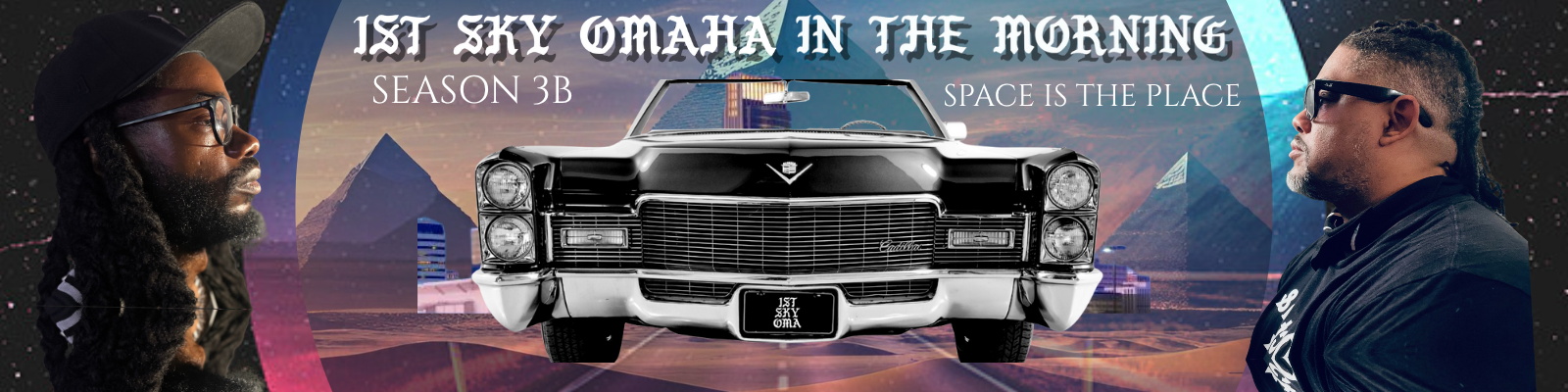
Friday mornings on 1st Sky Omaha in the Morning have a certain kind of energy, and this past week’s episode turned that energy all the way up. Hosts Paul B. and Buddy the God declared it “Love Supreme Friday” — a deliberate pivot from the week’s heavier political conversations toward something more nourishing. “We’ve been talking a lot of politics for a while and it’s time to change our mindsets,” Paul B. told the audience. “It’s going to be Love Supreme Friday today.” The chat room, full of the regulars Paul B. and Buddy affectionately call the Chat Chimers, was already buzzing before the main guest even arrived.
The morning’s centerpiece was a rich, wide-ranging conversation with Dana Murray, founder and director of the North Omaha Music Academy — known to many longtime Omahans as Love’s Jazz — nestled right in the heart of the North 24th Street corridor. A South Omaha native who spent eleven formative years in New York City before returning home, Murray has quietly been building something extraordinary, and Friday’s show gave him the space to lay out exactly what that is and where it’s headed.
The conversation opened with a question that sits at the heart of so many discussions about North Omaha: what should the North 24th Street corridor actually be? Murray didn’t hesitate. “There are a lot of districts in Omaha redeveloping — Blackstone, Benson, Little Bohemia — but the area that can truly claim it is a cultural and arts district is the North 24th Street corridor,” he said. He was equally clear-eyed about the challenges, noting that sustainable development requires more than passion. “You need enough housing, places of service, parking, laundromats, eateries, gas stations — all the things that allow an area to be self-sustained. We can’t get caught up in the emotion of redevelopment without making sure the metrics are there.”
Paul B. echoed that reverence for the corridor with a line that drew appreciative responses from the chat. “I’ve always called it the most important black corner in Nebraska,” he said, “and we got to serve it. We have to be of service to it.” Viewer Pops weighed in with a piece of living history: “Artists like Fats Domino used to stay at your grandfather’s home when he came to town to perform. So yes, more infrastructure for the artist around the Deuce corridor would be a godsend.”
Murray, who grew up in South Omaha, addressed the geography of his work directly — and thoughtfully. “If you were black and in Omaha, especially in the 70s and early 80s, North Omaha was the Mecca for all of us — it was a shared relationship,” he said. He drew a pointed comparison between how different communities celebrate their culture, holding up South Omaha’s Cinco de Mayo festivities as a model of inclusive cultural pride. “They champion their culture and invite everybody,” he observed. NMA, he said, has been built on that same philosophy — and it’s working. “That taboo about the area being an attraction was false. We’ve proven that.”
The heart of the conversation turned to NMA’s vision — and it is an ambitious one. Murray sees the academy not merely as a place where young people learn to play instruments, but as a full-scale economic and cultural engine for North Omaha. “Think of what Omaha Performing Arts means to downtown — not just as a cultural entity, but as an economic vehicle bringing in $40 to $50 million in revenue every year,” he said. “That’s what we’re building toward for North Omaha.” Beyond the economics, Murray spoke about the deeper human transformation the academy is after. “We’re not just raising musicians — we’re raising more critical thinking human beings. Not every kid is going to become a musician. Some will become doctors, lawyers, business owners. Whatever they choose, they’re going to be better because they were aligned with artistry.”
NMA’s programming already extends well beyond music lessons. Murray described a broadcast lab where students conduct their own artist interviews and learn live-streaming production. “It’s not just telling them, ‘Oh, you can be this someday,'” he said. “No — you can be this right now. Once you remove those barriers, the sky’s the limit.” The academy is equally intentional about teaching local history. Students don’t just hear that Buddy Miles was from Omaha — they learn who Buddy Miles was, what he represented, and why Victor Lewis is one of the most recorded jazz drummers in history. “If you give kids context, they connect the dots themselves,” Murray said.
Looking ahead, Murray revealed plans for a capital campaign with an initial phase targeting $20 million, with the long-term goal of building an NMA campus. Viewer Pops, watching the interview unfold, put it simply: “I love this interview. This brother’s vibe is so cool and his intentions are admirable. First Sky loves the kids.”
The show also touched on Nebraska’s primary election results and the stubborn problem of low voter turnout — a thread that prompted honest reflection from both hosts and viewers. Buddy the God summed up the stakes plainly: “None of this really matters if everybody voted. It’s the missing piece.” Viewer Kimber Snipes offered a ground-level perspective: “I’ve been having conversations with people between the ages of 20 and 35. What I hear the most is most of them don’t really know what to do and know nothing about the candidates. I think we need to have more education and deep dive discussions.” The morning also paused to celebrate a significant community win — Charell Shelton’s $52,000 diagnostic lab prize — a reminder that North Omaha talent is earning recognition well beyond city limits.
Paul B. closed the morning by returning to a theme that underlies everything the show does — what he calls the “secondary matrix.” “Everything that we do has a secondary meaning, a deeper meaning,” he explained. “On the surface, we’re a couple of talking heads — but what we’re really trying to do is build community, build coalition, build a family of people that we can come to some conclusions with and get to some action.” It’s the same philosophy Dana Murray is living out on North 24th Street, one young musician — one critical thinker — at a time.
“Dance is the shortcut to happiness,” Paul B. said, quoting his grandmother near the end of the show. On a Love Supreme Friday, it felt exactly right.
If you missed it, NMA Fest is coming up, and if Paul B.’s enthusiasm is any measure — “This one to me is the one. If I was going to put a festival together, it would look like this” — you won’t want to sit this one out. Music instructors interested in joining the NMA team can reach Dana Murray at dmurray@northomahmusic.org or his assistant Andrew Bailey at abailey@northomahmusic.org.
Pull up a chair and join the Chat Chimers Monday morning — 1st Sky Omaha in the Morning is back, and the conversation is always worth showing up for.