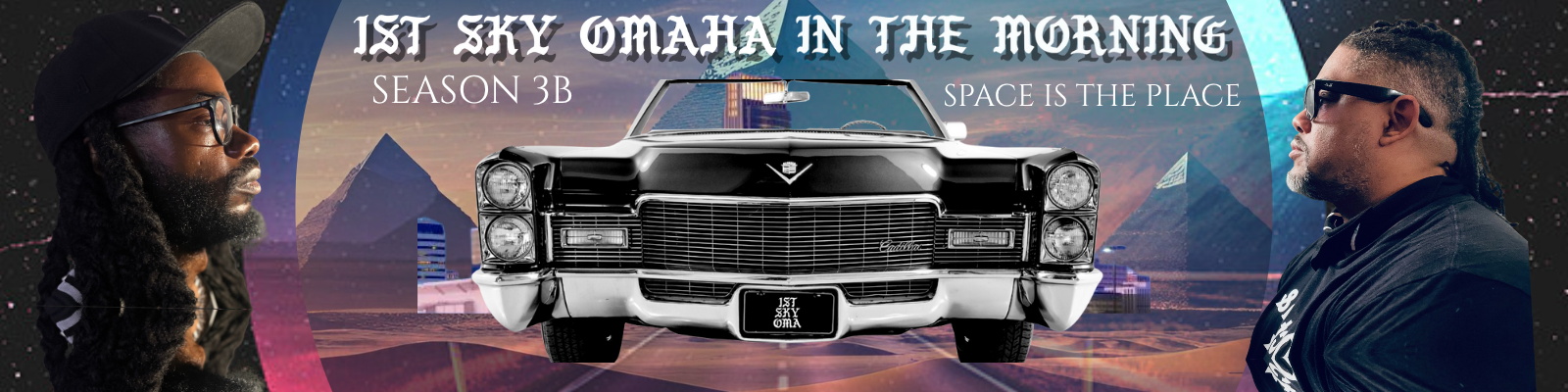
Friday mornings on 1st Sky Omaha in the Morning have a particular kind of energy, and this past “Love Supreme Friday” was no exception. Hosts Paul B. and Buddy the God opened the show with intention, steering the conversation away from the week’s political noise and toward something more sustaining — community, purpose, and the people quietly doing the work that holds North Omaha together.
Nebraska’s midterm primary results were still fresh, and the hosts didn’t shy away from the civic moment. Buddy the God kept it plain: “None of that really matters if the people don’t vote — and those maps and those numbers are still based on who’s registered, who’s of age, and actually who comes out to vote.” Viewer Kimber Snipes echoed a tension many feel: “I’ve been having conversations with people between the ages of 20 and 35. What I hear the most is most of them don’t really know what to do and know nothing about the candidates. I don’t think we should be slamming people for not voting when the system is really what has caused this. I think we need to have more education and deep dive discussions.” It was the kind of honest pushback the show welcomes, and it set the stage for a broader conversation about self-determination and community building.
Paul B. offered a framework he called the “secondary matrix” — the idea that beneath every surface-level effort lies a deeper purpose. “Everything that we do has a secondary meaning, a deeper meaning,” he said. “The secondary matrix of what we’re trying to do here is build community, build some coalition, be able to speak to and build a family of people that we can regularly talk to and come to some conclusions and get to some action.” Buddy grounded it in practical terms: “We have to build our own ecosystems and continue to do the things that we’re about to talk about. But in the long run, we do got to figure this out as far as this political structure — whether you want to be engaged in it or not, you’re a part of it. Don’t pay taxes and see what happens.” The room — virtual and otherwise — laughed, but the point landed.
Before bringing on their guest, the hosts paused to celebrate a community win: North Omaha entrepreneur Charell Shelton had just taken home a $52,000 prize. It was exactly the kind of moment Paul B. loves to amplify — proof that investment in North Omaha talent pays off.
Then came the conversation many viewers had been waiting for. Dana Murray, director of the North Omaha Music Academy (NMA), joined the show to talk about what’s being built on the North 24th Street corridor — and why it matters far beyond music lessons. A South Omaha native who spent eleven years in New York City before returning home, Murray brings both an insider’s love and an outsider’s clarity to what North Omaha needs.
“The arts are the core of who we are as people — definitely as black people — and the history of North Omaha, and really Omaha,” Murray said. “With a lot of the development going on infrastructure-wise, very little is talked about the social, people development, healing that has to happen to even take advantage of all the opportunities.” He’s not interested in sentiment for its own sake, though. “I just want us all to look at it as an equation — 2 plus 2 equals 4 — and oftentimes we get caught up in the emotion of building a community when we need some real X’s and O’s.”
His vision for NMA is ambitious and precise. He invoked Omaha Performing Arts — not as a competitor, but as a model. “If you think of Omaha Performing Arts and what it means to downtown — not only as a cultural and music entertainment entity, but as an economic vehicle bringing in $40 to $50 million in revenue every year — that’s the model.” He’s already planning a capital campaign, with a first phase of $20 million, aimed at building a full NMA campus that could anchor the corridor the way Omaha Performing Arts anchors downtown.
But the work happening right now is just as compelling. Beyond instrument instruction, NMA students are learning live sound engineering, live streaming production, and broadcasting — including conducting their own artist interviews in a dedicated broadcast lab. “It’s not just telling them ‘you can be this’ — no, you can be this right now,” Murray said. “Once you remove those barriers, the sky’s the limit.”
On the question of North 24th Street itself — Paul B. calls it “the most important black corner in Nebraska” — Murray was visionary but grounded. He pointed to Blackstone, Benson, and Little Bohemia as examples of Omaha districts that have successfully redeveloped, then argued that none of them can match what the North 24th Street corridor actually represents historically and culturally. What’s been missing, he said, is the willingness to invite all of Omaha in. “Look at South Omaha’s Cinco de Mayo and how they champion their culture — it brings them together but they invite everybody down to be part of it,” he said. “People told me that was going to be very hard, but people have no problem coming from wherever they are in Omaha or Iowa to come down and hear jazz music or whatever we present.”
“What we have to sell in most black communities is our culture, because if we don’t monetize it — and 99% of the time we don’t — the rest of the country monetizes our culture for us. The sooner we understand that our culture is equity, that our brilliance and artistic genius is equity, the better off we’re going to be.”
— Dana Murray, NMA Director
The chat was alive throughout. Viewer Pops offered a personal note that connected the show’s themes beautifully: “Artists like Fats Domino used to stay at your grandfather’s home when he came to town to perform. So yes, more infrastructure for the artist around the Deuce corridor would be a godsend.” And viewer Senator KML put it simply: “Thank you, Uncle Dana. You’re changing lives in big ways. We are the students.”
For those who want to get involved — whether as a music instructor, a supporter, or simply a curious neighbor — Murray invites outreach at dmurray@northomahamusic.org or through his assistant Andrew Bailey at abailey@northomahamusic.org.
It was the kind of Friday morning that reminds you why community media matters — not just to inform, but to connect, to inspire, and to keep the conversation going. 1st Sky Omaha in the Morning airs live weekday mornings, and if this episode is any indication, Monday can’t come soon enough. Tune in and bring a neighbor.