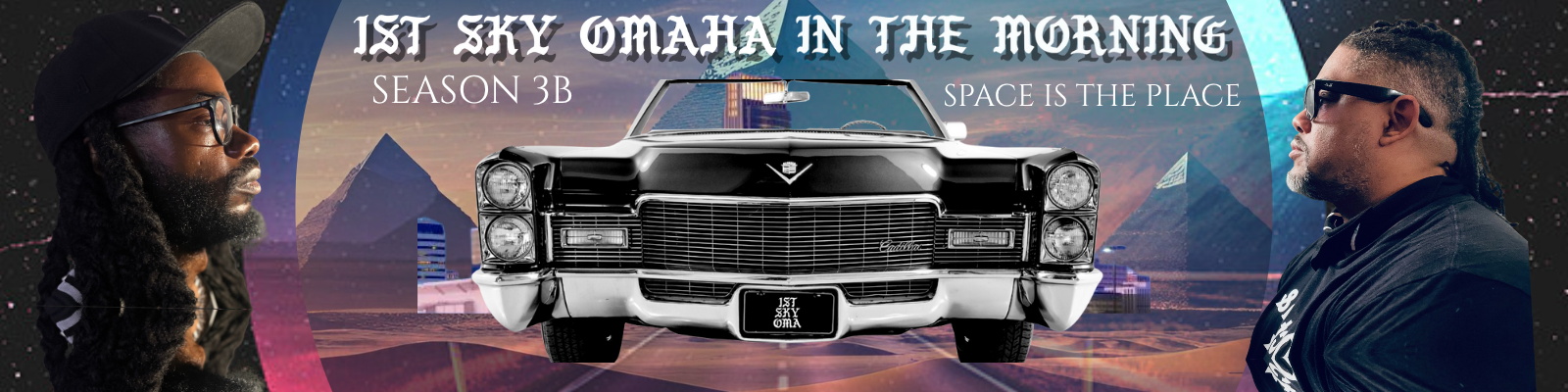
It was a Love Supreme Friday on 1st Sky Omaha in the Morning, and hosts Paul B. and Buddy the God set the tone early. Before the news, before the guests, before anything else, Paul B. made a deliberate choice. “We have to make a decision,” he told viewers. “It’s going to be Love Supreme Friday today. And we’re going to change our mindsets over to something else — it’s an effort because it’s real easy to let your emotions take over when there’s so much to be emotional about.” That spirit of intentional positivity carried the entire episode, anchored by a conversation that felt less like a broadcast interview and more like a community gathering around something important.
The show’s centerpiece was a rich, wide-ranging conversation with Dana Murray, founder and director of the North Omaha Music Academy (NMA), located on North 24th Street. A musician and educator with deep roots in Omaha, Murray spent eleven years in New York City before returning home, and has now spent two decades teaching music in the city he never really left behind. What he’s built at NMA — part youth academy, part performance venue, part broadcast lab — is exactly the kind of institution North Omaha has long deserved.
Murray didn’t mince words about why arts matter in a community still finding its footing. “The arts are the core of who we are as people — definitely as black people — and the history of North Omaha, and really Omaha,” he said. “There’s so much shared history from North Omaha and South Omaha, and with a lot of the development going on infrastructure-wise, very little is talked about the social, people development, healing that has to happen to even take advantage of all the opportunities.” He’s spent his career shining light on exactly those unquantifiable things — the things you feel before you can name them.
The conversation turned, as it often does on this show, to the future of North 24th Street — what the hosts affectionately call “the Deuce.” Paul B. has long held a special reverence for it. “I’ve always called it the most important black corner in Nebraska,” he said. “We got to serve it. We have to be of service to it.” Murray agreed, and offered a vision both practical and inspired. He pointed to Omaha’s other redeveloping districts — Blackstone, Benson, Little Bohemia — and argued that none of them can claim what North 24th Street actually has: authentic cultural history. “The area that has the most history and the one that can truly claim to be a cultural and arts district is the North 24th Street corridor,” Murray said, describing old photographs of a thriving Saturday morning street scene — people shopping, eating, men in their suits. “It was a vibe,” he said. “There was a unity and togetherness.”
Viewer Pops chimed in with a memory that brought that history to life: “Artists like Fats Domino used to stay at your grandfather’s home when he came to town to perform. So yes, more infrastructure for the artist around the Deuce corridor would be a godsend.” It was one of those chat moments that reminded everyone watching why this show matters — history lives in the community, not just the textbooks.
Murray also addressed something that often goes unspoken: the tension between pride and progress. Though he grew up in South Omaha, he said the divide is a false one. “If you’re black and you’re in Omaha, especially in the ’70s and early ’80s, everyone had a shared relationship with North Omaha. That was the Mecca for us.” He spoke candidly about missed opportunities to showcase Black culture to all of Omaha, and about his own efforts to make NMA a beacon — not just for North Omaha, but for the whole city. “People told me that was going to be very hard,” he said, “but people have no problem coming from wherever they are in Omaha or Iowa to come hear jazz music or whatever we present. That taboo about the area and its ability to be an attraction was false — we’ve proven that.”
The vision for NMA’s future is nothing short of ambitious. Murray spoke about a planned capital campaign — the first phase at $20 million — with the ultimate goal of building a full NMA campus. He invoked Omaha Performing Arts as a model, an institution that brings $40 to $50 million in economic activity to downtown every year, and said plainly: that’s what North Omaha needs. “Our culture is equity,” he said. “Our brilliance and artistic genius is equity, and the sooner we understand that, the better off we’re going to be.”
Beyond the music lessons, NMA is already doing the work. Students learn live sound engineering, broadcast production, and podcasting. They interview visiting artists. They are, as Murray put it, not just being told they can be something — they’re being it right now. “Once you remove those barriers,” he said, “the sky’s the limit.” Viewer Senator KML put it simply: “Thank you, Uncle Dana. You’re changing lives in big ways. We are the students.”
The episode also touched on local primary election results, with Buddy the God noting that civic participation remains the missing piece in building real community power. “None of this really matters if everybody voted,” he said. “The reality is, until we do that, we’re going to have to keep building our own ecosystems — and we got to do both.” Viewer Mama God echoed the sentiment: “People say they want younger leaders, but are they prepared to donate their time and vote? Low to average turnout even when Spivey, McKini, Kimra, Wayne, etc. are on the ballot.” Viewer Sean McCarthy added context, noting that “the Douglas County Election Commissioner said the average primary voter turnout percentage was around 35% in Douglas County” — a sobering number on an otherwise uplifting Friday.
Good news also found its way into the show. The team celebrated Core Science Bio Diagnostics, a North Omaha diagnostic lab, which recently won a $52,000 prize — the kind of local win that deserves more applause than it gets. And Paul B. offered a warm preview of the upcoming NMA Fest, calling it the gold standard. “When I’m comparing festivals, I’m saying this one to me is the one,” he said. “If I was going to put a festival together, it’d be this — and it’s going to be huge.”
The show closed with Paul B. reflecting on what all of it — the interviews, the news, the chat, the community — is really about. He called it the “secondary matrix”: the deeper purpose underneath the surface of a morning talk show. “What we’re really trying to do is build community, build some coalition, be able to speak to and build a family of people that we can regularly talk to and come to some conclusions and get to some action.” Viewer Judy Princ offered perhaps the most quietly powerful line of the morning: “If you are sad or angry, go out and help others. Your attitude will change.”
On that note, Love Supreme Friday signed off — but the conversation, as always, is just getting started. Tune in Monday morning and join the family.