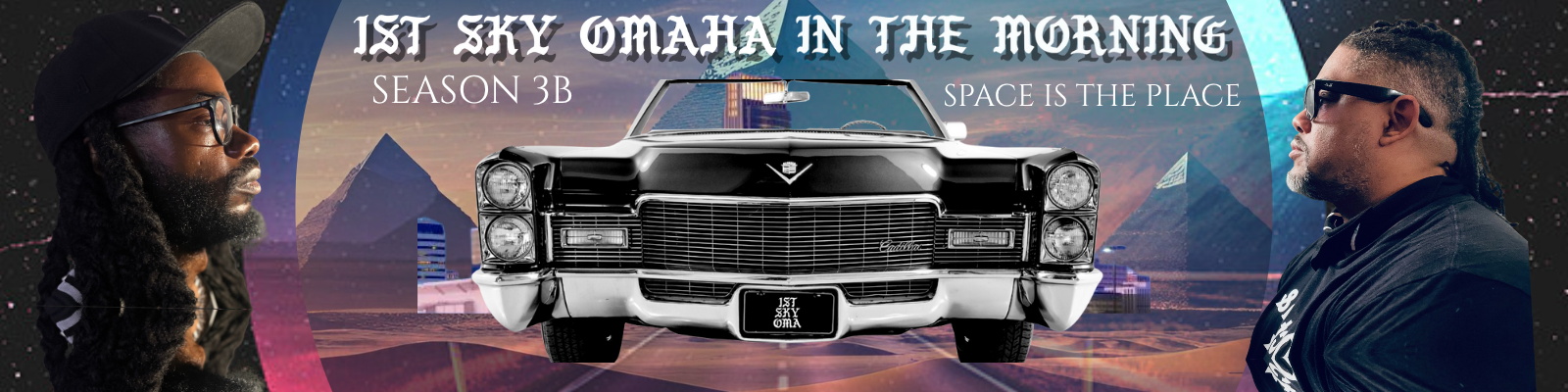
It was a Love Supreme Friday on 1st Sky Omaha in the Morning, and hosts Paul B. and Buddy the God made a deliberate choice to steer the ship toward community, culture, and possibility — even as the political waters around them stayed choppy.
The morning after Nebraska’s primary election, the conversation in the show’s viewer chat had apparently gotten heated. Paul B. didn’t shy away from acknowledging it. “There’s a lot of chatter going on on Friends of First Sky Omaha,” he said. “There’s a lot of back and forth, friends breaking up, all kinds of stuff happening over politics — and that just is like, okay, well, we have to make a decision. It’s going to be Love Supreme Friday today.” And with that, the tone was set.
Still, the election wasn’t entirely off the table. Buddy the God raised a sobering number shared by Raquel Henderson of the mayor’s office: only 339,000 of more than 1.2 million registered Nebraska voters showed up to the polls. “Nationwide, more people don’t vote than do,” Buddy said. “And as I’ve been pointing out, it’s the missing piece — as far as people having to fend for themselves — and the reality is until we do that, we’re going to have to keep building our own ecosystems.” Viewer Kimber Snipes added some nuance from the chat: “I’ve been having conversations with people between the ages of 20 and 35. What I hear the most is most of them don’t really know what to do and know nothing about the candidates. I don’t think we should be slamming people for not voting when the system is really what has caused this. I think we need to have more education and deep dive discussions.”
It was a thread that wove itself naturally into the morning’s main event — a rich, wide-ranging conversation with Dana Murray, founder and executive director of the North Omaha Music Academy (NMA). Murray, a South Omaha native who spent eleven years in New York City before returning home, has planted his flag on North 24th Street, and he’s thinking big.
Murray didn’t mince words about the corridor’s untapped potential — or the obstacles standing in the way. “Really, the area that has the most history and the one that can claim ‘we are a cultural and arts district’ for real is the North 24th Street corridor,” he said. “And we’ve been so far removed from that — not even what the rest of Omaha views North 24th Street as. I’m more talking about the people that are there being so far removed from what that was, that it is hard to build momentum from within when a lot of the community can’t relate to the power of what was.” Paul B., who has long called the intersection of 24th and Lake “the most important Black corner in Nebraska,” echoed the urgency. “We have to be of service to it,” he said simply.
Murray laid out a practical vision for what a thriving corridor actually requires — housing, parking, laundries, eateries, gas stations — and then the destinations that draw people in: entertainment venues, restaurants, lounges, and eventually, a hotel. “With a hotel, now you can throw larger attractions, music festivals, conferences right in the community,” he said. It’s not a dream sequence. It’s an infrastructure checklist.
And NMA itself is already checking boxes. The academy teaches youth music performance, but also live sound, broadcasting, podcasting, and live streaming — real, marketable skills. Murray was clear-eyed about who his students will become. “We’re not only raising musicians but more importantly we’re raising more critical thinking human beings,” he said, “because all these young kids are not going to become musicians by choice. Some will become doctors, some will become lawyers, some will become business owners — but whatever they choose to do, they’re going to be better because they were aligned with artistry.” Paul B. framed it through what he calls the “secondary matrix” — the deeper transformation that happens beneath the surface of any discipline. “The secondary matrix for him is to create critical thinkers,” Paul B. explained, “create people that can go further in their fields because they have the discipline of musical training and the mind-expanding benefits of musical training.” Viewer Pops knew exactly what they meant: “I experienced my secondary matrix in junior high when I took algebra. I was gaining proficiency and noticed that I was suddenly able to think outside the box on several different levels. Music the same.”
Murray also pushed back gently on the notion that NMA is just “a cool little music thing.” He pointed to Omaha Performing Arts as a model — an institution that generates $40 to $50 million in annual revenue for its surrounding area — and made the case that Black culture deserves to be treated with the same economic seriousness. “Our culture is equity,” he said. “Our brilliance, our artistic genius is equity. Every music in America has been built off of our experience — from the hardest rock music to the jazziest jazz music to the poppiest pop music, you trace it all the way back to the music that was brought over here from Africa.” The sooner the community monetizes that legacy, he argued, the better positioned North Omaha will be.
The vision doesn’t stop at the current building. Murray described plans for a $20 million capital campaign — the first phase of what he hopes becomes a full NMA campus, a cultural vehicle for North Omaha the way Omaha Performing Arts is for downtown. “It’s a very simple equation,” he said. “The larger the attractions, the larger the crowds, the more fuel you have to develop an area.”
NMA is also actively seeking music instructors who can do more than teach scales. “They don’t need us for the ‘what’ — they can go to YouTube and see anything we’re trying to teach them,” Murray said. “The ‘why’ they’re doing it is everything.” Interested educators can reach Murray directly at dmurray@northomahamusic.org or assistant Andrew Bailey at abailey@northomahamusic.org. And for those looking to experience NMA’s work firsthand, the upcoming NMA Fest is on the horizon — keep an eye on their channels for details.
The show closed on a warm note, with viewer Aeros 402 sharing a personal milestone that put everything in perspective: “On a love note, my only daughter gave birth to my second granddaughter. They are both new and good. I feel blessed.” It was exactly the kind of moment Love Supreme Friday was made for.
Whether the conversation turned to voter turnout, corridor revitalization, or the quiet genius of teaching a child to play an instrument, the throughline was the same: build something real, right here, for the people who call this place home. That’s the 1st Sky way — and it’s a pretty good reason to tune in Monday morning and see what’s next.