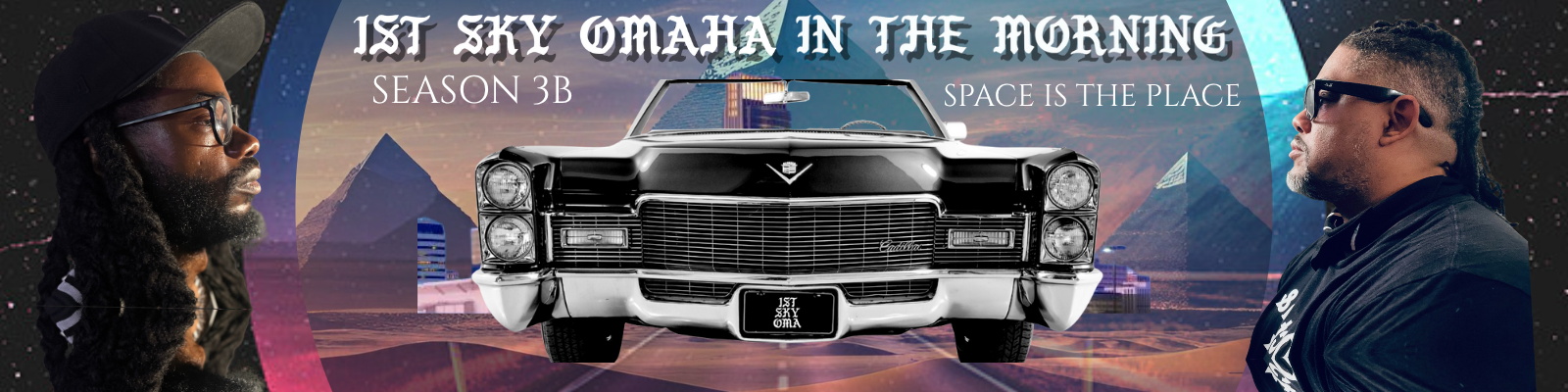

There are Fridays, and then there are Love Supreme Fridays. This past episode of 1st Sky Omaha in the Morning was decidedly the latter. Host Paul B. set the tone right out of the gate, declaring, “We have to make a decision. It’s going to be Love Supreme Friday today. And we’re going to change our mindsets over to something else.” And just like that, the show pivoted from the week’s midterm primary results toward something more nourishing — a conversation about community, culture, and the quiet, determined work of building something lasting in North Omaha.
Co-host Buddy the God didn’t let the civic moment pass entirely without comment, noting that electoral participation remains the missing link in so much of what the community is striving for. “None of this really matters if everybody voted,” he said plainly. “It’s the missing piece.” But Buddy was equally clear that organizing from within can’t wait for perfect political conditions. “We got to do both — build our own ecosystems and continue to vote so it can be supported and uplifted rather than undermined by those in office.” Viewer Mama God echoed the sentiment in the chat, writing, “People say they want younger leaders, but are they prepared to vote? Low to average turnout even when Spivey, McKini, Kimra, Wayne, etc. are on the ballot.”
With that foundation laid, the show welcomed its featured guest: Dana Murray, executive director and founder of the North Omaha Music Academy — formerly known as Love’s Jazz — nestled right on the North 24th Street corridor. Murray, a musician and educator who spent eleven years in New York City before returning home to Omaha, brought an infectious mix of vision, practicality, and deep cultural pride to the conversation.
When asked about what the North 24th Street corridor — affectionately called “the Deuce” — could and should be, Murray didn’t romanticize. “There are very deliberate, intentional things that have to be in place for a community to thrive,” he said, ticking off the essentials: housing, groceries, parking, laundromats, restaurants, entertainment destinations, and ideally a hotel capable of hosting large-scale music festivals and conferences. He acknowledged the emotional weight of North Omaha’s legacy while insisting that emotion alone won’t rebuild it. “A lot of stuff on North 24th Street hasn’t been sustainable, and I can’t get caught up in the emotion of redevelopment.”
Paul B., who has long called North 24th Street “the most important black corner in Nebraska,” pressed Murray on how someone raised in South Omaha comes to feel such ownership over this particular stretch of the city. Murray’s answer was both personal and historical. “If you were black and in Omaha, especially in the 70s and early 80s, everyone had a shared relationship with North Omaha. That was the Mecca for us.” He drew a pointed contrast between how the community has traditionally presented itself versus how it could: “I love Native Omaha Days at its core, but it’s a failed opportunity to showcase our culture because it doesn’t invite the rest of Omaha to partake in what we have to offer. Compare that to South Omaha’s Cinco de Mayo — they champion their culture and invite everybody.” Murray said NMA has worked to be that open invitation, and that the supposed taboo about outsiders visiting North 24th was simply false. “People have no problem coming from wherever they are in Omaha or Iowa to hear jazz music or whatever we present. We’ve proven it.” Viewer Pops reinforced the point with a piece of living history: “Artists like Fats Domino used to stay at your grandfather’s home when he came to town to perform. So yes, more infrastructure for the artist around the Deuce corridor would be a godsend.”
The heart of the interview turned to NMA’s mission, which Murray described as something far deeper than music lessons. The academy serves as a youth music school, a performance space, and — in its fullest ambition — an economic engine modeled after what Omaha Performing Arts has meant for downtown. “We’re not only raising musicians; more importantly, we’re raising more critical thinking human beings,” Murray said. “All these young kids are not going to become musicians by choice — some will become doctors, lawyers, business owners — but whatever they choose, they’re going to be better because they were aligned with artistry.” NMA also teaches live sound, broadcasting, and podcasting so students understand these aren’t distant dreams. “They can do these things right now,” Murray emphasized, “not just aspire to them someday.”
Murray spoke movingly about how NMA connects students to local musical legends — figures like Buddy Miles and Victor Lewis — not through dry biography but through meaningful context. “If you give kids context, they connect the dots for themselves and start to see the wins and losses — not only in black history but in the rest of the country. Then they can see how they can be impactful within that ecosystem. Now you’ve got a critical thinking human. That’s ultimately what we’re trying to do.”
Paul B. tied this directly to what he called the “secondary matrix” — a framework the hosts return to often on the show. “Everything that we do has a secondary meaning, a deeper meaning,” he explained. “The secondary matrix for Dana Murray is to create critical thinkers — create people that can go further in their fields because they have the discipline of musical training.” The concept also came up later in the episode when Paul B. previewed the film I Love Boosters, directed by Boots Riley and screening at Film Streams on May 22nd. “He’s not just making an entertaining film,” Paul B. said. “He’s going to make a film with a secondary matrix that’s going to teach you a lesson about all the things he’s fighting against.”
Looking ahead, Murray outlined a $20 million capital campaign — the first phase of a full NMA campus — and reframed the conversation around what North Omaha’s greatest asset actually is. “Money is not our issue in North Omaha — it’s transformative ideas,” he said. “What we have to sell in most black communities is our culture. Our culture is equity. Every music in America has been built off of our experience, from rock to jazz to pop — trace it all back to the music brought over from Africa. The sooner we look at that as equity to build and monetize for our community, the better we’re going to be.” NMA is also currently seeking music instructors who can do more than teach technique. As Murray put it, “The ‘why’ they’re doing it is everything. The instructors we bring in have to have in their arsenal the ability to inspire another human being.” Interested candidates can reach Murray at dmurray@northomahamusic.org or his assistant Andrew Bailey at abailey@northomahamusic.org.
The show also gave a shoutout to local entrepreneur Charell Shelton of Core Science Bio Diagnostics, and the chat was full of community warmth throughout. Viewer Judy Princ offered a piece of wisdom that fit the day’s spirit perfectly: “If you are sad or angry, go out and help others. Your attitude will change.” And viewer Aeros 402 brought pure joy to the feed, sharing, “On a love note, my only daughter gave birth to my second granddaughter. They are both new and good. I feel blessed.”
It was, by every measure, a Love Supreme Friday. Join Paul B., Buddy the God, and the whole 1st Sky Omaha in the Morning family back here Monday — you won’t want to miss what’s next.