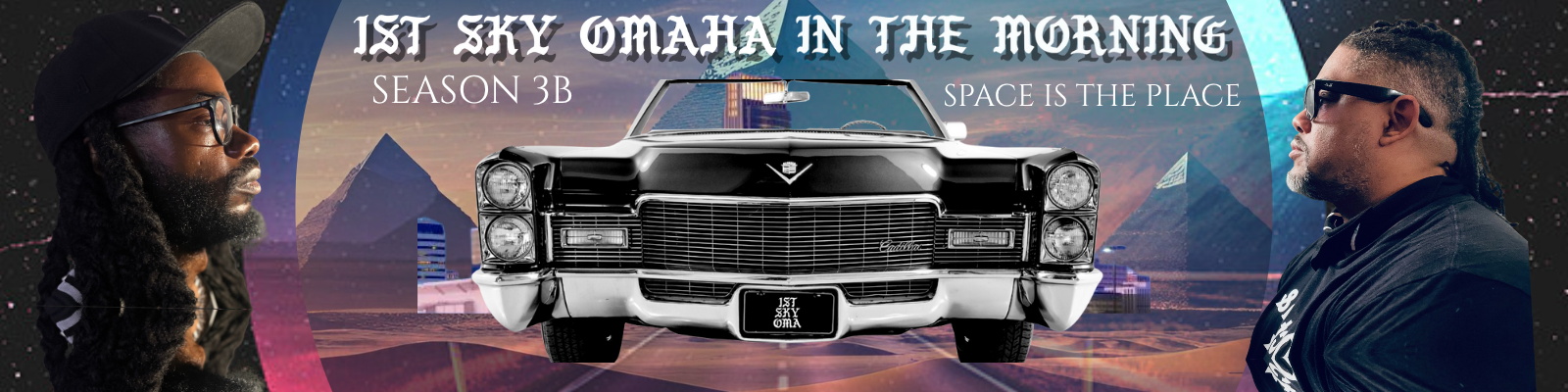
It was a Friday morning with a lot weighing on the air — primary election results still fresh, familiar frustrations about civic engagement simmering in the chat — but host Paul B. wasn’t having it. Not today. “We have a lot going on that I could be feeling kind of low about,” he told viewers at the top of the show, “but it’s a decision. It’s going to be Love Supreme Friday today, and we’re going to change our mindsets.” And just like that, the tone was set for what turned out to be one of the more inspiring episodes of the season.
Co-host Buddy the God helped ground that energy in something personal. A product of the engineering program at Omaha North, he reflected on how that education shaped him far beyond any career path. “I didn’t necessarily go into the field of civic engineering,” he said, “but that critical thinking, that understanding of processes and systems — that is definitely a product of Omaha North.” It was the kind of moment that quietly previewed everything the show was building toward: a conversation about what it really means to invest in young people, in community, and in a stretch of street that holds more history than most people know.
That stretch is North 24th Street — what Paul B. has long called “the most important Black corner in Nebraska.” And the guest brought in to talk about its future was someone who has staked his life’s work on it: Dana Murray, executive director and founder of the North Omaha Music Academy, known to many as NMA and formerly as Love’s Jazz.
Murray is a South Omaha native who spent eleven years in New York City before coming home and planting himself firmly on the North 24th Street corridor, where he has been teaching music for more than two decades. His story alone would make for good radio, but what makes Murray compelling is how he thinks. Ask him about music lessons and he’ll answer with a philosophy of human development. “We’re not only raising musicians,” he said, “but more importantly raising more critical thinking human beings, because all these young kids are not all going to become musicians. Some will become doctors, lawyers, business owners — but whatever they choose, they’re going to be better because they were aligned with artistry.”
Paul B. had a name for that kind of layered purpose. He called it the “secondary matrix” — the idea that there’s always a deeper mission beneath the visible one. “In Dana Murray’s case, he teaches kids music,” Paul B. explained, “but the secondary matrix is to create critical thinkers.” Viewer Pops recognized the concept immediately, writing in: “I experienced my secondary matrix in junior high when I took algebra. I was gaining proficiency and noticed I was suddenly able to think outside the box on several different levels. Music the same.”
Murray made that connection vivid when he talked about teaching students the history of musicians like Buddy Miles and Victor Lewis — both Omaha natives who went on to shape American music in profound ways. The key, he said, isn’t just dropping names. “They’re not going to retain it if you just tell them Buddy Miles is from here and he played with Jimi Hendrix,” he said. “We’re teaching them who Buddy Miles was, what he represented for the community, what he represented for the world. If you give kids context, they connect the dots for themselves — and now you’ve got a critical thinking human.”
The conversation widened naturally into a vision for what the North 24th Street corridor could become. Murray was both clear-eyed about the challenges and unapologetically ambitious about the possibilities. “The area that has the most history and the one that can claim we are a cultural and arts district for real is the North 24th Street corridor,” he said. He ticked off the building blocks any thriving district needs — housing, eateries, parking, laundromats, entertainment — and then raised the bar higher: “It would be great to have a hotel. With a hotel, you can throw larger attractions, music festivals, conferences right in the community.”
He pointed to Omaha Performing Arts as a model — not just as a cultural institution, but as an economic engine generating tens of millions in revenue annually for its surrounding area. “That’s what we’re trying to build for North Omaha,” Murray said. Viewer Pops echoed the sentiment with a piece of living history: “Artists like Fats Domino used to stay at your grandfather’s home when he came to town to perform. So yes, more infrastructure for the artist around the Deuce corridor would be a godsend.”
Murray also spoke candidly about Black culture as a form of equity — one that is too often monetized by others and undervalued by its own community. “Every music in America has been built off of our experience,” he said. “From the hardest rock music to the jazziest jazz to the poppiest pop, you trace it all the way back to the music brought over here from Africa. That’s equity, and the sooner we look at it that way, the better we’re going to be.”
NMA is currently building toward a $20 million first phase of a capital campaign, with a full campus as the long-term vision. Murray is also looking for music instructors who bring more than technical skill to the table. “Unless you’re able to inspire a young person, they don’t really have the attention span for the X’s and O’s of music,” he said. Interested educators can reach him at dmurray@northomahahusic.org or his assistant Andrew Bailey at abailey@northomahahusic.org.
The show’s warmth spilled over into the viewer chat all morning. Viewer Aeros 402 shared a love note of his own: “My only daughter gave birth to my second granddaughter. They are both new and good. I feel blessed.” And viewer Senator KML summed up what many were feeling about the guest: “Thank you, Uncle Dana. You’re changing lives in big ways. We are the students.”
Buddy the God closed out the civic thread with a reminder that community building and political engagement aren’t an either/or choice. “We got to do both,” he said. “We have to build our own ecosystems and continue to do the things we’re about to talk about. But in the long run, we do got to figure this out as far as this political structure — because whether you want to be engaged in it or not, you’re a part of it. Don’t pay taxes and see what happens.”
It was that kind of Friday — equal parts grounded and inspired, practical and visionary. The kind of morning that reminds you why local matters. Tune in next week for another edition of 1st Sky Omaha in the Morning, and bring a neighbor along for the conversation.