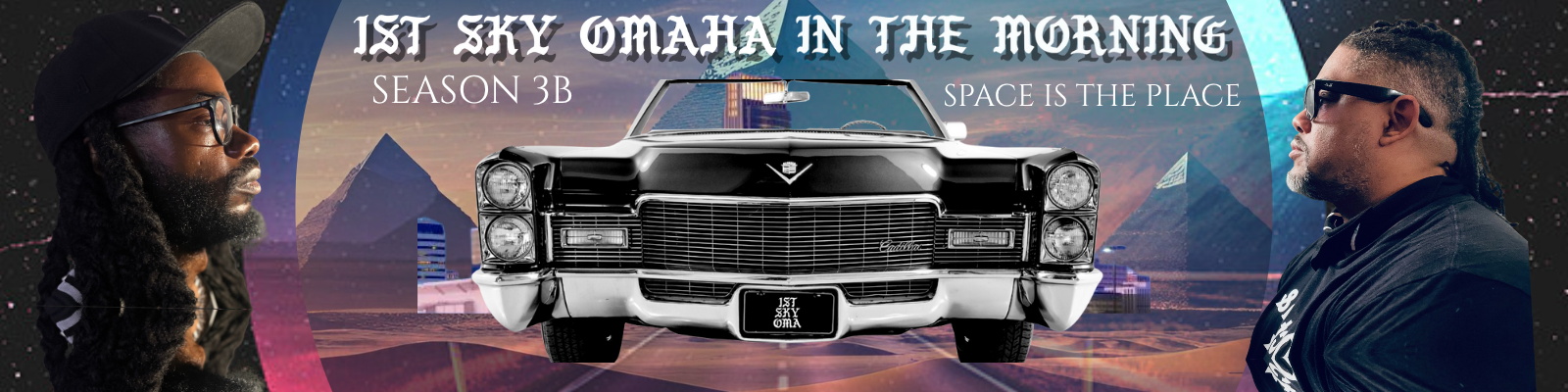

Friday mornings on 1st Sky Omaha in the Morning have a rhythm all their own, and this past week’s episode leaned into that feeling hard. Hosts Paul B. and Buddy the God made a deliberate choice to shift the energy after what had been a charged primary election season. “We have to make a decision,” Paul B. told the audience. “It’s going to be Love Supreme Friday today. And we’re going to change our mindsets over to something else.” And just like that, the show pivoted — from politics to purpose, from division to community, from noise to music.
That pivot set the table perfectly for their guest: Dana Murray, founder and director of the North Omaha Music Academy (NMA), located on North 24th Street. A South Omaha native who spent eleven years in New York City before returning home, Murray has spent two decades teaching music in Omaha and is now building something that he believes could reshape the economic and cultural future of the entire North 24th Street corridor.
The conversation opened with what Paul B. called the “secondary matrix” — the idea that community efforts carry a deeper purpose beneath the surface. “Everything that we do has a secondary meaning, a deeper meaning,” he said. Murray didn’t miss a beat. “The arts are the core of who we are as people — definitely as black people,” he said. “A lot of my agenda has been wrapped around shining light on the things you really can’t see but are there.” Viewer Pops echoed the thought from the chat, writing: “I experienced my secondary matrix in junior high when I took algebra. I was gaining proficiency and I noticed that I was suddenly able to think outside the box on several different levels. Music the same.”
Murray’s vision for NMA reaches well beyond a music school. He pointed to Omaha Performing Arts as a model — not just as a cultural institution, but as an economic engine that generates $40 to $50 million in revenue annually for its surrounding area. “We need a vehicle like that for North Omaha,” he said plainly. His plans include a capital campaign with a first phase of $20 million, with the long-term goal of developing a full NMA campus. “Money is not our issue really in North Omaha,” he said. “It’s transformative ideas that are going to allow us to be not only sustainable but gainfully active. The sooner we understand that our culture is equity, that our brilliance and artistic genius is equity, the better off we’re going to be.”
Paul B., who has long championed the stretch of North 24th Street he calls “the most important black corner in Nebraska,” pressed Murray on the vision for what the corridor could become. Murray was direct: the infrastructure has to be real — housing, services, parking, eateries — and the destination attractions have to follow. “It would be great to have a hotel,” Murray said. “With a hotel, you can throw larger attractions, music festivals, conferences right in the community.” He acknowledged that momentum from within the community has been hard to build, partly because so many people have grown disconnected from what North 24th Street once represented. “That was the Mecca for us,” he said of his own relationship to the corridor growing up. “And I think one of the things that holds us back is this false sense of security with pride as it pertains to North Omaha. None of that does anything for us at this point.”
Viewer Pops offered a vivid historical footnote during the discussion, writing: “Artists like Fats Domino used to stay at your grandfather’s home when he came to town to perform. So yes, more infrastructure for the artist around the Deuce corridor would be a godsend.” It was the kind of detail that reminded everyone in the chat — and everyone watching — just how deep the roots of this community run.
Inside NMA’s walls, Murray and his team are already doing the work. Students learn live sound, broadcasting, podcasting, and interviewing — skills that position them for futures in any field. “We’re not only raising musicians but more importantly raising more critical thinking human beings,” Murray explained. “All these young kids are not going to become musicians by choice. Some will become doctors, lawyers, business owners. Whatever they choose, they’re going to be better because they were aligned with artistry.” He described a broadcast lab where students interview visiting artists, teaching them context and history alongside craft. “We’re teaching who Victor Lewis was — why he’s one of the most recorded jazz drummers in history. If you give kids context, they connect the dots for themselves.”
Viewer Derek Higgins offered a simple but warm note from the chat: “Congrats, Dana, and what NMA is doing.” That sentiment seemed to run through the entire audience. NMA is currently seeking music instructors with the ability to inspire, not just instruct. Interested candidates can reach Murray at dmurray@northomahmusic.org or his assistant Andrew Bailey at abailey@northomahmusic.org.
The episode also made room for pure joy. Viewer Aeros 402 shared a personal milestone mid-show: “On a love note, my only daughter gave birth to my second granddaughter. They are both new and good. I feel blessed.” The hosts paused to celebrate — because that’s what Love Supreme Friday is for.
Buddy the God closed out the civic thread of the show with a reminder that all of this community-building exists within a larger context. “We got to build our own ecosystems,” he said, “and continue to do the things that we’re about to talk about. But in the long run, we do got to figure this out as far as a nation.” The primary season may be behind us, but the work — the real work — is always just beginning.
If Friday’s episode left you inspired, hopeful, or simply glad to be an Omahan, you won’t want to miss what’s coming next. Tune in to 1st Sky Omaha in the Morning — because the conversation that matters most is always happening right here at home.