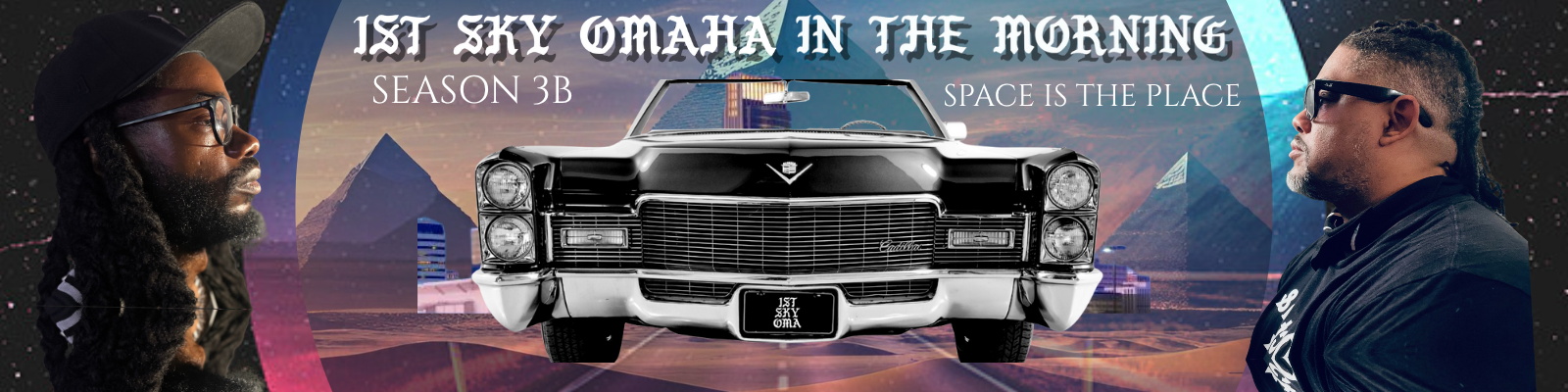
It was a Friday morning with intention behind it. From the moment the stream went live, co-host Paul B. made clear that the energy was shifting. “We’ve been talking a lot of politics for a while and it’s time to change our mindsets over to something else — it’s going to be Love Supreme Friday today,” he told viewers. And that’s exactly what it was.
Still, the show never pretends the world outside isn’t turning. Before the conversation fully pivoted, co-host Buddy the God paused to read aloud a post from Raquel Henderson of the mayor’s office, a sobering reminder of Nebraska’s primary election results the day before. “Only 339,000 out of more than 1.2 million registered voters in Nebraska showed up yesterday. Posting on Facebook is not enough. Awareness without action changes nothing.” Viewer Kimber Snipes offered some context from her own experience: “I’ve been having conversations with people between the ages of 20 and 35. What I hear the most is most of them don’t really know what to do and know nothing about the candidates. I don’t think we should be slamming people for not voting when the system is really what has caused this. I think we need to have more education and deep dive discussions.” It’s the kind of nuanced back-and-forth that keeps 1st Sky Omaha in the Morning feeling less like a broadcast and more like a kitchen table.
But the heart of this particular Friday belonged to Dana Murray, director of the North Omaha Music Academy — known to the community simply as NMA. A South Omaha native who spent eleven years honing his craft in New York City before returning home with a mission, Murray brought a calm, visionary energy to the conversation that had the chat section buzzing. Viewer Pops summed it up simply: “I love this interview. This brother’s vibe is so cool and his intentions are admirable. First Sky loves the kids.”
Murray’s academy sits on the North 24th Street corridor — what Paul B. has long called “the most important black corner in Nebraska.” And Murray’s vision for what that corridor could become is both practical and profound. He didn’t speak in abstractions. He spoke in hotels, foot traffic, housing density, parking, and laundromats — all the unglamorous infrastructure that allows a community to truly sustain itself. “For any district to succeed, you have to have enough housing, enough people from within to provide fuel, places of service, parking, laundromats, eateries, gas stations — all the things any area needs to be self-sustained,” he said. “And then you have to have destinations: entertainment, restaurants, lounges, things that are your bread-and-butter attractions to draw people into the community.”
He also challenged a comfortable complacency he sees around the neighborhood’s identity. Pointing to the contrast between Native Omaha Days and South Omaha’s Cinco de Mayo celebration, he was direct: “They champion their culture and invite everybody down. One of the things I’ve tried to do was reach out and be a beacon for all of Omaha to come down to North 24th Street. People told me that was going to be very, very hard, but people have no problem coming from wherever they are in Omaha or Iowa to come down to hear jazz music. That taboo about the area and its ability to be an attraction was false. We’ve proven that.” Viewer Mark Manor echoed that from personal experience: “When I go there it is the same people at shows at Waiting Room, Slow Down, and the Jewels. So people are coming from all around town and getting down at NMA, which I find impressive.”
NMA is not simply a place where kids learn to play instruments, though they do that too. Murray described a broader curriculum that includes live sound engineering, broadcasting, podcasting, and on-camera interviewing — with real artists, in real time. “It’s not just telling them ‘you can be this’ — no, you can be this right now,” he said. “Once you remove those barriers, sky’s the limit.” Paul B. connected the dots for viewers with what he called the “secondary matrix” — the deeper purpose beneath the surface mission. “The secondary matrix for him is to create critical thinkers. Everybody’s not going to make it as a musician, but they become a better student, more intelligent, more mind-expanded when you expand the mind with studying music.”
Murray also spoke candidly about the economic argument for Black cultural investment — a point he framed not as sentiment, but as strategy. “The sooner we understand that our culture is equity, that our brilliance and our artistic genius is equity, the better off we’re going to be,” he said. “Every music in America has been built off of our experience, from the hardest rock to the jazziest jazz to the poppiest pop. You trace it all the way back to the music that was brought over here from Africa. That’s equity.”
Looking ahead, NMA Fest is on the horizon — four nights of live music designed to do exactly what Murray preaches: draw people in, build energy, and fuel the corridor. It’s the opening move in a larger capital campaign, with a $20 million first phase and a full NMA campus as the long-term goal. Murray’s ambition is clear: he wants NMA to be for North Omaha what Omaha Performing Arts is for downtown — a cultural and economic engine. “Money is not our issue in North Omaha,” he said. “It’s transformative ideas that are going to allow us to be not only sustainable but gainfully active.”
For those inspired to get involved, NMA is actively seeking music instructors with more than technical skill. “Unless you’re able to inspire a young person, they don’t really have the attention span for the technical side of music,” Murray explained. Interested educators can reach him at dmurray@northomahmusic.org or his assistant Andrew Bailey at abailey@northomahmusic.org.
The show closed on the warm, community-woven note it always seems to find. Viewer Aeros 402 (Mary Sanchez) shared joyful news mid-stream: “On a love note, my only daughter gave birth to my second granddaughter. They are both new and good. I feel blessed.” It was, in many ways, the perfect Love Supreme Friday moment — new life, new vision, and a neighborhood refusing to stop building.
Buddy the God offered the thread that tied the whole morning together: “We got to do both — build our own ecosystems and continue to engage the political structure. You still do for self and then you vote so it can be supported and uplifted.” It’s a philosophy. It’s also a Friday morning in Omaha.
Tune in Monday to 1st Sky Omaha in the Morning — because the conversation is always worth showing up for.