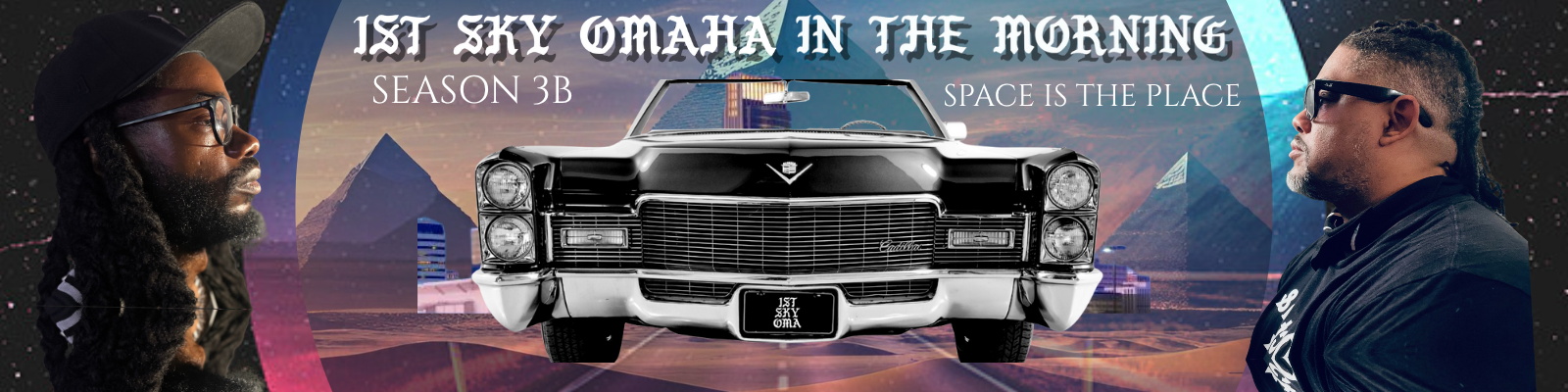
It was a Love Supreme Friday on the set of 1st Sky Omaha in the Morning, and hosts Paul B. and Buddy the God made good on that title — setting the tone for a show that was equal parts community vision, civic reflection, and genuine inspiration. With primary election results still fresh on everyone’s minds, the duo made a conscious choice to shift the energy.
“We’ve been talking a lot of politics for a while and it’s time for a little break,” Paul B. told viewers. “It’s real easy to let your emotions take over when there’s so much to be emotional about — hot, mad, sad — and then it’s just, hey, let’s make a decision to change it up today.”
But changing it up didn’t mean checking out. Before the show’s marquee guest arrived, the hosts took a moment to reflect on civic engagement — and why it still matters even when the system feels broken. Viewer Kimber Snipes captured a sentiment many are feeling, writing in that her conversations with people between the ages of 20 and 35 reveal a troubling knowledge gap: “Most of them don’t really know what to do and know nothing about the candidates. I don’t think we should be slamming people for not voting when the system is really what has caused this. I think we need to have more education and deep dive discussions.”
Buddy the God echoed that frustration while holding firm on the stakes. “None of this really matters if everybody voted,” he said. “You can sit it out, and I understand why a lot of people are just disengaged with the system in general — but it’s the missing piece. Until we do that, we’re going to have to keep building our own ecosystems. We got to do both.”
That idea — building your own ecosystem — became the throughline of the entire episode when Dana Murray, founder and director of the North Omaha Music Academy (NMA), joined the conversation. A South Omaha native who spent eleven years in New York City before returning home to plant roots on North 24th Street, Murray brought the kind of grounded, forward-thinking vision that made the chat room light up from the moment he started talking.
Murray didn’t shy away from the big picture. When asked what the North 24th Street corridor — “the deuce,” as the hosts lovingly call it — could and should become, he laid out a blueprint rooted in both history and practicality.
“The area that has the most history and the one that can claim we are a cultural and arts district — for real — is the North 24th Street corridor,” Murray said. “As a district, you would also need destinations: entertainment, restaurants, lounges, things that are going to be your bread-and-butter attractions. It would be great to have a hotel — with a hotel, now you can throw larger attractions, music festivals, and conferences right in the community.”
Paul B. has long held that stretch of Omaha in the highest regard. “I’ve always called it the most important black corner in Nebraska,” he said. “We have some history there and some legacy there, and that’s what it’s about. We have to be of service to it.” Viewer Pops added a personal touch to that history, recalling that “artists like Fats Domino used to stay at your grandfather’s home when he came to town to perform — so yes, more infrastructure for the artist around the Deuce corridor would be a godsend.”
When someone in the chat noted that Murray hails from South Omaha rather than North, he addressed it directly — and thoughtfully. “If you’re black and you’re in Omaha, especially in the 70s and early 80s, North Omaha was the Mecca for us,” he said. “Everyone had a shared relationship with North Omaha.” He also challenged the community to reconsider how it presents itself to the broader city, pointing to South Omaha’s Cinco de Mayo celebration as a model of cultural pride that also extends an open invitation. “One of the things I’ve tried to do is reach out and be a beacon for all of Omaha to come down to North 24th Street,” Murray said. “People told me that was going to be very hard. But people don’t have any problem coming from wherever they are in Omaha or Iowa to come down to North 24th Street to hear jazz music. That taboo about the area and its ability to be an attraction was false. We’ve proven that.”
At the heart of everything Murray is building is NMA itself — a youth music academy and performance venue that he envisions as something far larger than a music school. He drew a direct comparison to Omaha Performing Arts and the tens of millions in annual revenue it generates for downtown, then made the case that North Omaha deserves that same kind of economic engine.
“We’re not only raising musicians, but more importantly we’re raising more critical-thinking human beings,” Murray said. “Whatever they choose to do, they’re going to be better because they were aligned with artistry. That opens up their curiosity, their ability to set a high bar for themselves, to be accountable.”
He also spoke candidly about brain drain — the steady loss of young talent to larger cities — calling it “a killer for Omaha” and noting that North Omaha is “far more adversely affected by it.” His long-term vision includes a full NMA campus, anchored by a $20 million first phase of a capital campaign. “What we have to sell in most black communities is our culture,” he said. “The sooner we understand that our culture is equity, that our brilliance and our artistic genius is equity, the better off we’re going to be.”
For music educators interested in joining the NMA team, Murray encouraged outreach directly to him at dmurray@northomahamusic.org or to his assistant Andrew Bailey at abailey@northomahamusic.org. He was clear, however, that inspiration matters as much as instruction. “Unless you’re able to inspire a young person, they don’t really have the attention span for the X’s and O’s of music,” he said. “The why you’re doing it is everything.”
As the show wound down, Paul B. returned to a concept he called the “secondary matrix” — the deeper purpose humming beneath everything the show, and guests like Murray, are trying to do. “Everything that we do has a secondary meaning, a deeper meaning,” he said. “On the surface, we’re a couple of talking heads that talk about some news with the community — but what we’re really trying to do is build community, build some coalition, build a family of people that we can regularly talk to and come to some conclusions so we can get to some action.” Viewer Pops put it beautifully: “I experienced my secondary matrix in junior high when I took algebra. I noticed that I was suddenly able to think outside the box on several different levels. Music the same.”
The show closed with a reminder of upcoming events — including NMA Fest and a Film Streams screening of Boots Riley’s film I Love Boosters — and not before Paul B. shared one last gem, a quote from his grandmother that felt tailor-made for Love Supreme Friday: “Dance is the shortcut to happiness.”
It was that kind of morning in Omaha — the kind that reminds you why community matters, why art matters, and why showing up — for your neighbors, for your city, for each other — is never wasted effort. Tune in next week for more of the conversations that keep Omaha connected, curious, and moving forward.