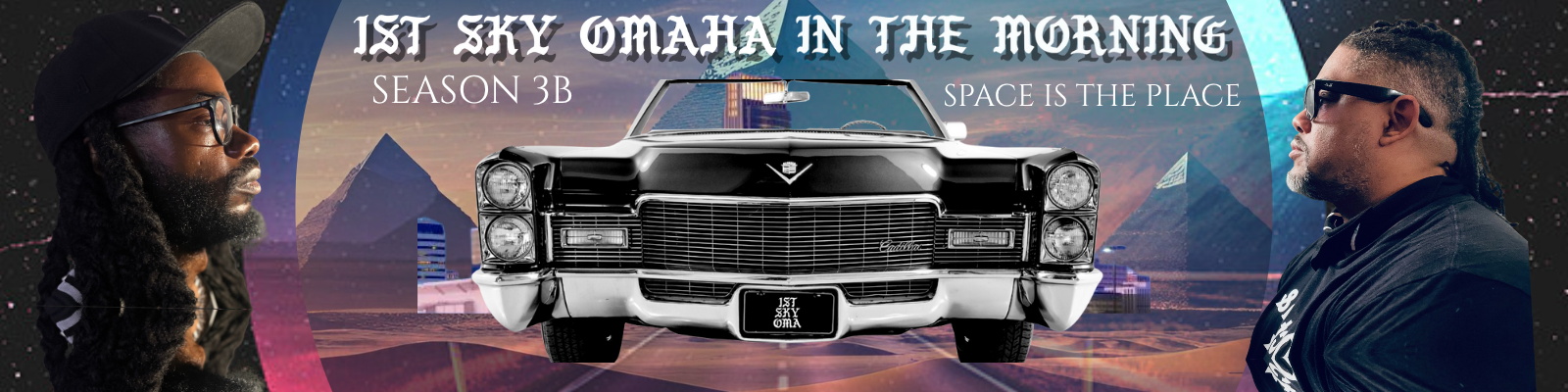

It was a “Love Supreme Friday” on 1st Sky Omaha in the Morning, and hosts Paul B. and Buddy the God made good on the promise right from the jump. After a stretch of heavy political coverage in the wake of Nebraska’s primary election, the duo made a deliberate choice to shift the energy. “We’ve been talking a lot of politics for a while and it’s time for a little break,” Paul B. told the audience. “Love Supreme’s going down today for sure.” And with that, the show turned its full attention to the people and institutions quietly building something beautiful in North Omaha.
The election didn’t disappear entirely — viewer Sean McCarthy noted that Douglas County’s average primary voter turnout clocked in around 35%, and the chat had plenty of thoughts on local races. But Buddy the God offered a perspective that framed the whole morning: “We got to do both — we have to build our own ecosystems and continue to do the things that we’re about to talk about. But in the long run, we do got to figure this out as far as a nation.” With that grounding thought in place, the conversation moved toward building.
The hosts touched on several community wins worth celebrating. Charell Shelton’s diagnostic lab earned a shout-out, as did Heart Ministry Center’s upcoming grocery store — a major development for food access on the north side. And Omaha North’s engineering program recently received national recognition, a reminder that excellence is alive and well in the community. These weren’t passing mentions; they were woven into a larger argument that the infrastructure for a thriving North Omaha already exists in the hearts and hands of people working every day.
That argument found its fullest expression in the morning’s main interview: a wide-ranging, deeply engaging conversation with Dana Murray, the director of the North Omaha Music Academy (NMA), located at 24th and Lake — what Paul B. has long called “the most important Black corner in Nebraska.” Murray, a South Omaha native who spent eleven years in New York City before returning home to teach and build, brought both vision and candor to the conversation.
Asked about the potential of the North 24th Street corridor, Murray didn’t sugarcoat the challenges. “We’ve been so far removed from what that was — not even what the rest of Omaha views North 24th Street as,” he said. “I’m more talking to the people that are there who are so far removed from what that was, that it is hard to build momentum from within when a lot of the community can’t relate to the power of what was.” He laid out a clear framework for what a thriving district requires: housing, services, parking, eateries — and destinations. “It would be great to have a hotel — with a hotel, now you can throw larger attractions, music festivals, and conferences right in the community.”
Some might wonder about Murray’s place in that North Omaha story given his South Omaha roots. He addressed it head-on. “If you’re Black and you’re in Omaha, especially in the 70s and early 80s, everyone had a shared relationship with North Omaha. That was the Mecca for us.” He was equally direct about what he sees as a persistent missed opportunity: “At every opportunity, we fail at taking advantage of showcasing our culture and highlighting the excellence of who we are.” He pointed to Native Omaha Days with affection but also with honest critique, calling it “a failed opportunity to showcase our culture because none of that is trying to invite the rest of Omaha down to partake in what we have to offer.” NMA, he said, has already proven the skeptics wrong. Viewer Mark Manor backed that up from experience: “When I go there, it is the same people at shows at Waiting Room, Slow Down, and the Jewels. So people are coming from all around town and getting down at NMA, which I find impressive.”
Murray’s vision for NMA stretches far beyond music lessons. He invoked Omaha Performing Arts — which brings in $40 to $50 million in annual revenue — as a model for what NMA could become for North Omaha. “We’re not only raising musicians, but more importantly we’re raising more critical thinking human beings,” he said, “because all these young kids are not going to become musicians by choice. Some will become doctors, some will become lawyers, some will become business owners. Whatever they choose to do, they’re going to be better because they were aligned with artistry.” Paul B. put it plainly: the secondary matrix — the idea that music training develops minds capable of excellence in any field — is the real product NMA is delivering to the community.
Beyond instruments, NMA students are learning live sound engineering, broadcasting, podcast production, and how to interview working artists. “So it’s not just telling them ‘you can be this,'” Murray said. “No, you can be this right now.” The academy is also in the early stages of a $20 million capital campaign, with an eye toward an NMA campus that could anchor the corridor the way a performing arts center anchors a downtown. “What we have to sell in most Black communities is our culture,” Murray said. “Our culture is equity. Our brilliance, our artistic genius is equity. The sooner we understand that, the better off we’re going to be.”
NMA Fest — four nights of live music — is coming up soon, and Murray extended a simple, heartfelt invitation: come out, support live music, and see what North Omaha is about. Music instructors who share NMA’s philosophy of inspiring young people can reach Murray at dmurray@northomahahusic.org or assistant Andrew Bailey at abailey@northomahahusic.org.
The morning closed the way it opened — with warmth. Viewer Pops summed it up for the whole chat: “Thanks for another great week of shows. You and the Chat Chimers have made First Sky a true pillar in the community.” Paul B. closed with a piece of wisdom passed down from his grandmother: “Dance is the shortcut to happiness.” On a Love Supreme Friday, that felt exactly right.
Tune in Monday morning for another edition of 1st Sky Omaha in the Morning — your neighbors will be there, and so should you.