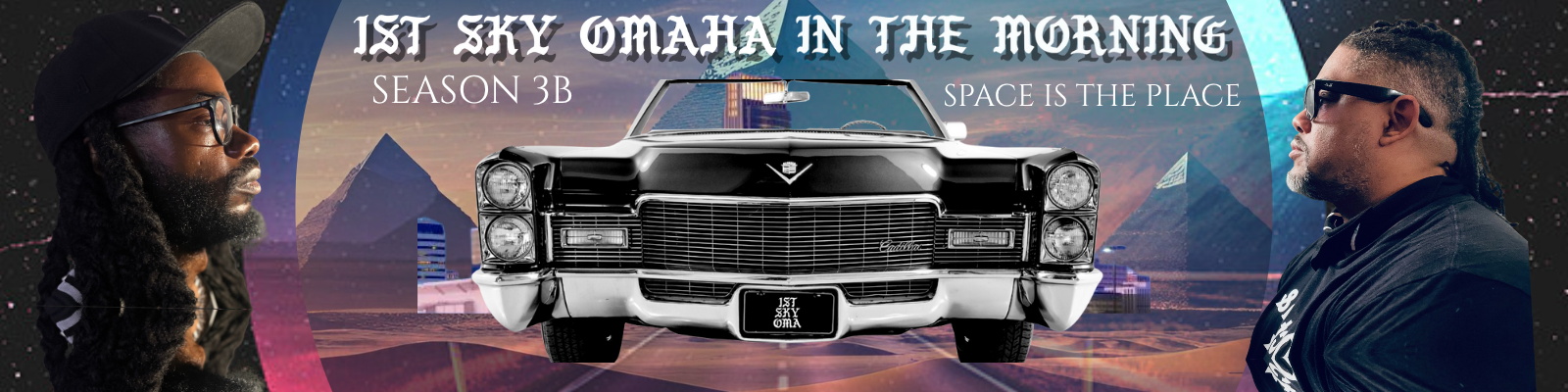
It was a Love Supreme Friday on 1st Sky Omaha in the Morning, and hosts Paul B. and Buddy the God were in the kind of mood that makes you want to pull up a chair and stay awhile. After weeks of heavy political coverage surrounding the Nebraska primary, the two took a breath — and an intentional one at that.
“We’ve been talking a lot of politics for a while and it’s — we got a little break after the primaries,” Paul B. told listeners. “Never going to go away completely, but it doesn’t have to dominate the show today.”
That said, the primary results were still on everyone’s mind — and the numbers were hard to ignore. Paul B. read aloud a post from Raquel Henderson of the mayor’s office that stopped the room: “Only 339,000 out of more than 1.2 million registered voters in Nebraska showed up yesterday. Think about that for a second. And yet everybody has something to say. Posting on Facebook is not enough. Awareness without action changes nothing.”
The chat lit up in response. Viewer Kimber Snipes offered a more measured take: “I’ve been having conversations with people between the ages of 20 and 35. What I hear the most is most of them don’t really know what to do and know nothing about the candidates. I don’t think we should be slamming people for not voting when the system is really what has caused this. I think we need to have more education and deep dive discussions.” Viewer Sean McCarthy added another layer: “One huge problem is so many of these positions don’t pay a living wage, so only those who can afford to hold those positions run.”
Buddy the God brought it home with the kind of clarity the show does best: “We got to do both. We got to build our own ecosystems and continue to do the things that we’re about to talk about — but in the long run, we do got to figure this out as far as a nation.”
And with that, the show turned its full attention to one of Omaha’s most exciting community builders: Dana Murray, founder and director of the North Omaha Music Academy (NMA).
Murray — a musician and educator who grew up in South Omaha, spent eleven years in New York City, and returned home to plant something lasting — sat down for a wide-ranging conversation about what the North 24th Street corridor was, what it is, and what it could become.
Paul B. set the stage with characteristic passion. “I’ve always called it the most important Black corner in Nebraska,” he said. “We have some history there and some legacy there — and that’s what it’s about. We have to be of service to it.” Viewer Pops echoed that sentiment from the chat: “Artists like Fats Domino used to stay at your grandfather’s home when he came to town to perform. So yes, more infrastructure for the artist around the Deuce corridor would be a godsend.”
Murray spoke with equal reverence — and equal urgency. “The area that has the most history and the one that can claim we are a cultural and arts district, for real, is the North 24th Street corridor,” he said. “And we’ve been so far removed from that — not even what the rest of Omaha views North 24th Street as. I’m more talking to the people that are there who are so far removed from what that was, that it is hard to build momentum from within when a lot of the community can’t relate to the power of what was.”
His vision for what the corridor could be is both practical and bold. He talked about the infrastructure any thriving district needs — housing, eateries, parking, laundromats — alongside the destination attractions that draw people in. He even floated the idea of a hotel, which he said would open the door to larger music festivals and conferences right in the heart of the community.
Some had questioned whether Murray, a South Omaha native, had standing to lead that charge. He answered thoughtfully. “If you’re Black and you’re in Omaha, especially in the 70s, early 80s, everyone had a shared relationship with North Omaha,” he said. “That was the Mecca for us.” He also issued a gentle challenge to the community itself, comparing North Omaha’s cultural celebrations to South Omaha’s Cinco de Mayo: “They invite everybody down to be part of that. One of the things I’ve tried to do was reach out and be a beacon for all of Omaha to come down to North 24th Street. People told me that was going to be very, very hard. And people don’t have any problem coming from wherever they are in Omaha or Iowa to come down to North 24th Street to hear jazz music.”
At its core, NMA is a youth music academy and performance venue — but Murray is quick to reframe what that really means. “We’re not only raising musicians, but more importantly we’re raising more critical thinking human beings,” he said. “Some will become doctors, some will become lawyers, some will become business owners. Whatever they choose to do, they’re going to be better because they were aligned with artistry.” The Academy also teaches live sound, broadcasting, and podcast production — giving young people real, working skills. “It’s not just teaching them ‘oh you can be this’ — no, you can be this right now.”
And the future? Murray has his eyes on a full NMA campus, anchored by a $20 million first phase of a capital campaign. He pointed to Omaha Performing Arts as a model — not just culturally, but economically. “If we don’t monetize our culture — which 99% of the time we don’t — the rest of the country monetizes our culture,” he said. “The sooner we understand that our culture is equity, that our brilliance and our artistic genius is equity, the better off we’re going to be.”
Paul B. had introduced the morning with a concept he called the “secondary matrix” — the idea that everything worthwhile has a deeper purpose woven underneath it. By the end of the conversation with Dana Murray, that idea had never felt more alive. And Buddy the God wrapped the week with a simple invitation: “All you have to do is find get in where you fit in. That’s all you got to do. It’s all happening. The lanes are running. The lanes are wide open.”
Before signing off, the chat offered one more warm moment. Viewer Ariel 402 shared some beautiful personal news: “On a love note, my only daughter gave birth to my second granddaughter. They are both new and good. I feel blessed.” The whole room paused to celebrate that — because that’s what Love Supreme Fridays are for.
Whether you’re a longtime listener or just finding your way to the First Sky family, pull up a chair Monday morning — the conversation is always worth showing up for.