

Read the full article on KETV 7
This space matter has been ‘missing’ for decades — MIT researchers just found it
Scientists at MIT find ‘missing’ space matter, drawing new maps of the universe

Digital Content Producer, Video

Chief Meteorologist
An astrophysics team at the Massachusetts Institute of Technology has located mysterious space matter labeled “missing” since the late 1990s, a scientific paper published July 21 reports.
WCVB spoke with one of the lead researchers, Dr. Haochen Wang, who specializes in cosmology and radio astronomy, to better understand the implications of their findings. According to Wang, their report could reframe previous assumptions about the complexity of the universe. Essentially, space isn’t as empty as we think.
Advertisement
After calculating the amount of ordinary matter (a substance made of atomic particles that forms anything physical) in the universe, scientists hit a wall when discovering roughly 90% of the matter was undetectable with 20th-century equipment. They later hypothesized the missing matter likely existed as hot diffused gas with a low density, making it difficult to observe.
But in 2007, scientists discovered Fast Radio Bursts, individual flashes of radio waves traveling through space and coming from the distant universe. They also found these FRBs’ wavelength pattern changes whenever they travel through ordinary matter.
They did not, however, have the data or tools to locate where in the universe these FRBs traveled through missing matter… yet.
Today, data from the CHIME telescope in British Columbia is helping Wang and his team to finally map out the missing matter.
Photo shows: The CHIME telescope in British Columbia
According to Wang, his research team has analyzed almost 3,000 FRBs so far, comparing their wavelength changes to various locations across the universe. As a result, they have begun to map out the clusters of hidden matter.
Photo shows: The map of missing matter
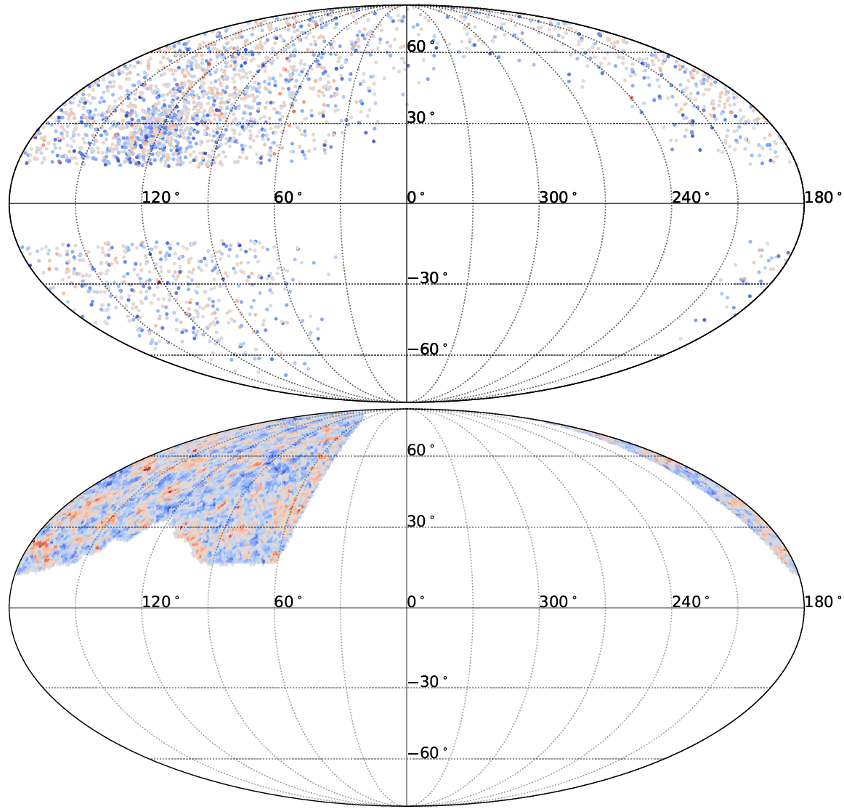
From this map, current results indicate ordinary matter taking up more space in the areas around individual galaxies, which is reshaping the way scientists understand the universe.
“The takeaway of the study is that by discovering the distribution of the missing matter around galaxies, we have found evidence for strong activities in galaxies. In other words, galaxies are busier and messier than we thought,” Wang said.
Previous simulations of matter in the universe show gas clouds of ordinary matter hovering closely to galaxies because of the inward-pulling tendencies of gravity. But this new research and its resulting simulations build on that idea.
Photo shows: The new (left) and old (right) simulations of matter in the universe
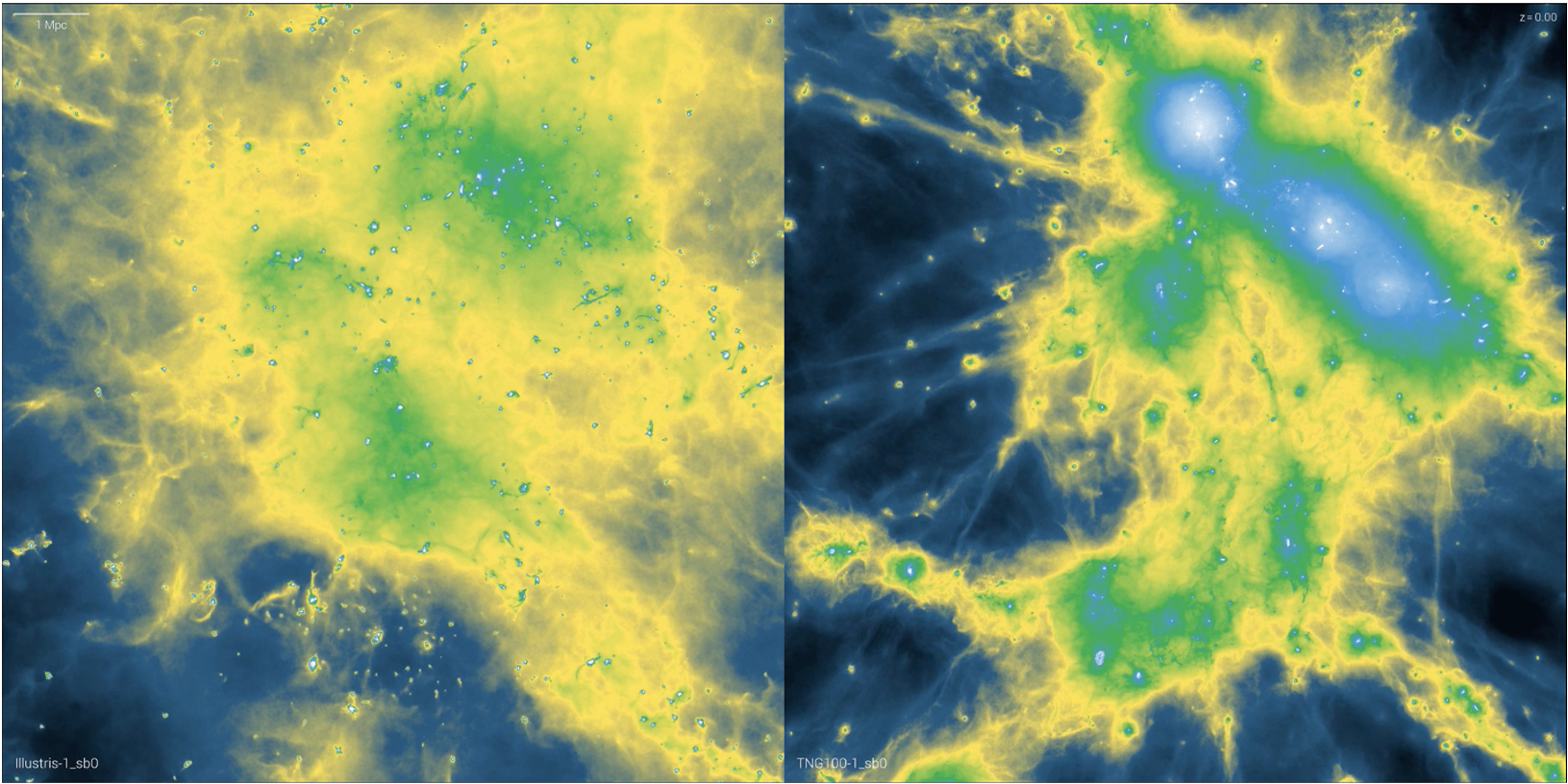
“Everything, naively you think, will be just falling into a galaxy because there’s gravity pulling in,” Wang said. “[But] the busy events in galaxies like exploding stars [and] bursting supermassive black holes, they really act as something that can project [ordinary matter] out.”
The typical span of a galaxy is around 100,000 light years, according to Wang. But from the research team’s current simulations, these clouds of missing matter extend to more like 4 million light years around galaxies.
While their initial findings indicate a different foundational understanding of the universe, Wang and his team plan to continue building on their research and its implications. But Wang said there is still much to learn.
“There are follow-up experiments, and our current experiments are still going. So there will be more data coming in,” Wang said. “So in other words, we are expecting a lot better data and more powerful techniques to extract more information about the universe.”