

Read the full article on KETV 7
Tracking alligator attacks: Here’s which states are home to the apex predator
Data Visualization Journalist
Already this year, there have been four reported alligator attacks on people in the U.S. One of those attacks — in late June — was fatal.
Brittany Clark, 31, was swimming in a Central Florida river when a 13-foot alligator pulled her under, amputating her left arm and severely injuring her right arm. She later died of her injuries.
Advertisement
Clark is at least the 39th person to be killed in an alligator attack since 1980. Last year, three were killed — two in Florida, one in Louisiana.
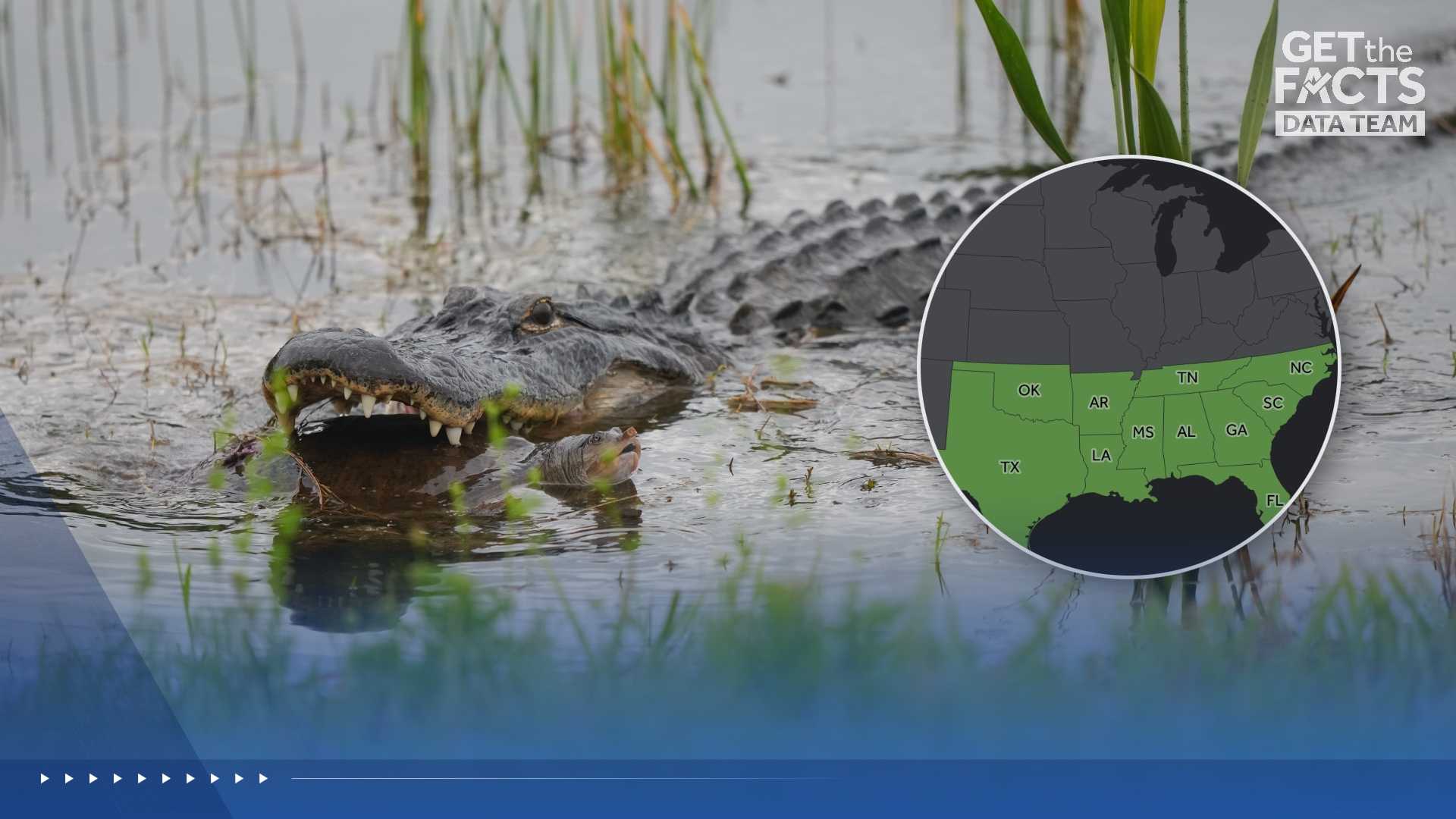
Where alligators can be found
Eleven states have wild alligator populations.
Louisiana has the highest number of alligators, about 3 million, followed by Florida.
Many states, however, do not have an up-to-date estimate of their alligator populations. Mississippi and Oklahoma are currently resurveying their state populations.
Part of the lack of current information is because the alligator departments at many of these state wildlife divisions are very small — some are run by just one person.
“It’s hard when I’m just a one-man leader,” said Andrew Arnett, alligator program leader for the Mississippi Department of Wildlife, Fisheries and Parks.
Alligator attacks tracker
Similar to data on alligator populations, data on attacks is sparse. The U.S. Fish and Wildlife Department has no national count.
The Get the Facts Data Team contacted the wildlife departments of each of the 11 states with alligators to build a database of attacks.
Louisiana’s wildlife department does not keep records on alligator attacks, despite the state having the largest population. Using data from CrocAttack, which only goes back to 2015, the Get the Facts Data Team was able to identify five attacks in the state.
Florida publishes comprehensive records on alligator injuries and fatalities online.
The Get the Facts Data Team was also able to obtain records on attacks from Georgia, North Carolina and Arkansas, although these states have few alligators and few attacks. Oklahoma and Tennessee wildlife department representatives were not aware of any attacks in their states.
Texas does not have an official database but provided some attack information based on a survey of staff. Alabama also surveyed its alligator staff to provide information on attacks in their state.
In Mississippi, Arnett, who took over the alligator program three years ago, estimates there is about one attack a year. Mississippi is in the process of digitizing attack records and was not able to pull the data in time for publication.
Experts from the South Carolina Department of Natural Resources did not provide attack data by the time of publication.
The majority of documented attacks, about 92%, occurred in Florida, which is also the state with the most extensive recordkeeping.
Last year, beyond the three fatal incidents, 13 people were attacked by the large reptiles.
Some attacks may go underreported if someone was injured while illegally hunting or poaching.
How to stay safe
Alligator attacks are very rare and are most often caused by human-initiated contact.
“It’s not the aggressiveness of the alligator, it’s the risky behavior of humans,” said Frank Mazzotti, professor of wildlife ecology at the University of Florida.
Always assume alligators are present, never feed them, be careful when disposing of food waste near water, do not harass the reptiles, watch out for your pets and stay aware — that is the advice from experts at the 11 state wildlife departments home to alligators, who created GatorWise as a resource to educate people about alligators.
If you see an aggressive alligator, do not approach and call the appropriate state wildlife hotline.
If it heads toward you, run away in a straight line to try to get as much distance between you and the alligator as possible. Zigzagging back and forth is not effective, Mazzotti said.
And if you are among the rare few attacked, fight back.
“Fight like your life depends on it because it does,” Mazzotti said. “Do everything you can. Punch it, poke it in the eye, stick your hand down its throat and make it gag.”