
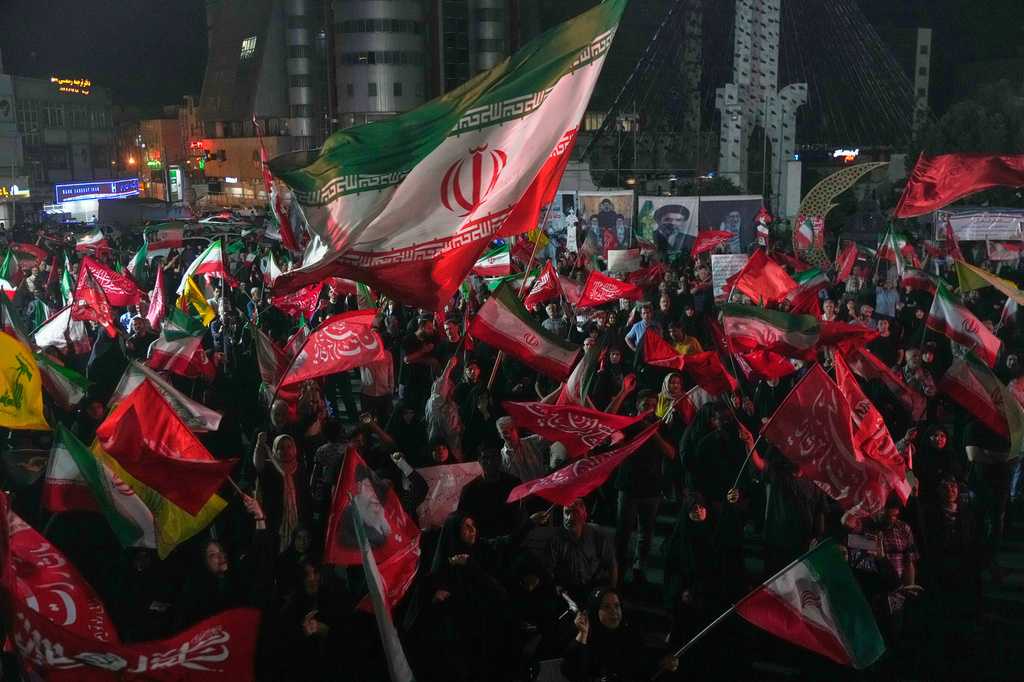

Read the full article on KETV 7
US launches strikes to ‘swiftly punish’ Iran for American troop deaths
Two U.S. service members in Jordan were killed in action as U.S. Central Command (CENTCOM) and partner forces defended against Iranian ballistic missile and drone attacks, according to the Pentagon.
The U.S. military launched air strikes on Sunday to “swiftly punish” Iran’s paramilitary Revolutionary Guard Corps (IRGC) following attacks that killed two American service members, marking the first such deaths from direct Iranian fire since the early days of the war.
President Donald Trump described those deaths as a “shame” on Saturday, but he continued to defend his mission.
Advertisement
“They did it because they don’t want to see Iran have a nuclear weapon,” Trump said of the troops in an interview with the New York Post.
The fallen service members were not immediately identified out of respect for the families. U.S. Central Command (CENTCOM) said they were killed on Friday in Jordan while defending against Iranian ballistic missile and drone attacks alongside partner forces.
In Saturday’s press release, CENTCOM said another service member was missing, and four others were hospitalized but later discharged.
Since the war started in late February, 16 U.S. troops have been killed, with more than 430 wounded.
CENTCOM said Saturday that more than 50,000 Americans in uniform are operating across the Middle East as daily attacks between the U.S. and Iran have intensified following the collapse of an interim deal aimed at ending the fighting.
Iranian authorities said on Saturday that at least 50 people have been killed and more than 500 wounded in the latest U.S. attacks.
During the eighth consecutive night of U.S. strikes, CENTCOM forces “successfully hit Iranian military coastal surveillance and air defense facilities, maritime capabilities, and missile and drone storage sites to continue degrading Iranian military capabilities.”
CENTCOM declined to comment this weekend when asked to confirm Iranian state media reports that U.S. airstrikes have also hit several desalination plants and bridges. The White House didn’t respond to emailed questions.
President Trump has repeatedly threatened to target bridges and power plants, despite concerns that attacks on civilian infrastructure could amount to war crimes.
Tehran has also hit infrastructure in its wide-ranging retaliation against U.S.-allied nations, including attacks on power and desalination plants in Kuwait. The semiofficial Iranian news agency Fars, believed to be close to the IRGC, also issued threats against airports and ports in the UAE on Saturday.
In a statement on Saturday, Iran’s Supreme Leader Mojtaba Khamenei warned of “unforgettable lessons” if the U.S. continues its attacks.
A new warning for Americans abroad
Against that backdrop, the U.S. State Department issued a new alert, warning Americans traveling worldwide, especially in the Middle East, to exercise increased caution.
“Due to heightened tensions in the Middle East, the security environment remains complex with the potential for unforeseen escalation,” the alert said. “Groups supportive of Iran may target other U.S. interests overseas or locations associated with the United States and/or Americans throughout the world.”
The State Department urged Americans to monitor breaking news developments and security alerts issued by their nearest U.S. embassy or consulate. The department also warned that flight cancellations and periodic airspace closures may cause travel disruptions.
Defense spending debate intensifies in Congress
The death of U.S. troops could further intensify a fierce debate in Congress over defense spending.
Lawmakers on both sides of the aisle issued prayers and condolences in response to the news on Saturday, but some Democrats also pointed to the deaths as further proof that, in their view, this war needs to end.
“No more American heroes need to die because of this reckless war of choice,” said House Minority Leader Hakeem Jeffries on social media.
In protest over the war last week, Senate Democrats blocked the advancement of a $1 trillion annual defense bill that, if passed, would substantially increase funding for the Pentagon.
As the typically bipartisan package stalls, House Republicans are moving forward with another approach to pass some defense spending with a smaller price tag, as well as other conservative priorities. If the budget reconciliation push is successful, it could allow Republicans to pass these priorities on a party-line vote, bypassing opposition from Democrats.
House Speaker Mike Johnson said he hopes to pass a key initial legislative step this week before lawmakers leave for their August recess, but he could face roadblocks while navigating a razor-thin Republican majority.