

Read the full article on KETV 7

Meta Platforms and the state of New Mexico returned to court on Monday for the second phase of the legal battle. Following a March decision where a jury ordered Meta to pay a $375 million financial penalty, this phase proceeds as a bench trial, leaving a judge to determine what operational changes the company must implement.The state has presented a public nuisance case against the social media giant. The claim alleges that Meta has created a specific harm to health or public safety through the design and operations of its business.During a news conference outside the First Judicial Court, parents who say they lost children to social media harms gathered to demand changes.Jen Marcus, the mother of Braden, spoke about her son, whom she described as “forever 15″ after he was sextorted in October 2021.“When a kid says it over and over again, ‘I’m only 15 years old. Why are you doing this to me? I will just kill myself.’ That thread should have been shut down from the get-go,” Marcus said. “They’re not serving this country.”Julianna Arnold, whose 17-year-old daughter, Coco, died from fentanyl poisoning after being groomed on Instagram and sexually assaulted, expressed frustration with the company’s response.“Instead of fixing it, they’re threatening to now pull out of New Mexico. That’s their answer, and it’s just not acceptable,” Arnold said. “It’s like a company choosing to protect its business model instead of doing the right thing and protecting children.”Attorney General Raul Torrez argued that digital harm should be viewed with the same urgency as a physical threat.“If there was in Santa Fe right now, a physical space or a physical warehouse where members of the community could come and understand that they could buy and sell and trade pornography or trade human beings or sexually exploit children, there would be an immediate outcry,” Torrez said.Meta’s legal team, however, argued that the platform is not a public nuisance simply because some individuals misuse the service. In an opening statement, Alex Parkinson, representing Meta, compared the platforms to other industries.“Are bars a public nuisance because drinking alcohol is undeniably associated with car fatalities, fetal alcohol syndrome, with domestic violence?” Parkinson asked. “Is fast food a public nuisance, because it is undeniable that eating processed food and hamburgers contributes to obesity?”Should the judge rule that Meta is a public nuisance, the state has proposed more than 75 potential fixes. These include stricter age limits, the elimination of infinite scroll, and fundamental changes to how algorithms control user feeds.“If your interests lie with little girls, it will be very good at connecting you with little girls. There has to be a technical solution for solving that issue, right?” Torrez said.The defense maintains that the state has not proven these changes are legally or technically feasible. Parkinson noted that Meta has previously attempted to address age-related issues.“For example, the state wants a system that verifies that users are at least 13 years old to 99% accuracy. Gee, what a great idea. I wish we had thought of that — we did,” Parkinson said. “We tried for four years to build that kind of classifier.”Torrez countered by pointing to international regulations as proof that such technical changes are possible.“Australia has banned social media for anyone under the age of 16. What does that mean? It means they’re already working on age verification. They’re just not doing it in America,” Torrez said. “They’re already working on curating different forms of dangerous features on their platform. They’re just not doing it in America.”The judge will also consider a $3.7 billion abatement plan proposed by New Mexico to fund mental health programs, counseling, and education campaigns. Meta argues the figure is inflated and misrepresents the legal definition of abatement.Parkinson stated that the plan includes “the construction of dozens of community-based health centers, buildings, hiring 1000s of doctors to come from out of state to live in New Mexico, and service people here in the state, for any reason. The $3.7 billion abatement plan doesn’t abate. It does not stop the conduct; it pays for the downstream effect of that conduct abatement in the nuisance conduct context,” Parkinson said.The trial is expected to last three weeks.
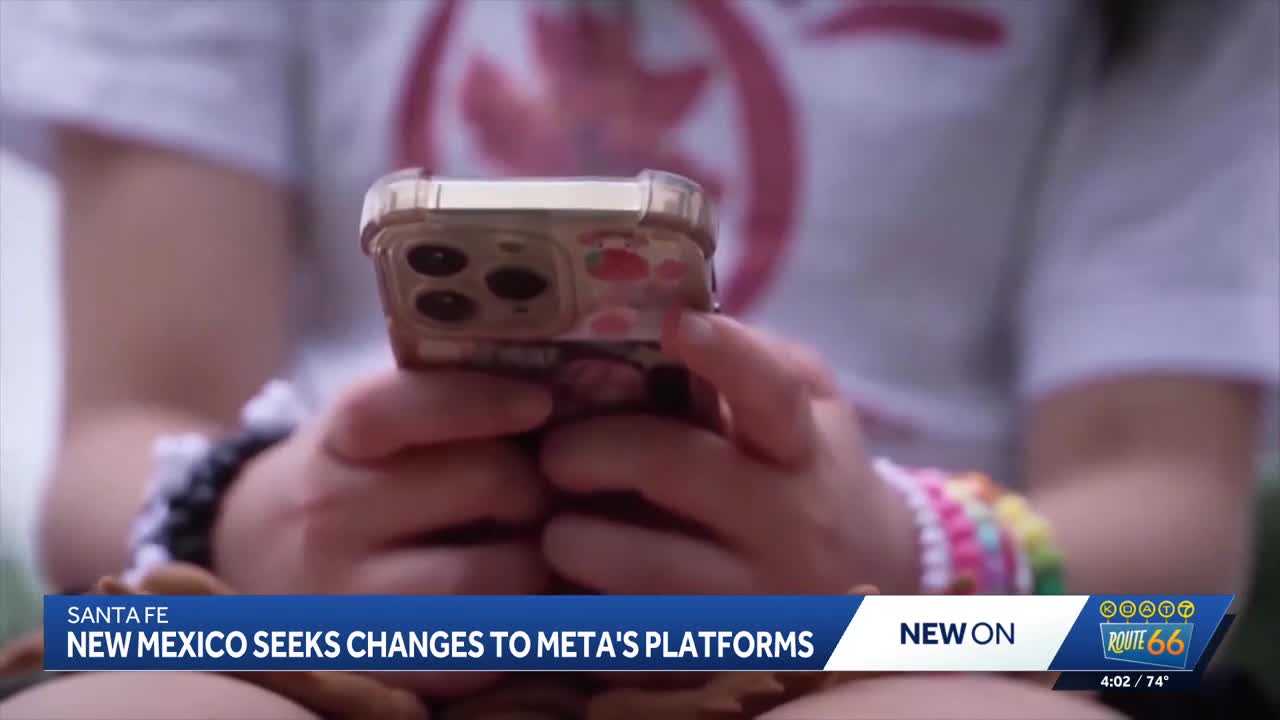
Meta Platforms and the state of New Mexico returned to court on Monday for the second phase of the legal battle. Following a March decision where a jury ordered Meta to pay a $375 million financial penalty, this phase proceeds as a bench trial, leaving a judge to determine what operational changes the company must implement.
The state has presented a public nuisance case against the social media giant. The claim alleges that Meta has created a specific harm to health or public safety through the design and operations of its business.
Advertisement
During a news conference outside the First Judicial Court, parents who say they lost children to social media harms gathered to demand changes.
Jen Marcus, the mother of Braden, spoke about her son, whom she described as “forever 15” after he was sextorted in October 2021.
“When a kid says it over and over again, ‘I’m only 15 years old. Why are you doing this to me? I will just kill myself.’ That thread should have been shut down from the get-go,” Marcus said. “They’re not serving this country.”
Julianna Arnold, whose 17-year-old daughter, Coco, died from fentanyl poisoning after being groomed on Instagram and sexually assaulted, expressed frustration with the company’s response.
“Instead of fixing it, they’re threatening to now pull out of New Mexico. That’s their answer, and it’s just not acceptable,” Arnold said. “It’s like a company choosing to protect its business model instead of doing the right thing and protecting children.”
Attorney General Raul Torrez argued that digital harm should be viewed with the same urgency as a physical threat.
“If there was in Santa Fe right now, a physical space or a physical warehouse where members of the community could come and understand that they could buy and sell and trade pornography or trade human beings or sexually exploit children, there would be an immediate outcry,” Torrez said.
Meta’s legal team, however, argued that the platform is not a public nuisance simply because some individuals misuse the service. In an opening statement, Alex Parkinson, representing Meta, compared the platforms to other industries.
“Are bars a public nuisance because drinking alcohol is undeniably associated with car fatalities, fetal alcohol syndrome, with domestic violence?” Parkinson asked. “Is fast food a public nuisance, because it is undeniable that eating processed food and hamburgers contributes to obesity?”
Should the judge rule that Meta is a public nuisance, the state has proposed more than 75 potential fixes. These include stricter age limits, the elimination of infinite scroll, and fundamental changes to how algorithms control user feeds.
“If your interests lie with little girls, it will be very good at connecting you with little girls. There has to be a technical solution for solving that issue, right?” Torrez said.
The defense maintains that the state has not proven these changes are legally or technically feasible. Parkinson noted that Meta has previously attempted to address age-related issues.
“For example, the state wants a system that verifies that users are at least 13 years old to 99% accuracy. Gee, what a great idea. I wish we had thought of that — we did,” Parkinson said. “We tried for four years to build that kind of classifier.”
Torrez countered by pointing to international regulations as proof that such technical changes are possible.
“Australia has banned social media for anyone under the age of 16. What does that mean? It means they’re already working on age verification. They’re just not doing it in America,” Torrez said. “They’re already working on curating different forms of dangerous features on their platform. They’re just not doing it in America.”
The judge will also consider a $3.7 billion abatement plan proposed by New Mexico to fund mental health programs, counseling, and education campaigns. Meta argues the figure is inflated and misrepresents the legal definition of abatement.
Parkinson stated that the plan includes “the construction of dozens of community-based health centers, buildings, hiring 1000s of doctors to come from out of state to live in New Mexico, and service people here in the state, for any reason. The $3.7 billion abatement plan doesn’t abate. It does not stop the conduct; it pays for the downstream effect of that conduct abatement in the nuisance conduct context,” Parkinson said.
The trial is expected to last three weeks.