Read the full article on Nebraska Examiner
LINCOLN — After months-long resistance by Gov. Jim Pillen, a state board he leads on Thursday approved the use of a state sales tax incentive to help build an Omaha professional soccer stadium and a Lincoln volleyball complex.

The action of the Sports Arena Facility Financing Assistance Act Board drew excitement from representatives of the two urban projects. However, nine other proposals from groups and cities across the state were rejected. A few had been waiting for a board decision for nearly 18 months.
The pair slated to benefit from the so-called turnback tax:
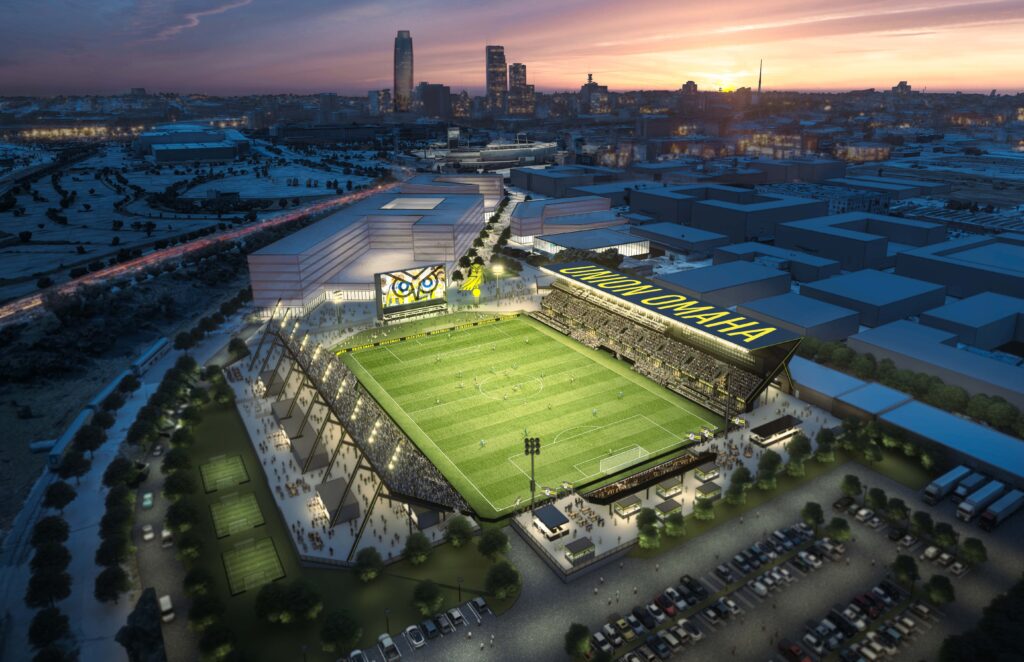
- A $140 million open-air downtown Omaha soccer stadium, a partnership of the City of Omaha and Union Omaha professional soccer franchise. The 6,500-seat facility is to be surrounded by a privately developed district of housing, retail and entertainment venues.
- A $17 million volleyball-centric youth sports complex in Lincoln, a partnership of the City of Lincoln and nonprofit Nebraska for Volleyball (N4VB). Up to 12 indoor courts are envisioned near 30th Street and Folkways Boulevard.
“It’s an exciting next step for us,” Union Omaha general manager Alexis Boulos said following the meeting. Like a soccer ball, she said, the group will be moving “fast and furious” to break ground in the fall on the project that will serve its existing professional men’s team and a new professional women’s team.
‘Sounds like politics’
Thursday’s board meeting in a conference room of the Governor’s Office was brief, lasting less than a half hour, with no public comment.
It’s unclear how many of the other projects — spanning the state from rural Valentine to suburban La Vista — will materialize without a boost from the turnback tax.
Tony Carrow, co-founder and president of Nebraska Elite Volleyball, said his organization’s proposed $63 million sports complex in Douglas County is unlikely to rise without state help. The Douglas County Board of Commissioners was a co-applicant.
“It just doesn’t make sense,” Carrow said after the meeting. “Show me a project that has a better return on investment and track record than ours. It sounds like politics to me.”

Jeff Weak, who helped with the application for a proposed Gretna sports complex featuring youth cheer and dance athletics, said the SAFFAA board’s decision was a major disappointment but that the cheer project team had a potential “Plan B” to help fund the $28.5 million facility.
Weak questioned the board’s actions, and wondered what made one project and not another “in the best interest of the state.” He said he helped write the underlying state law that created the sports facility turnback tax. The SAFFAA board must approve individual applications for the incentive.
“There can’t have been a criteria they actually used, except the political clout that somebody had to call the governor,” Weak said.
For larger cities such as Omaha and Lincoln, the financing incentive works generally like this: Up to 70% of new state sales taxes generated within 600 yards of the sports facility goes to help pay off bonds for construction. The “new” tax revenue generated refers to sales on tickets or retailers that sprout in the designated area for a certain time after the project is announced. In most cases, city voters must approve the use of such bonds. For smaller cities, the state assistance, or tax to be “turned back,” can be 25% of all state sales taxes in the town for five years.
Weak challenged comments some have made that the incentive “takes away from state sales tax.” He said the turnback was designed to capture funds from new retail and economic development spurred by proposals such as the cheer facility.
“How do you lose something you don’t have?” he said. “You only get to eat what you kill.”
For ‘any little girl’
Pillen, who previously resisted approving the incentive at all, said he voted favorably for two projects whose development did not rely too heavily on the state tax assistance and that he believed were good investments. He said he also considered area competitors, and whether the public incentive provided an unfair advantage to an applicant.

He noted that the public incentive for the Omaha soccer stadium, for example, is capped at $25 million over 20 years. Representatives expect new sales tax revenues related to the project and a future mixed-use “stadium district” surrounding it would generate an additional $27 million over that time.
The district envisioned around the soccer stadium, near Charles Schwab Field and Creighton University, is to be privately developed and include about 450 apartments and 40,000 square feet of retail and dining space, raising the total anticipated investment for the stadium and mixed-use district to $330 million across 25 acres of land currently vacant.
The team’s owner expects to invest about $23 million. The facility is to host concerts and community events as well.
The N4VB project, which has been endorsed by former Husker Volleyball Coach John Cook, is envisioned to offer more recreational opportunities at a lower cost than clubs charge for competitive volleyball. Its application projects 418,122 visitors during its first year of operation. The board noted that Lincoln voter approval remains necessary.
Board member Diane Mendenhall, also co-owner of Omaha Supernovas, said in an earlier statement that N4VB supporters intend to “create a world-class training facility for Nebraska’s homegrown talent — without the world-class price of admission.”
Pillen said the facility, which he said was exclusively for girls, “has a far geographic reach and takes care of all the socioeconomic barriers.”
“Any little girl that wants to play volleyball, she doesn’t have to have a penny. She can come and play,” the governor said.
New lens
Nebraska Treasurer Joey Spellerberg is also on the five-member SAFFAA board. One member was absent Thursday. Of the 11 projects considered, Spellerberg supported the turnback tax for only the Omaha downtown soccer stadium.
As a former mayor of Fremont, he said he understands the value each proposal would bring to their communities. But now, via the lens of the state’s chief financial officer, Spellerberg said he acted based on return on investment to the state, jobs and tourism potential and local financial buy-in.
He said other projects considered Thursday — which were discussed during previous hearings where developers and supporters spoke — did not “get me over the top.”
The Union Omaha stadium proposal was approved 3-1 and the N4VB was approved 3-1.
Turnback tax applications rejected by the board:
- City of Norfolk and NE Nebraska Youth Sports Association, 0-4.
- City of Omaha and Omaha Performing Arts, 1-3.
- City of Valley and Elkhorn Athletic Association, 1-3.
- City of Valentine, 1-3.
- City of West Point, 0-4.
- Douglas County and NE Elite Volleyball, 0-4.
- City of Gretna and Wolf Pack Sports Foundation, 0-4.
- City of La Vista, 0-4.
- City of Omaha and Omaha Public Facilities Corp. (Tranquility Park project), 0-4.
SUBSCRIBE: GET THE MORNING HEADLINES DELIVERED TO YOUR INBOX.