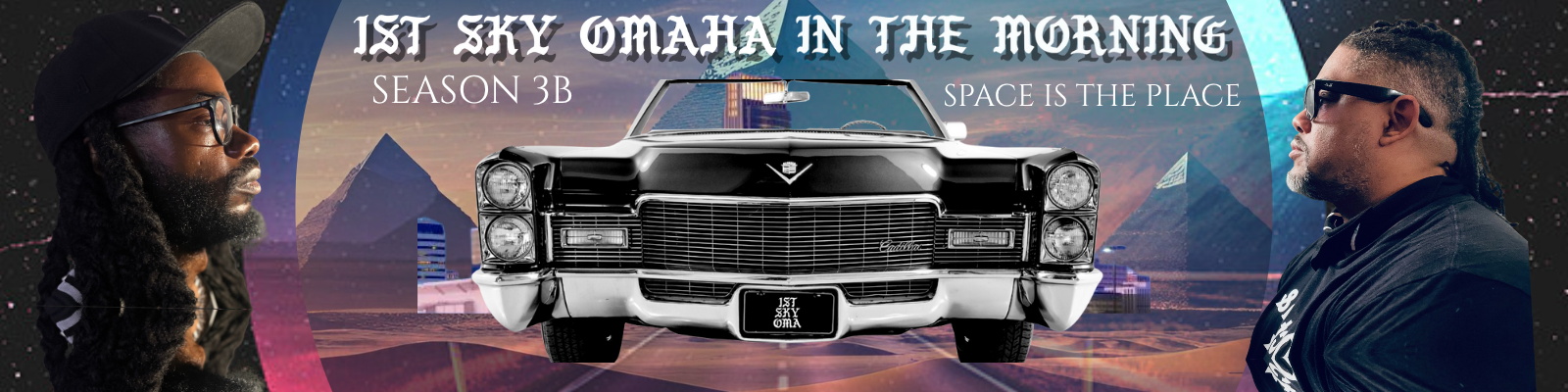
There’s something about a Friday morning that invites people to exhale — and on this particular Love Supreme Friday, the hosts of 1st Sky Omaha in the Morning made sure their audience had plenty of reasons to do just that. Paul B. and Buddy the God opened the show with the kind of warm, wide-ranging conversation that has made their program a fixture in the Omaha community, touching on civic responsibility, local pride, and the quiet power of the arts before welcoming a guest whose work embodies all three.
The morning began with a look at Nebraska’s midterm primary results and a frank discussion about voter turnout. Viewer Sean McCarthy noted in the chat that “the Douglas County Election Commissioner said the average primary voter turnout percentage was around 35% in Douglas County” — a number that prompted reflection from both hosts. Paul B. didn’t hold back: “There’s so much to it — how would anything move? The level of rhetoric, complaints, arguments, propaganda, keyboard warriorship — it doesn’t even compare to what kind of change you can actually make with what it is you’re upset about.” Viewer Kimber Snipes offered a compassionate counterpoint, writing, “I’ve been having conversations with people between the ages of 20 and 35. What I hear the most is most of them don’t really know what to do and know nothing about the candidates. I don’t think we should be slamming people for not voting when the system is really what has caused this.” It was the kind of back-and-forth that makes the 1st Sky chat feel less like a comment section and more like a community meeting.
Buddy the God framed the show’s larger purpose with characteristic clarity: “What we’re really trying to do — the secondary matrix of what we’re trying to do — is build community, build some coalition, be able to speak to and build a family of people that we can regularly talk to and come to some conclusions about some things so we can get to some action.” That spirit carried straight into the morning’s main conversation.
The guest for this Love Supreme Friday was Dana Murray, founder and director of the North Omaha Music Academy — known as NMA — located on the storied North 24th Street corridor. A South Omaha native who spent eleven years honing his craft in New York City before returning home, Murray has spent two decades teaching music in Omaha. What he has built at NMA, however, reaches far beyond scales and chord progressions.
“The arts are the core of who we are as people — definitely as black people — and the history of North Omaha and really Omaha,” Murray told the hosts. “With a lot of the development going on, infrastructure-wise, very little is talked about the social, people development, healing, if you will, that has to happen to even take advantage of all the opportunities.”
Murray’s vision for North 24th Street — affectionately called “the Deuce” — is bold and unapologetic. He sees the corridor not just as a neighborhood in transition, but as a legitimate cultural and arts district with the history to back that claim up. “The area that has the most history and the one that can claim ‘we are a cultural and arts district’ for real is the North 24th Street corridor,” he said. His blueprint for what that could look like is practical as well as visionary: sustainable housing, essential services, destination restaurants and entertainment — and even a hotel capable of hosting large-scale music festivals and conferences right in the heart of the community.
Paul B., who has long called North 24th Street “the most important black corner in Nebraska,” connected Murray’s work to the show’s recurring theme of deeper purpose. “Everything that we do has a secondary meaning, a deeper meaning,” Paul B. said. “In Dana Murray’s case, he teaches kids music — but on the deeper level, he’s creating critical thinkers. That’s what this is really about.” Murray agreed wholeheartedly, drawing a comparison to Omaha Performing Arts and its economic engine downtown. “We’re not only raising musicians,” he said, “but more importantly we’re raising more critical thinking human beings, because all these young kids are not going to become musicians by choice. Some will become doctors, some lawyers, some business owners — whatever they choose to do, they’re going to be better because they were aligned with artistry.”
The programming at NMA extends well beyond instrument lessons. Murray described electives in live sound engineering, broadcast production, live streaming, and podcasting — even a broadcast lab where students conduct interviews with visiting artists. “It’s not just telling them ‘you can be this,'” Murray said. “No — you can be this right now. Once you remove those barriers, the sky’s the limit.”
Murray also spoke with conviction about the cultural and economic stakes involved. “What we have to sell in most black communities is our culture,” he said. “Because if we don’t monetize it — which 99% of the time we don’t — the rest of the country monetizes our culture for us. Every music in America has been built off of our experience — from the hardest rock music to the jazziest jazz to the poppiest of pop, you trace it all the way back to the music that was brought over here from Africa. And that’s equity.” Viewer Pops echoed the sentiment from the chat, noting that artists like Fats Domino once stayed at Paul B.’s grandfather’s home when performing in town — a living reminder of just how deep the roots of the Deuce really run.
Looking ahead, Murray revealed plans for a $20 million capital campaign, the first phase of a full NMA campus he envisions as a North Omaha equivalent of Omaha Performing Arts. “Money is not our issue really in North Omaha,” he said. “It’s transformative ideas that are going to allow us to be not only sustainable but gainfully active.” For educators interested in joining the NMA faculty, Murray emphasized that the right fit goes beyond technique. “Unless you’re able to inspire a young person, they don’t really have the attention span for the X’s and O’s of music,” he said. Interested instructors can reach him at dmurray@northomahamusic.org or his assistant Andrew Bailey at abailey@northomahamusic.org.
The morning also celebrated several community wins worth highlighting: Charell Shelton, founder of Core Science Bio Diagnostics, was awarded a $52,000 prize; Omaha North’s engineering program earned national recognition; and Film Streams will be screening Boots Riley’s film I Love Boosters — another reminder that Omaha’s creative and intellectual energy continues to rise.
The chat closed out the week beautifully, as it so often does. Viewer Aeros 402 shared a moment of personal joy: “On a love note, my only daughter gave birth to my second granddaughter. They are both new and good. I feel blessed.” That kind of warmth — a new life, a community gathering, a musician teaching a child to think bigger — is exactly what Love Supreme Friday is made of.
If you missed this episode, do yourself a favor and catch the replay. And if you haven’t yet joined the 1st Sky Omaha in the Morning family, Monday morning is the perfect time to start.