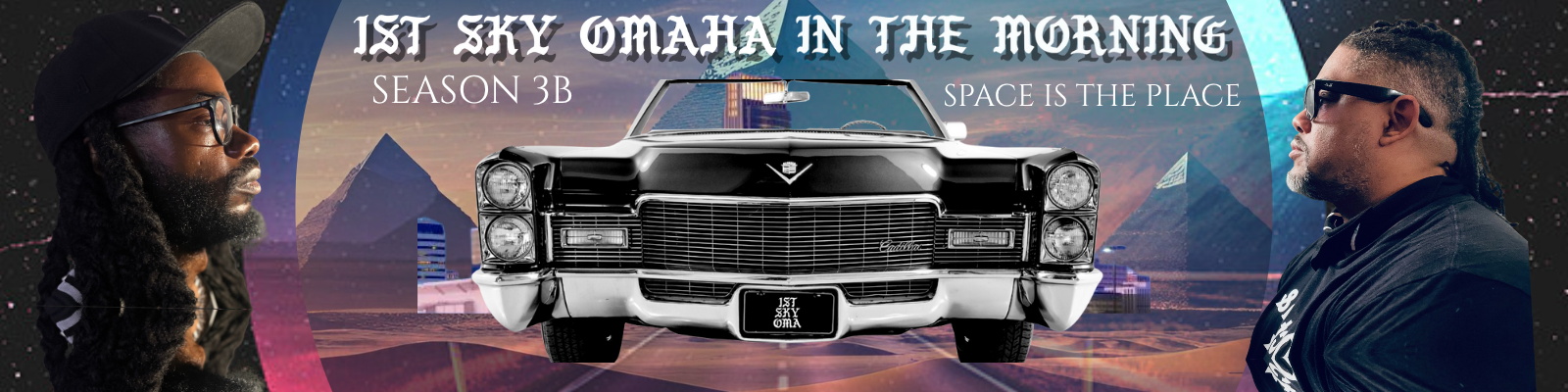
It was a Love Supreme Friday on 1st Sky Omaha in the Morning, and hosts Paul B. and Buddy the God were determined to keep it that way — even as the conversation turned toward some heavy realities facing the community. From Nebraska primary turnout numbers to a wide-ranging vision for North Omaha’s future, Season 4, Episode 53 was the kind of show that reminds you why local media still matters.
Paul B. set the tone early, acknowledging that staying positive isn’t always the easy choice. “We have to make a decision,” he told viewers. “It’s going to be Love Supreme Friday today. And we’re going to change our mindsets over to something else — because it’s real easy to let your emotions take over when there’s so much to be emotional about.” It was a grounding moment, and one the audience clearly needed before diving into the week’s news.
The primary election results were hard to ignore. A viewer comment from Raquel Henderson hit the chat like a cold splash of water: “Only 339,320 out of more than 1.2 million registered voters in Nebraska showed up yesterday. Think about that for a second. And yet everybody has something to say. Everybody’s angry. Everybody’s debating policies and leadership decisions online. Where is that same energy when it’s time to organize, educate, mobilize, register, and actually vote? Posting on Facebook is not enough. Awareness without action changes nothing.” Buddy the God echoed that sentiment with characteristic directness: “None of this really matters if everybody voted. It’s the missing piece — people having to fend for themselves — and the reality is until we do that, we’re going to have to keep building our own ecosystems.”
That word — ecosystem — became the through-line of the entire episode. And no one embodied it more fully than the morning’s featured guest, Dana Murray, executive director and founder of the North Omaha Music Academy (NMA).
Murray, a South Omaha native who spent eleven years in New York City before returning home, has made it his mission to transform the North 24th Street corridor — what Paul B. lovingly calls “the most important Black corner in Nebraska” — into a thriving cultural and economic engine. And he’s doing it one young musician at a time.
“Really, the area that has the most history and can claim it is a cultural and arts district, for real, is the North 24th Street corridor,” Murray said. “And we’ve been so far removed from that — not even what the rest of Omaha views North 24th Street as. I’m more talking to the people that are there being so far removed from what that was, that it is hard to build momentum from within when a lot of the community can’t relate to the power of what was.”
For Murray, the vision is both sweeping and practical. He laid out the metrics clearly: housing density, places of service, eateries, parking, gas stations — all the building blocks of a self-sustaining neighborhood — plus destination attractions like entertainment venues, restaurants, and, one day, a hotel large enough to host music festivals and conferences right in the heart of North Omaha.
He was equally candid about the cultural work that still needs to happen. “At every opportunity, we fail at taking advantage of showcasing our culture,” he said, pointing to events like Native Omaha Days as missed chances to invite the broader city in. His own experiment in openness, he argued, has already proven the skeptics wrong. “People don’t have any problem coming from wherever they are in Omaha or Iowa to come down to hear jazz music. That taboo about the area and its ability to be an attraction was false. We’ve proven that.”
Viewer Pops added a personal note that brought the history alive: “Artists like Fats Domino used to stay at your grandfather’s home when he came to town to perform. So yes, more infrastructure for the artist around the Deuce corridor would be a godsend.”
At the heart of NMA’s work is a belief that music education is about far more than music. “We’re not only raising musicians, but more importantly we’re raising more critical thinking human beings,” Murray explained. “Some will become doctors, some lawyers, some business owners — whatever they choose to do, they’re going to be better because they were aligned with artistry.” Students at NMA don’t just take lessons — they learn live sound, broadcasting, and live streaming, and they interview professional artists in the academy’s own broadcast lab. “It’s not just teaching them ‘oh, you can be this,'” Murray said. “No — you can be this right now.“
The academy is also thinking big about its future. Murray outlined plans for a $20 million first phase of a capital campaign aimed at building a full NMA campus — a North Omaha answer to what Omaha Performing Arts is for downtown. “Money is not our issue really in North Omaha,” he said. “It’s transformative ideas that are going to allow us to be not only sustainable but gainfully active.”
The conversation deepened into something almost philosophical when Murray addressed the broader meaning of Black culture as an economic asset. “The sooner we understand that our culture is equity — that our brilliance and our artistic genius is equity — the better off we’re going to be,” he said. “Every music in America has been built off of our experience. From the hardest rock music to the jazziest jazz, to the poppiest pop music — you trace it all the way back to the music brought over from Africa. And that’s equity.”
Paul B. reflected on what First Sky itself is trying to do with that same spirit in mind. “On the surface we’re a couple of talking heads that talk about some news with the community,” he said. “But what we’re really trying to do is build community, build some coalition, be able to build a family of people that we can regularly talk to and come to some conclusions so we can get to some action.”
The show also made room for joy. A warm note from viewer Aeros 402 (Mary Sanchez) floated through the chat: “On a love note, my only daughter gave birth to my second granddaughter. They are both new and good. I feel blessed.” The hosts celebrated right along with her — a small, perfect reminder of why community broadcasting exists.
Paul B. closed the morning with a piece of wisdom passed down from his grandmother: “Dance is the shortcut to happiness.” After an hour of honest, hopeful conversation about music, culture, civic life, and the power of building something real together, it felt exactly right.
The NMA Fest is coming up for four nights — keep an eye on NMA’s channels for details, and if you’re a music educator interested in joining the team, reach out to Dana Murray at dmurray@northomahamusic.org or assistant Andrew Bailey at abailey@northomahamusic.org.
1st Sky Omaha in the Morning airs live to kick off your week — tune in Monday morning and bring a neighbor with you. This is the kind of conversation Omaha needs.